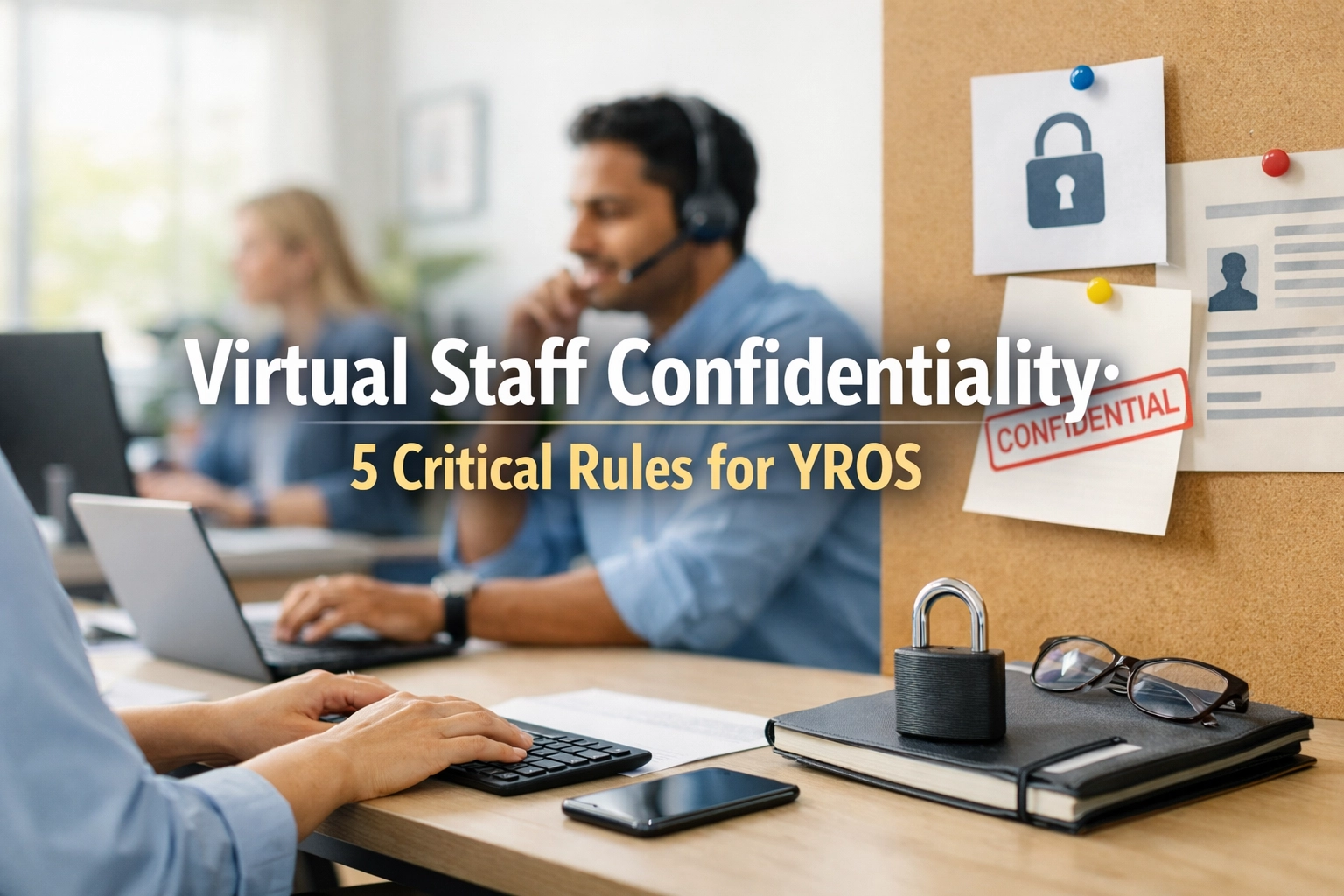
Virtual Staff Confidentiality: 5 Critical Rules for YROS
You are handing the keys to your kingdom to a stranger and hoping for the best. That is not a business strategy. It is a suicide mission. You have built your company from the ground up, sweat through the 95 degree heat on rooftops, and stayed up until 2:00 AM chasing invoices. Now, because you are finally growing, you are ready to let someone else in. But you are doing it with your eyes closed. You are leaving your back door wide open and inviting the world to walk off with your client lists, your trade secrets, and your peace of mind.
It is time to stop being naive. You think a handshake or a nice Zoom interview is enough to protect your life’s work. It isn’t. You believe that because you are a small fish, nobody wants your data. You are wrong. Every time you share a password in a plain text email or give a new hire full admin access to your QuickBooks, you are bleeding. You are one disgruntled person or one hacked laptop away from total collapse.
Virtual Staff Confidentiality is not a “nice to have” luxury. It is the literal foundation of your ability to scale without ending up in a courtroom. If you don’t take this seriously today, you won’t have a business to worry about tomorrow.
The Problem: You Trust Too Much and Verify Too Little
Here is the problem: You are a good person. You want to believe that the people you hire are as honest as you are. You think that because you are paying them a fair wage, they will automatically respect your privacy. But Virtual Staff Confidentiality is not about whether someone is a “good person.” It is about systems.
When you hire someone to help with your HVAC dispatching or your pest control scheduling, you are giving them access to your customers’ homes, their phone numbers, and often their credit card details. If you are an NHA trainer, you are dealing with sensitive professional data and HIPAA concerns. You are managing people who have access to the very soul of your operations.
The agitation starts when you realize you have no idea where that data goes once it leaves your brain. Is it sitting on a personal laptop in a coffee shop? Is it being backed up to a public cloud account? Is it being shared with a “friend” who also happens to work for your biggest competitor? You are currently operating on hope. And hope is a terrible security protocol.
The Worst Case: The Day the Lawsuit Hits
This is where it gets worse. Imagine waking up on a Tuesday morning to a phone call from a long term client. They are screaming. Their identity was stolen, or their proprietary business model was leaked to a rival. They traced it back to a file you shared.
Now, look at your bank account. Can you afford a $50,000 legal defense? Can you survive the 40% drop in revenue when your reputation in the local St. Louis community hits the floor? Once the trust is gone, it never comes back. You aren’t just losing a file. You are losing your legacy. You are losing the ability to provide for your family because you were too “busy” to enforce Virtual Staff Confidentiality.

In the Wild: The Case of the Compromised Contractor
Let’s look at a real scenario. We will call him Mike. Mike runs a high end plumbing and restoration company. He was drowning in paperwork and decided to hire a cheap freelancer from a random job board to help with his invoicing and client follow up. He was so relieved to have the help that he gave this person his master login for his CRM and his QuickBooks. He didn’t think twice about Virtual Staff Confidentiality because the guy seemed “really nice” on their initial call.
Three months later, Mike noticed something strange. Several of his biggest remodeling leads were suddenly going to a competitor. Even worse, several of his clients reported receiving weird phishing emails that looked like they came from Mike’s office.
The “nice guy” freelancer had been downloading Mike’s lead list and selling it to a rival plumbing firm for a few hundred dollars on the side. Because Mike had no access logs, no NDA, and no encrypted tools in place, he had zero recourse. He lost $30,000 in projected revenue in a single month. He spent another $5,000 on a cybersecurity consultant just to figure out the extent of the damage. Mike learned the hard way that without Virtual Staff Confidentiality, his business was just a piggy bank for someone else.
The Fix: 5 Critical Rules for Virtual Staff Confidentiality at YROS
You do not need to live in fear, but you do need to grow up. At Your Remote Office Space, we don’t play games with your data. We have built our entire model around the reality that your information is your most valuable asset. If you want to protect your business, you need to follow the same rules we use.
Here are the five non negotiable rules for Virtual Staff Confidentiality.
Rule 1: Legally Binding, Human-Vetted NDAs
You think a template you found on the internet is going to save you? It won’t. Every single person who interacts with your business through YROS must sign a comprehensive Non Disclosure Agreement (NDA). This isn’t just a formality. It is a legal shield.
The fix is ensuring that these agreements are not just signed but understood. We explain exactly what constitutes “confidential information.” It is not just your bank login. It is your pricing structure. It is your “secret sauce” for dispatching. It is your client list. At Your Remote Office Space, we treat these documents as the start of a professional relationship based on accountability, not just trust.
Rule 2: Strict Role-Based Access Controls
Why does your virtual assistant need your master admin password? They don’t. One of the biggest failures in Virtual Staff Confidentiality is the “all or nothing” approach to access. You get tired of being the bottleneck, so you just hand over the keys to everything.
The YROS way is different. We implement role based access controls. If someone is handling your after hours call answering service, they only see the dispatch screen. They do not see your profit and loss statements. If someone is helping with project coordination services, they see the project files, not your payroll. You limit the “blast radius” of any potential issue by only giving people exactly what they need to do their job. Nothing more. Nothing less.
Rule 3: Mandatory Use of Encrypted Tools and Password Managers
If I see one more password written on a sticky note or sent via a text message, I am going to lose it. You are literally begging to be hacked.
Virtual Staff Confidentiality requires that you never actually share your passwords. We use professional grade password managers. This allows our staff to log into your systems without ever seeing your actual password. If a relationship ends, you click one button and their access is gone. No need to change 50 passwords across 20 different sites. We also insist on encrypted communication channels. Your client data should never be floating around in an unsecured personal email account.
Rule 4: Regular Security Audits and Compliance Checks
Security is not a “set it and forget it” task. It is a living process. You need to know who logged in, when they logged in, and what they looked at.
At YROS, we conduct regular audits. We check the logs. We ensure that access levels are still appropriate for the work being done. If a project ends, the access is revoked immediately. We don’t leave “ghost accounts” lingering in your software for months. This constant vigilance is what keeps your Virtual Staff Confidentiality intact while you are focused on growing your actual business.
Rule 5: Documented Data Breach Protocols
What happens if the worst does occur? Most business owners just panic. They have no plan.
Rule five is about having a clear, written protocol for any potential breach. Who gets notified first? How do we lock down the accounts? How do we communicate with the clients? Having this plan in place actually reduces the risk of a breach because it keeps everyone focused on prevention. At Your Remote Office Space, we believe that being prepared for the storm is the best way to keep the sun shining on your business.

The ROI of Security: Protecting Your Bottom Line
Let’s talk numbers, because that is the only language that matters in the end. You might think that setting up these systems is too expensive or takes too much time. You are stepping over dollars to pick up pennies.
Let’s look at the ROI of Virtual Staff Confidentiality:
- Cost of a Data Breach: The average cost for a small business can exceed $150,000 when you factor in legal fees, forensics, lost clients, and reputational repair.
- Cost of a “Cheap” Freelancer: Often $15-$20 per hour, but with zero security protocols.
- Cost of YROS Professional Service: Slightly higher per hour, but includes a built-in security infrastructure.
The Calculation:
If you save $10 per hour by hiring a random person without Virtual Staff Confidentiality, you “save” $20,000 over a year. But you are carrying a $150,000 liability risk.
$150,000 (Risk) / $20,000 (Savings) = 7.5.
You are essentially betting your entire business at 7.5 to 1 odds that nothing goes wrong. Would you take those odds at a casino with your house on the line? No. So why are you doing it with your company?
By investing in a service like YROS that prioritizes Virtual Staff Confidentiality, you are paying for an insurance policy that allows you to scale safely. You are buying the ability to sleep at night.
Why YROS is Different
You have heard the pitches before. Everyone claims to be “secure.” But ask them for their specific protocols. Ask them how they handle password handoffs. Ask them about their audit schedule. You will usually get a blank stare.
At Your Remote Office Space, we are not a “gig” platform. We are a business consulting and support firm. We hire human beings who are trained in these five rules. We understand the specific needs of HVAC companies, NHA trainers, and pest control owners. We know that your “business owner time” is too valuable to spend worrying about whether your admin is stealing your data.
We speak your language. We know that in the trades, your reputation is your currency. If you lose that, you lose everything. That is why we don’t take shortcuts. We provide human based services that prioritize Virtual Staff Confidentiality at every single step.

Stop Fighting the Wrong Battles
You are currently fighting a war on two fronts. You are trying to win new customers and grow your revenue, but you are also constantly looking over your shoulder because your “back office” is a mess of unsecured spreadsheets and shared passwords.
You cannot scale while you are afraid. You cannot lead while you are looking for leaks. You need a partner who takes Virtual Staff Confidentiality as seriously as you take your craft.
There is a better way to do this. You can have the help you need without the heart attack. You can delegate the boring stuff, the invoicing, the scheduling, and the follow ups, while knowing that your data is locked in a vault.
It Is Time to Decide
You have a choice to make today. You can keep doing what you are doing. You can keep “hoping” that your data stays safe. You can keep sharing logins and praying that no one notices. Or, you can be pragmatic. You can be the leader your business deserves.
Stop trying to be the IT manager, the security guard, and the CEO all at once. You are the bottleneck. Your fear of delegating is rooted in your lack of secure systems. Once you have Virtual Staff Confidentiality locked down with a partner like YROS, that fear disappears. And when the fear disappears, your business starts to grow.
Be pragmatic. Be profitable. Be secure.
Stop waiting for a disaster to happen. Take control of your company’s future right now.
Secure Your Business – Book a Call with YROS
Frequently Asked Questions
Does Virtual Staff Confidentiality really matter for a small HVAC shop?
Yes. Your client list and pricing are your most valuable assets. If a competitor gets them, you are finished. Plus, if you handle any payment info, you have a legal obligation to protect it.
Is an NDA actually enforceable?
Absolutely. While no one wants to go to court, having a signed, professional NDA serves as a massive deterrent and gives you the legal standing to take action if someone crosses the line.
What tools does YROS use for Virtual Staff Confidentiality?
We utilize industry standard password managers, encrypted communication platforms, and secure remote access tools to ensure that your sensitive data never touches an unsecured personal device.
How long does it take to set up these security protocols?
When you work with YROS, we handle the heavy lifting. We have the systems ready to go. We can transition your tasks into our secure environment in a matter of days, not weeks.
Can I still see what my virtual staff is doing?
Of course. Our transparency is part of our security. You will have more insight into your operations than you ever did when you were trying to do it all yourself.
What if I already had a data leak?
Stop the bleeding immediately. Reach out to us. We can help you implement the systems you should have had in place months ago and help you move forward with a secure, professional team.
Related Blogs
- Executive Costs: 7 Brutal Truths to Protect Your Runway
- Revenue Leakage: Where Your Profit Disappears Before You Notice
- Founder Opportunity Cost: The Hidden Burn Rate You’re Ignoring
- The Hiring Overhead Lie: Why Cheap Help Is the Most Expensive Option
- Human-Based Business Support vs. AI: What Actually Scales Securely?
- Admin Transition Path: 7 Secrets to Stop Being Overworked
- Solo Operator: 5 Critical Admin Upgrades to Scale Fast
- You Are the Bottleneck: Why Growth Stalls at the Owner Level
- Fractional Executive Support: When Full-Time Hires Hurt More Than Help
- After-Hours Call Handling: How to Protect Reputation and Data
- Professional Client Intake Systems: Secure Delegation Without Risk
- CRM Data Hygiene: Why Dirty Systems Create Legal Exposure
- HIPAA and Remote Teams: What Small Practices Must Get Right