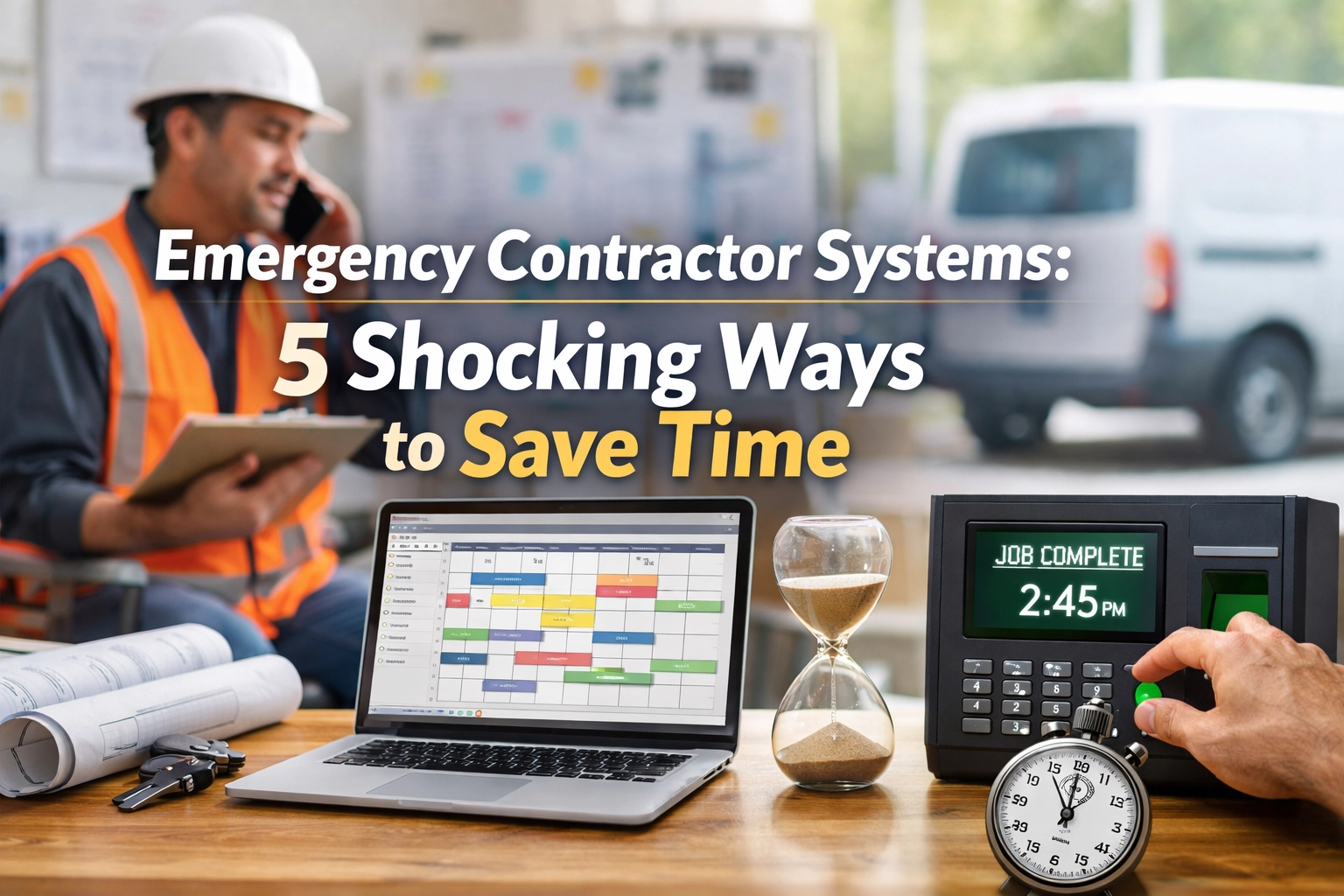
Emergency Contractor Systems: 5 Shocking Ways to Save Time
You are killing your business and you do not even realize it. You think you are a hero because you answer the phone at 3:00 AM on a Tuesday. You think your customers love you because you are always available. That is a lie. Your customers do not love your availability; they love the fact that you have no boundaries. You are a professional firefighter in a world where the fires never stop. You are stepping over thousand dollar contracts to pick up fifty dollar service calls because you are terrified of missing a single ring.
Stop it. Just stop.
You became an emergency contractor because you are good at fixing things. You are a master plumber. You are an HVAC wizard. You are the person people call when their basement is under three feet of water or their furnace dies in a polar vortex. But right now, you are not a business owner. You are a high priced employee of your own chaos. If you do not implement real Emergency Contractor Systems today, you will burn out before the next season even hits.
The Problem: You Are the Central Point of Failure
Here is the problem: every single thing in your company goes through you. The calls go to your cell phone. The scheduling happens in your head. The invoices are drafted when you are half asleep on your couch at 9:00 PM. This is not a business. This is a prison.
You tell yourself that nobody can talk to customers like you can. You think that if you do not handle the dispatching, the crews will mess up the routes. You are convinced that your specific brand of Emergency Contractor Systems is just “hustle.” But hustle without a system is just a slow motion train wreck.
When you are on a ladder or under a sink, you are losing money. Every time your phone vibrates in your pocket and you ignore it, that is a lead going to your competitor. Every time you stop what you are doing to answer a basic question about pricing, you are losing your momentum. You are context switching yourself into poverty. The brutal reality is that your lack of Emergency Contractor Systems is the biggest bottleneck in your company.
The Agitation: The Cost of Being a Hero
Let’s talk about what happens when you keep living like this. You start making mistakes. You forget to follow up on a quote for a major commercial repipe because a frantic homeowner called about a leaky faucet. You send a technician to a job site with the wrong parts because you were distracted when you took the call.
This is where it gets worse: your family starts to resent the business. You are physically at the dinner table, but mentally, you are checking your dispatch board. You cannot take a weekend trip without your phone being glued to your hand. You are trading your life for “emergency” calls that could have been handled by a professional remote team.
Without robust Emergency Contractor Systems, you are also vulnerable to legal and financial ruin. If you are too busy to document a job site properly or too tired to verify a contract, you are one bad job away from a lawsuit. You are operating on raw adrenaline, and adrenaline is a terrible fuel for long term growth.

The Worse Case Scenario: The Silence of a Dead Business
The worst case is not a busy phone. The worst case is when the phone stops ringing because your reputation has turned to dust. In the world of emergency services, word travels fast. If you are known for being disorganized, late, or impossible to reach, people will stop calling.
Imagine a Friday night. A major storm hits. This should be your most profitable night of the year. But because you do not have Emergency Contractor Systems in place, your voicemail is full. Your technicians are frustrated because they do not have clear instructions. You are at home, staring at a pile of crumpled invoices, trying to remember who owes you money.
By Monday, your best tech quits because they found a job with a company that actually has their act together. You are left holding the bag, doing the labor yourself, and realizing you have built a job, not a business. This is the death spiral of the unorganized contractor.
In the Wild: Mike’s Midnight Meltdown
Let’s look at a real scenario. Mike owns a plumbing company in the St. Louis Metro area. Mike is the best plumber I know. He can find a leak in a slab faster than most guys can find their toolboxes. But Mike was drowning.
Mike thought his “system” was his iPhone. He had 14 different apps for everything from weather tracking to invoicing, but nothing talked to each other. One Saturday in July, Mike was at his daughter’s graduation party. His phone rang. It was an emergency: a burst pipe at a local restaurant. Mike answered. Then another call came in. Then a tech texted saying they ran out of PEX.
Mike spent the entire graduation party in the driveway on his phone. He missed the ceremony. He missed the cake. He even missed the fact that he quoted the restaurant job $500 lower than he should have because he was distracted.
The result? He lost $500 in profit, he ruined a major family milestone, and the restaurant owner still complained because Mike took three hours to get a tech on site. Mike didn’t need more “hustle.” He needed Emergency Contractor Systems. He needed a human team at Your Remote Office Space to filter those calls and manage the chaos so he could be a father first and a CEO second.
The Fix: 5 Shocking Ways to Save Time with Emergency Contractor Systems
You do not need to work harder. You need to work smarter. You need to stop being the receptionist, the dispatcher, and the bookkeeper. Here is how you use Emergency Contractor Systems to reclaim forty hours a month.
1. The Triage Protocol
Not every call that someone labels an “emergency” is actually an emergency. You know this. A dripping faucet at 11:00 PM is a nuisance, not a catastrophe. However, when you answer the phone, you feel obligated to treat it like a 911 call.
The first of our Emergency Contractor Systems is the Triage Protocol. You need a human being at Your Remote Office Space who knows your industry. When a call comes in, they follow a logic tree.
- Is there active flooding?
- Is there a risk of fire or electrical hazard?
- Is the HVAC system out in extreme temperatures?
If the answer is no, the call is scheduled for the next available “normal” block. This protects your technicians from burnout and keeps your schedule clear for the high-margin, true emergencies. You save hours every week by simply not chasing low-priority ghosts.
2. Live Dispatch Logic
Stop texting your guys. Stop calling them while they are driving. It is dangerous and inefficient. A core part of your Emergency Contractor Systems should be live dispatching handled by a remote professional.
When a true emergency hits, your YROS team looks at the GPS, looks at the skill set of the available techs, and updates the job in your software. They send the “On My Way” text to the customer. They provide the tech with the gate code and the customer’s history. You do not have to say a word. You just watch the jobs turn from blue to green on your dashboard. This eliminates the back and forth that eats up your morning.
3. The “Windshield Time” Filter
How much time do your guys spend driving to the supply house because they didn’t have the right info? If you do not have Emergency Contractor Systems that include a pre-arrival checklist, you are burning fuel and billable hours.
Your remote office team can ask the customer to send photos of the issue before the tech even leaves the shop. They can identify the brand of the water heater or the model of the furnace. By the time your tech arrives, they have the parts they need. This can save an average of 45 minutes per emergency call. Multiply that by ten calls a week, and you just found a full work day.
4. Real-Time Documentation Management
Contractors hate paperwork. It is a universal truth. But in emergency work, documentation is your only defense against chargebacks and insurance disputes.
One of the most effective Emergency Contractor Systems is having a remote assistant who monitors your job files in real time. As your tech uploads photos to the job, your YROS assistant checks them. Are they clear? Is the “before” shot there? If something is missing, they ping the tech immediately while they are still on site. You don’t have to chase guys on Friday for photos from Monday. The documentation is done, filed, and ready for the invoice before the van leaves the driveway.
5. Instant Invoicing and Payment Collection
If you wait until the end of the week to send invoices for emergency calls, you are losing money. People are much more willing to pay when their basement is dry and they are feeling grateful. Three days later, they start nitpicking the labor rate.
Your Emergency Contractor Systems must include instant invoicing. As soon as the tech marks the job complete, your remote team reviews the notes, applies the correct emergency multipliers, and sends the invoice. They can even call the customer to collect payment over the phone. This keeps your cash flow healthy and saves you from the “Sunday Night Accounting Session” you currently dread.

ROI Calculations: The Brutal Math of Your Time
Let’s look at the numbers. If you are a specialized emergency contractor, your time is worth at least $150 an hour. Probably more.
If you spend:
- 5 hours a week answering non-emergency calls.
- 5 hours a week coordinating dispatch and technicians.
- 3 hours a week chasing photos and documentation.
- 2 hours a week manually drafting invoices.
That is 15 hours a week.
15 hours x $150 = $2,250 per week.
That is $9,000 a month in “hidden” costs.
Annually, you are flushing $108,000 down the toilet because you refuse to implement human-based Emergency Contractor Systems.
Now, compare that to the cost of a dedicated remote team at Your Remote Office Space. You are paying a fraction of that $108,000 to buy back your life and ensure that your business runs with professional precision. The ROI is not just in the dollars; it is in the sanity you regain.
| Task Category | DIY Time (Weekly) | YROS Time (Weekly) | Your Savings |
|---|---|---|---|
| Call Triage | 5 Hours | 0 Hours | 5 Hours |
| Dispatching | 5 Hours | 0 Hours | 5 Hours |
| Documentation | 3 Hours | 0.5 Hours | 2.5 Hours |
| Invoicing | 2 Hours | 0 Hours | 2 Hours |
| Total | 15 Hours | 0.5 Hours | 14.5 Hours |
Why Human-Based Systems Beat Everything Else
You might be tempted to look for a software “fix” or some automated bot to handle your calls. Do not do it. In the emergency world, people are stressed. They are often angry. They need to hear a calm, professional human voice that understands their problem.
At Your Remote Office Space, we do not use bots. We use trained professionals who understand the difference between a main line backup and a slow drain. We understand that in St. Louis or Alton, a furnace going out in January is a life safety issue. Our Emergency Contractor Systems are built on human intelligence and empathy.
Software can’t tell when a customer is lying about the severity of a leak. A bot can’t negotiate with a frustrated technician who has been on call for 12 hours. You need people. But you don’t need the overhead of an in-office employee who requires a desk, benefits, and a high salary. You need YROS.
Stop Fighting the 80/20 Rule
The 80/20 rule applies to your business just like it applies to your tools. 20% of your activities produce 80% of your revenue. For most emergency contractors, that 20% is high-level diagnostic work, complex repairs, and strategic sales.
The other 80% is the “boring stuff.” It is the scheduling, the phone calls, the parts ordering, and the invoicing. If you are doing the 80% work, you are neglecting the 20% that actually grows the company. Emergency Contractor Systems allow you to delegate the 80% so you can dominate the 20%.
You did not start this company to be a professional paper shuffler. You started it to build something. You started it to provide for your family. Right now, the business is providing for itself by consuming your time. It is time to flip the script.

Common Myths About Emergency Contractor Systems
Myth 1: “A remote team won’t know my area.”
This is why we focus on specific regional knowledge and thorough onboarding. Whether you are in St. Louis or across the country, our team learns your service zones, your traffic patterns, and your local competitors. We become an extension of your office, not a detached service.
Myth 2: “It is too expensive.”
Refer back to the math above. The most expensive thing in your business is your own wasted time. If you can save 14 hours a week, you can use those 14 hours to sell two more major jobs. One extra job a month usually pays for our entire service. Everything after that is pure profit.
Myth 3: “I can’t let go of control.”
Control is an illusion. If your business stops working the moment you put your phone down, you don’t have control. You have a leash. Real control is having Emergency Contractor Systems that operate exactly how you want them to, even when you are sleeping.
The Path Forward: Be Pragmatic, Not Perfect
You do not need to overcomplicate this. You do not need a three month transition plan. You need to decide that you are done being the bottleneck. You need to decide that your time is worth more than what you are currently treating it as.
The first step is a simple audit of your current “system.” For the next 48 hours, write down every time you touch your phone for something that isn’t a billable repair. Every text to a tech, every “Where are you?” call from a customer, every invoice you look at. You will be horrified by how much time you are losing.
Once you see the reality, the solution is obvious. You need a partner who understands the trades. You need someone who knows that when a plumber says “stack,” they aren’t talking about a pile of paper. You need Your Remote Office Space.
Frequently Asked Questions
Will my customers know I am using a remote service?
They will know they are talking to a professional. Our goal is to sound exactly like your internal office staff. We use your software, we follow your scripts, and we maintain your brand voice. The only thing they will notice is that your company is suddenly much more responsive and organized.
What software do you work with?
We are experts in the tools you already use. From ServiceTitan and Housecall Pro to QuickBooks and Jobber, we integrate directly into your existing workflow. We don’t ask you to change your software; we just make your software actually work for you.
Can you handle after-hours and weekend emergencies?
Absolutely. That is the core of our Emergency Contractor Systems support. We can provide coverage when you and your team need to rest, ensuring that no lead is ever dropped and no customer is left in the dark.
How fast can we get started?
We can often have your basic triage and dispatching protocols live within a week. We don’t believe in long, drawn-out setups. We know you are busy, so we do the heavy lifting of the onboarding process.
Reclaim Your Life Today
You have a choice to make. You can keep doing what you are doing. You can keep answering the phone at dinner. You can keep missing your kids’ games. You can keep wondering why you are working so hard but the bank account isn’t growing as fast as it should.
Or, you can be pragmatic. You can admit that you cannot do it all. You can implement Emergency Contractor Systems that give you the freedom you thought you were buying when you started this business.
At Your Remote Office Space, we speak your language. We protect your revenue. We restore your life. Stop trying to be Superman. Superman didn’t have to deal with broken water mains and angry homeowners. Be a CEO instead.
Stop waiting for the “right time” to organize. The right time was six months ago. The second best time is right now. Click the link below and let’s build a system that actually works.
Book Your 30-Minute Strategy Session
Be pragmatic. Be profitable. Implement your Emergency Contractor Systems today and stop letting the chaos run the show. Your family will thank you. Your technicians will thank you. And eventually, you will thank yourself.
Related Blogs
- Service Call Prioritization: 7 Proven Ways to Boost ROI
- The Hidden Revenue Leak: Why Your Technicians Shouldn’t Be Your Office Staff
- Text Message Dispatch Systems: Why They Break at 3+ Techs
- Project Handoff Documentation: 5 Fast Ways to Stop Errors
- Warranty Claims Management for Trade Businesses Made Simple
- Creating Technician SOPs: The 8-Step Framework That Actually Gets Used
- Inbox Zero: 7 Proven Steps to Stop Email Chaos Today
- Decision-Maker Support: 5 Proven Ways to Stop Loneliness
- Hiring Your First Employee: When You’re Too Small for an Employee But Too Big to DIY