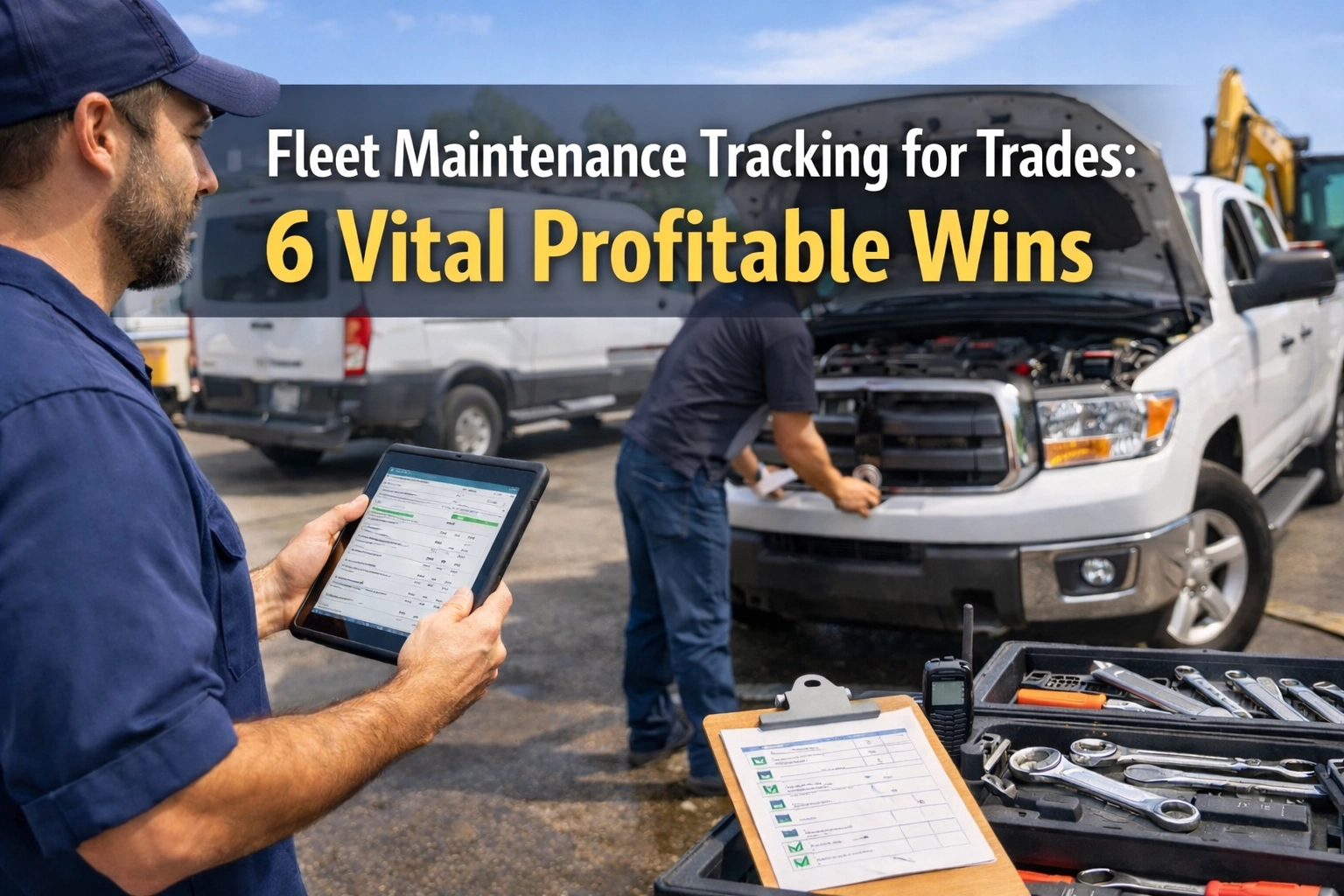
Fleet Maintenance Tracking for Trades: 6 Vital Profitable Wins
You are currently one transmission failure away from a catastrophic month. You know it. I know it. Your fleet is the backbone of your trade business, yet you treat it like a secondary thought. You ignore the rattling in the engine of Van #3 because the schedule is full. You skip the oil change on the box truck because you have a three-day install in St. Louis and cannot afford to have a vehicle sitting in the shop. You are gambling with your profit margins, and eventually, the house always wins.
Fleet maintenance tracking for trades is not a luxury. It is not something you do when you finally get around to it. It is the difference between a business that scales and a business that collapses under the weight of its own mechanical failures. If you are still relying on a faded whiteboard or a spreadsheet that has not been updated since 2024, you are failing. You are inviting chaos into your operation, and frankly, you deserve the headache that follows when a $70,000 asset turns into a $70,000 paperweight on the side of I-70.
There is a better way to run your shop. It involves moving away from reactive firefighting and moving toward proactive management. It is time to stop making excuses about being too busy to track your oil changes.
The Spreadsheet Delusion: Why Your Current System Is Failing
Most trade business owners believe they have a handle on things. You think your system works because you have not had a major engine blow up this week. That is a dangerous lie. Your spreadsheet is a graveyard of good intentions. It is inconsistent, prone to human error, and completely disconnected from the reality of your daily operations.
When you use a manual log, you rely on a technician to remember to tell you they hit 5,000 miles. They will not. They are focused on the plumbing leak or the HVAC install. They are focused on getting home after a ten-hour shift. They are not thinking about your capital expenditures. Fleet maintenance tracking for trades requires a level of precision that a busy contractor simply cannot maintain while also trying to manage crews, answer customers, and close sales.
Here is the problem. If the data is not tracked consistently by a real person with a real process, it might as well not exist. Fleet maintenance tracking for trades breaks down the minute it depends on memory, sticky notes, or a tech saying, “Oh yeah, I meant to mention that.”
That is how you end up flying blind. You have no idea what your cost per mile is. You have no idea which vehicles are bleeding you dry in “minor” repairs that add up to a new vehicle payment every single month. Fleet maintenance tracking for trades is not just about logging oil changes. It is about turning chaos into something you can manage.
The Real Goal: Uptime You Can Count On
You do not buy vehicles for fun. You buy them to make money. Every van and every truck has one job: show up, run hard, and get your crew home.
Fleet maintenance tracking for trades is how you protect that job.
It is also how you protect yourself from that 6:10 AM call: “Boss, the truck will not start.” Then you are scrambling, calling shops, rescheduling customers, and handing out excuses. You are not running a business in that moment. You are reacting.
Fleet maintenance tracking for trades replaces reacting with planning. Planning is boring. Planning is profitable.
1. Eliminate the 30% Breakdown Tax
Fleets without a preventive maintenance program suffer 25% to 30% more breakdowns. That is not a rounding error. That is a habit.
If you have ten vans, three of them are going to fail unnecessarily this year. That is what I call the Breakdown Tax.
When you implement fleet maintenance tracking for trades, you stop paying that tax. You move from fix it when it breaks to fix it before it breaks. A $150 preventive service is easy to schedule. A $4,500 emergency engine replacement on a Tuesday morning during your busiest season is a disaster.
Consider the math. If a van goes down, you lose the revenue from that technician for at least two days. At a conservative rate of $150 per hour, that is $1,200 per day in lost gross revenue. Add a $2,000 repair bill. Add the cost of a rental vehicle, if you can even find one. You are looking at a $4,400 hit for a problem that a $60 oil filter could have prevented.
Fleet maintenance tracking for trades is not about the truck. It is about protecting the revenue the truck generates.

2. Stop the Emergency Repair Price Gouging
Every mechanic in town knows when you are desperate. When your truck is towed into their bay because it died in the middle of a job, you have zero leverage. You pay whatever they ask because you need that truck back on the road yesterday.
Fleet maintenance tracking for trades changes the whole conversation. You schedule repairs on your terms. You can shop around for the best rates. You can schedule work during your slow periods. You can negotiate better pricing with a local shop because you are providing them with predictable work instead of emergency chaos.
Fleet maintenance tracking for trades also lets you plan for the inconvenient stuff. Tires. Batteries. Brakes. Belts. Those are not surprises. They only become surprises when you refuse to track them.
Here is where Your Remote Office Space helps. You do not need another app. You need follow-through. Our US-based team can keep your fleet maintenance tracking for trades up to date, flag what is coming due, and coordinate with your shop and your techs so the work gets done.
No rigid packages. No contracts. Just support that fits your hours and the way you actually run jobs.
3. The Compound Interest of Vehicle Longevity
You treat your trucks like disposable tools. They are not. They are expensive assets. A well-maintained Ford Transit can go 250,000 miles. A neglected one starts falling apart at 120,000.
Fleet maintenance tracking for trades extends the lifecycle of your fleet, and the money adds up fast.
Let us look at the numbers:
- New van cost: $55,000
- Life span with neglect: 5 years ($11,000 per year depreciation)
- Life span with strict tracking: 8 years ($6,875 per year depreciation)
- Annual savings: $4,125 per vehicle
If you have five vehicles, that is $20,625 per year straight back into your pocket. That is the power of fleet maintenance tracking for trades. It is not just about avoiding repairs. It is about maximizing the value of money you already spent.
4. Documentation Is Your Shield Against Liability
We live in a world where one accident can turn into a lawsuit. If one of your technicians is involved in a crash and your brakes were thin or your tires were bald, you are not just dealing with an insurance claim. You are dealing with the question: “Did you maintain this vehicle like a responsible owner?”
Fleet maintenance tracking for trades is how you answer that question.
Without fleet maintenance tracking for trades, you have no real proof. A spreadsheet can be edited after the fact. A notebook can disappear. A time-stamped record that lives in one place and is updated consistently is a whole different thing.
It shows you took safety seriously.
It also helps at renewal time. Insurance companies like organized businesses. If you can produce maintenance records quickly, you are not the high-risk gamble. Fleet maintenance tracking for trades makes you easier to insure and easier to defend.

5. Protect Your Reputation on the Road
Your trucks are rolling billboards. A van with a puff of blue smoke coming out of the tailpipe or a screeching belt tells the world you are disorganized. It tells potential customers that if you cannot take care of your own equipment, you probably will not take care of their home or facility either.
Fleet maintenance tracking for trades keeps your billboards representing you the right way.
Reliability also affects your reputation in a more painful way: being late. If a technician is late because their van would not start, the customer does not care about your mechanical problems. They care that they took time off and you did not show up.
Fleet maintenance tracking for trades keeps you on schedule, keeps you credible, and keeps your brand from getting dragged through the mud in the St. Louis Metro Area or anywhere else you operate.
6. Real-Time Resource Planning
When you know the health of every vehicle, you can plan growth. You know which truck is on its last leg. You know which van is a keeper. You know what is due next month so you can schedule around it.
Fleet maintenance tracking for trades gives you data you can actually use:
- Which makes and models cost the most in repairs
- Which vehicles have the most downtime
- What your average maintenance cost looks like per vehicle
- When it is smarter to replace versus keep repairing
You do not need to be a data scientist. You just need fleet maintenance tracking for trades that stays current.
That is the point of delegating it to a team that does not get pulled into installs, estimates, and emergencies.
In the Wild: The Plumber Who Almost Lost It All
Let us talk about Mike. Mike runs a plumbing company in Alton, Illinois. He had four vans and was doing about $800,000 a year. He was “too busy” for fleet maintenance tracking for trades. He kept everything in a spiral notebook in the glove box of each van. Or he thought he did.
In July, during a heatwave that saw record calls for water heater failures, two of his vans went down in the same week.
One had a blown radiator, a $400 fix if caught early, but it turned into a $3,500 engine job because the tech kept driving it.
The second van had a brake failure that resulted in a minor fender bender.
Mike lost $12,000 in revenue that week alone. He paid for two rentals and his insurance premiums spiked by 20% the following year. The total cost of his “busy-ness” was over $20,000 in a single month.
That is what skipping fleet maintenance tracking for trades looks like when it finally catches up to you.
Mike finally realized fleet maintenance tracking for trades was not optional. He hired Your Remote Office Space to take over the tracking and follow-up. We helped set up a simple digital system, created consistent check-in routines with the team, and now Mike gets a weekly snapshot and clear reminders.
He is now at six vans and $1.2 million in revenue because he stopped stepping over dollars to pick up pennies.
The Fix: How to Escape Spreadsheet Hell
You do not need a more complicated spreadsheet. You need a system that works without you.
You need fleet maintenance tracking for trades that stays accurate even when your week blows up.
This is where Your Remote Office Space comes in. We do not hand you software and wish you luck. Our US-based team handles the boring follow-up, the reminders, and the coordination so the tracking stays real.
The fix looks like this:
- Centralize: Get every vehicle’s history into one place.
- Standardize: Decide what you track, when you track it, and who provides the info.
- Schedule: Create a simple rhythm so inspections and service get booked before breakdowns.
- Delegate: Let Your Remote Office Space keep fleet maintenance tracking for trades updated so you stay focused on sales, service, and hiring.
You are a contractor, not a fleet manager. Stop trying to wear both hats. You get crushed when you try to do it all.

Why You Are the Bottleneck in Your Own Success
The hardest truth for most trade owners to swallow is that they are the reason the business is not growing. You think you are saving money by doing fleet maintenance tracking for trades yourself.
You are not.
You are wasting high-value time on low-value follow-up.
If your billable rate is $150 an hour and you spend three hours a week chasing mileage updates, calling shops, and updating logs, you just spent $450 of your own time.
That is $450 per week ($1,800 per month, about $21,600 per year) spent on something that should not be on your plate.
Fleet maintenance tracking for trades should be consistent. It should be boring. It should be handled.
When you delegate fleet maintenance tracking for trades to Your Remote Office Space, you free up real hours. Hours you can use to sell, train, or actually breathe.
The Math of Professional Fleet Maintenance Tracking
Let us break down the ROI when fleet maintenance tracking for trades is handled consistently:
- Prevented downtime: Saving just two days of downtime per year per vehicle saves roughly $2,400 in revenue.
- Extended lifespan: Adding 3 years to a vehicle’s life saves $4,125 annually in depreciation costs.
- Fuel efficiency: Properly maintained engines and tire pressure can improve fuel economy by up to 10%. For a van driving 20,000 miles a year at 12 MPG, that is roughly $500 per year at current gas prices.
- Total annual savings: Approximately $7,025 per vehicle
If you have a 5-van fleet, that is over $35,000 in found money every year.
Fleet maintenance tracking for trades is not a cost. It is a profit center. If you cannot see that, you are choosing chaos.
Stop Making Excuses for a Broken System
I hear the same excuses every day.
“My guys will not fill out the forms.”
“I will do it next month when things slow down.”
“The software is too expensive.”
None of that matters when your lead tech is sitting in a parking lot waiting for a tow truck while your customer is calling to cancel.
The pain of a broken system is always greater than the effort required to fix it.
Fleet maintenance tracking for trades is about discipline. If you do not have the discipline to do it yourself, you need the wisdom to hire someone who will.
Your Remote Office Space is that someone. We are straightforward, we are efficient, and we care about your uptime more than your excuses.

Implementing Fleet Maintenance Tracking for Trades Today
You do not have to wait for a perfect time. The perfect time was years ago when you bought your first van. The second best time is right now.
Start by identifying the current state of every vehicle:
- Current mileage
- Last oil change
- Last tire rotation
- Brake inspection date
- Any recurring issues
If you do not know, assume the worst and schedule an inspection this week.
Then get help putting a simple process around it. Reach out to YROS. We specialize in fleet maintenance tracking for trades for companies like yours. We speak HVAC, plumbing, electrical, garage door repair, pest control, and commercial cleaning. We know what truck stock means and why a down van is a financial emergency.
Frequently Asked Questions
Is fleet maintenance tracking for trades really necessary for a small fleet of 3 vehicles?
Yes. It is even more important for small fleets. If you have 50 vans and one goes down, you lose 2% of capacity. If you have 3 vans and one goes down, you lose 33%. Fleet maintenance tracking for trades protects your ability to deliver.
How does Your Remote Office Space get mileage data?
Fast. We work with your team using simple weekly odometer photo check-ins, mileage notes in your dispatch tool, or whatever you already use. The key is consistency. Fleet maintenance tracking for trades only works when the info shows up on time.
What if my technicians refuse to cooperate with the tracking?
Then you have a management problem. Fleet maintenance tracking for trades has to be part of the job. We can help you set a process that takes less than 60 seconds, which removes the “too busy” excuse.
Can fleet maintenance tracking for trades help with taxes?
Absolutely. Clear records of what you spent and when you spent it makes tax time cleaner and helps your accountant catch deductions you might miss.
Is it expensive to hire YROS for this?
It is more expensive not to. One preventable breakdown can cost more than months of consistent fleet maintenance tracking for trades support.
The Choice Is Yours: Chaos or Control
You can keep doing what you are doing. You can keep crossing your fingers every morning when your guys turn the key. You can keep paying for emergency repairs and losing sleep over spreadsheet hell.
Or you can decide to run this part of your business like a pro.
Implement fleet maintenance tracking for trades and watch what happens:
- Less downtime
- Fewer panic repairs
- Better vehicle lifespan
- Cleaner records
- More control over your schedule
Stop trying to be a superhero. You are a business owner who needs a solid foundation. Fleet maintenance tracking for trades is part of that foundation.
Be pragmatic. Be profitable. Stop waiting for the next breakdown to force your hand.

Take Action Now
The longer you wait, the closer you get to the next $5,000 repair bill. Do not let neglect kill your growth. Let us get your fleet under control and your business back on track.
Click here to schedule your 30-minute discovery call
Related Blogs
- 7 Operations Systems Every Small Business Must Have
- Trade Schedules: 7 Fixes for Calendar Chaos
- Business Owner Delegating: 5 Essential Proven Success Steps
- St. Louis VAs: Number 1 Trade Guide for Growth
- Billable Hours: 1 Vital Secret to Stop Lethal Costs
- Fleet Maintenance Systems for Trades: Stop Paying for Breakdowns
- Preventive Maintenance for Service Vans: Why Waiting Costs More
- Vehicle Downtime: The Silent Profit Killer in the Trades
- Cost Per Mile for Contractors: The Number You Should Actually Know
- Preventive Maintenance: 4 Brutal Costs Pest Control Owners Pay
- How to Track Oil Changes, Tires, and Brakes Without Spreadsheet Chaos
- Fleet Downtime Math: What One Dead Van Really Costs You
- Why Small Trade Fleets Cannot Afford “We’ll Deal With It Later”
- The Preventive Maintenance Checklist Every Contractor Needs
- How to Build a Fleet Tracking Routine Your Team Will Actually Follow
- Truck Stock and Fleet Maintenance: Why Both Systems Must Work Together
- How to Schedule Vehicle Maintenance Without Wrecking the Calendar
- The 60-Second Mileage Check-In Rule for Trade Businesses
- Fleet Replacement Planning for Contractors
- The Difference Between a Work Truck and a Money Machine
- How to Know When a Van Should Be Repaired or Replaced
- Why Your Oldest Truck Might Be Your Most Expensive Employee
- Vehicle Inspection Logs: The Liability Shield Most Owners Ignore
- How to Prevent Midday Vehicle Failures During Peak Season
- The Fleet Health Dashboard Every Owner Needs
- How a Down Van Wrecks Your Schedule in 3 Hours
- Dispatch Stability Starts With Fleet Reliability
- Why Missed Jobs Often Start in the Parking Lot
- How Better Fleet Tracking Protects Billable Hours
- The Ripple Effect of One Vehicle Breakdown
- How to Build Backup Vehicle Plans Before You Need Them
- Emergency Rental Costs: The Hidden Penalty of Poor Fleet Discipline
- Why Fleet Maintenance Is Really a Scheduling Strategy
- Protecting Technician Time With Better Vehicle Systems
- How Fleet Uptime Supports Faster Lead Response
- Why Fleet Maintenance Tracking Should Not Live in the Owner’s Head
- How a Remote Office Team Helps Keep Your Fleet on the Road
- The Real ROI of Delegating Fleet Maintenance Follow-Up
- Why Human Support Beats “We’ll Remember Later”
- What Your Office Team Should Own in Fleet Operations
- How YROS Helps Trades Stop Losing Money to Vehicle Chaos
- Why Cheap Fleet Tracking Habits Create Expensive Repairs
- The Admin Side of Fleet Management Most Owners Ignore
- How to Offload Fleet Tracking Without Losing Control
- Back Office Support for Contractors With Growing Fleets
- Preventive Maintenance for Service Vans: Why Waiting Costs More
- Cost Per Mile for Contractors: The Number You Should Actually Know
- How a Down Van Wrecks Your Schedule in 3 Hours
- Vehicle Inspection Logs: The Liability Shield Most Owners Ignore
- Why Fleet Maintenance Tracking Should Not Live in the Owner’s Head
At Your Remote Office Space, we are committed to helping you scale without the traditional overhead. Whether you are in Alton, Illinois, or the heart of St. Louis, we provide human-based support you need to thrive. Stop struggling with the boring stuff and start leading your company. YROS is here to make sure your fleet and your business keep moving forward.