VA Training: 5 Proven Success Tips for Trade Terminology
You are losing thousands of dollars every single month because your office staff does not know the difference between a load center and a circuit breaker. You have spent years mastering your craft, but the person answering your phones sounds like they have never stepped foot on a job site. This lack of knowledge is not just embarrassing. It is a massive revenue leak that is quietly draining your business of its professional reputation and its profit margins.
When a customer calls with an emergency and your remote support person stumbles over basic industry terms, the trust is gone before you even pull the truck out of the driveway. When your dispatcher schedules a simple thermostat swap as a full furnace replacement because they did not understand the terminology, you lose time, fuel, and crew morale. When your admin team cannot correctly identify parts in your inventory software, your technicians arrive at jobs empty-handed.
There is a better way to run your office without being the person who has to answer every single technical question. Stop doing the mental heavy lifting for everyone on your payroll. You need a system that bridges the gap between field expertise and office administration. You need to implement a structured approach to VA Training that turns remote staff into industry experts.
The High Cost of Linguistic Ignorance
If you think that basic administrative skills are enough to run a trade business, you are wrong. In the world of HVAC, plumbing, and electrical work, words have specific, technical, and high-stakes meanings. If your remote office professional does not understand these terms, they are essentially flying blind while trying to navigate your most important client relationships.
The problem is that most business owners assume their remote staff will just pick it up over time. They assume that by osmosis, a person sitting in a home office will eventually understand the intricacies of p-traps, ball valves, and refrigerant types. This never happens. Without intentional VA Training, your office staff will continue to make the same expensive mistakes until you finally reach your breaking point and go back to answering the phones yourself.
Think about the last time a technician got frustrated because the job notes were a disorganized mess of generic descriptions. Think about the last time you had to call a customer back to clarify what they actually needed because the intake form was filled with nonsense. This chaos is the direct result of skipping the essential step of technical vocabulary instruction.

The Escalating Cycle of Confusion
When VA Training is ignored, the problem does not just stay in the office. It travels with your technicians. It lands in your QuickBooks files. It infects your customer reviews. A single misunderstanding during the intake process can cascade into a week-long logistical nightmare.
Imagine a scenario where a roofing client mentions a leak near the flashing. Your office support person, not knowing what flashing is, simply writes down that the roof is leaking. Your technician shows up prepared for a minor shingle repair only to find that the entire chimney flashing needs replacement. Now, the technician has to leave the site to get the right materials, the customer is annoyed that the job was not finished on the first visit, and you are paying for an extra hour of travel time.
This is not a failure of the staff member’s intelligence. It is a failure of your training systems. You cannot expect someone to speak a language you have never taught them. To fix this, you must treat your office communication with the same precision you apply to your physical work.
In the Wild: The Wrong Pipe and the Lost Week
Consider the case of an appliance repair company in St. Louis that recently expanded its service area. The owner, whom we will call Robert, hired a remote office professional to handle all scheduling and customer inquiries. Robert was a master technician but a poor teacher. He gave his new staff member access to the software and told them to start booking jobs.
One afternoon, a customer called about a specific error code on a high-end European dishwasher. The customer used technical terms they had looked up online, mentioning a faulty solenoid valve and a specific drain hose issue. The remote staff member, having received no VA Training on appliance anatomy, misinterpreted the customer’s request. They booked the job as a simple cleaning and did not alert the technician to the specific part mentioned.
The technician arrived, diagnosed the very issue the customer had already identified, and then realized the part was backordered for three weeks. Because the office had not communicated the technical details correctly, the parts were not ordered in advance. The customer was furious, believing they had been ignored. Robert lost the service fee, the parts markup, and a long-term service contract. The fix was simple: Robert needed a system for teaching his staff how to listen for and record technical jargon.
The Fix: You Do Not Need a Technician in the Office, You Need a Translation System
You do not need to hire a retired master plumber to answer your phones. That would be an expensive and unnecessary use of talent. What you need is a robust system of VA Training that provides your remote team with a translation layer. This layer allows them to convert customer descriptions into technician-ready data.
Effective VA Training for trade terminology is about creating a bridge between the layperson’s language and the professional’s requirements. It is about empowering your office staff to ask the right follow-up questions so that your field team can do their jobs without a constant back-and-forth of clarifying texts and calls.
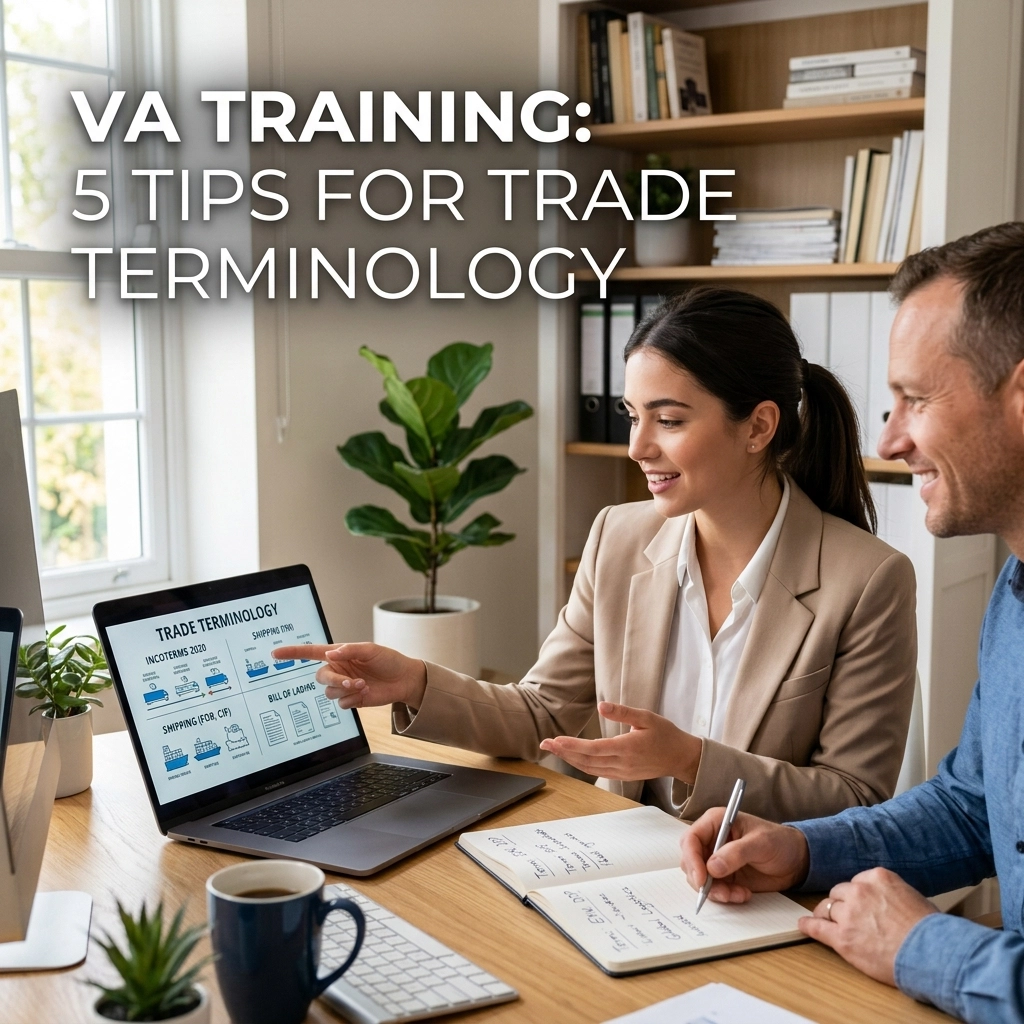
Tip 1: Create a Visual Hardware Glossary
The fastest way to teach trade terminology is through visual association. Words like “manifold,” “ballast,” or “sump pump” are just abstract concepts until a person can see them. One of the most effective methods of VA Training is to build a digital library of photos that represent 80 percent of the jobs you do.
You do not need professional photography. Use your phone to take pictures of common parts and equipment while you are on job sites. Label these photos clearly and store them in a shared cloud folder. When your remote support staff is talking to a customer about a leaking water heater, they should be able to pull up your visual glossary and see exactly what a pressure relief valve looks like.
This visual anchor makes the terminology stick. It moves the learning process from rote memorization to functional understanding. When you invest time in this type of VA Training, you are creating a permanent asset for your business that will benefit every future hire.

Tip 2: Use “Translation Scripts” for Intake
Customers rarely use the correct terminology. They talk about “the clicky thing under the sink” or “the box that makes the humming noise.” Your office staff needs to be trained on how to translate these vague descriptions into technical terms.
As part of your VA Training, develop a script that guides the staff through a diagnostic process. For example, if a customer says their AC is not working, the script should prompt the staff to ask if the outdoor unit is spinning or if the thermostat screen is blank. This helps the staff member narrow down the technical terms without needing to be an expert themselves.
This approach ensures that even if the customer is confused, your office staff remains professional and directed. By teaching your team how to categorize “layman speak” into technical buckets, you significantly improve the quality of the data entering your system. This level of VA Training is what separates a chaotic shop from a professional operation.
Tip 3: Record Field Conversations for Context
One of the biggest gaps in remote office support is the lack of exposure to real-world technician conversations. To solve this, record short snippets of yourself or your lead techs explaining a problem to a customer. Include these recordings in your VA Training modules.
Hearing how a technician describes a repair helps the office staff understand the tone, the terminology, and the priority of different issues. It allows them to hear the jargon used in its natural environment. When a remote staff member hears you explain why a specific circuit breaker keeps tripping, they learn the context around the words “load,” “short,” and “ground.”
This contextual learning is incredibly powerful. It helps the staff member understand not just what a word means, but why it matters in the grand scheme of the service call. This is a foundational element of any successful VA Training program for the trades.
Tip 4: Map Terms to Your Software Workflow
Terminology matters most when it enters your management software, such as ServiceTitan or Housecall Pro. If your office staff knows the term but puts it in the wrong field, the information is still lost. Your VA Training must include a direct mapping of industry terms to specific software actions.
For example, if a staff member hears the word “maintenance,” they should know exactly which service category that falls under in your system. If they hear “warranty repair,” they need to know which checkbox to hit and which documentation to attach. Without this link, the technical knowledge is disconnected from your operations.
Go through your software and identify the most common technical terms that trigger specific workflows. Create a simple cheat sheet that says, “When you hear [Trade Term], do [Software Action].” This turns your VA Training into a practical guide for daily tasks, reducing errors and increasing efficiency across the board.

Tip 5: Implement a “Terminology Challenge” Feedback Loop
Training is not a one-time event; it is a continuous process. To ensure that your VA Training is actually sticking, you need a feedback loop. Once a week, pick a technical term and ask your remote staff to explain what it is and why it is important to your customers.
This is not about being a drill sergeant. It is about identifying gaps in understanding before they cause a problem on a job site. If they cannot explain a term, it means the training material was not clear enough, and you have an opportunity to improve it. This collaborative approach to VA Training builds confidence in your remote team and shows them that you value their expertise.
When your staff knows you care about the details, they will start to care about them too. They will take more pride in their work, and they will become much more effective at managing your schedule and your customers. This is how you build a team that actually supports your growth rather than holding you back.
The Compound Effect of Specialized Knowledge
Imagine a world where you do not have to check every single job note before the trucks leave the shop. Imagine a morning where you are not answering five different text messages from your office staff asking for technical clarifications. That is the reality that comes from dedicated VA Training in industry jargon.
When your office staff speaks the language of your trade, your entire operation runs smoother. Your technicians are happier because they have the right information. Your customers are more confident because they feel heard and understood. You are less stressed because you are finally out of the middle of every single conversation.
The compound effect of these small improvements in communication is massive. It leads to higher first-call resolution rates, better online reviews, and a significantly lower stress level for you as the owner. You can finally focus on the high-level strategy of your business while your office handles the technical details with precision.
You Are Not a Teacher, You Are a Business Owner
I know what you are thinking. You do not have time to sit down and write a textbook on HVAC or plumbing for your office staff. You are already working 60 hours a week, and the last thing you want to do is create a curriculum. But here is the reality: you are already spending that time. You are spending it fixing mistakes, re-scheduling jobs, and calming down angry technicians.
The time you spend on VA Training is an investment that pays dividends for years. The time you spend fixing errors is a tax that you pay every single day. Stop paying the error tax. Start investing in the expertise of your remote office support team.
You do not need to do this alone. You can start small. Pick five terms this week and make sure your team understands them perfectly. Next week, pick five more. Before you know it, you will have an office staff that talks like pros and handles your business with the care it deserves.
The Psychology of Delegation in the Trades
Many trade business owners struggle with delegation because they believe their knowledge is too specialized to be handed off. They treat their technical expertise like a guarded secret. But this mindset is exactly what keeps you trapped in the “one-man-band” cycle.
To scale, you have to democratize your knowledge. You have to take the information that is currently stuck in your head and put it into a system that others can use. VA Training is the process of extracting your expertise and making it operational. It is the only way to build a company that can function without your constant physical presence.
When you empower a remote team member through thorough VA Training, you are not just teaching them words. You are giving them the tools to be a guardian of your brand. You are giving them the authority to represent you properly in the marketplace. That is a powerful shift that will change the trajectory of your business.

Ending the “I’ll Just Do It Myself” Habit
The phrase “I’ll just do it myself” is the death knell of a growing business. It usually comes from a place of frustration when an employee fails to meet a standard. But most of the time, that failure is rooted in a lack of clear instruction.
If your remote staff is failing at trade terminology, it is because you have not provided the resources they need to succeed. Shift your mindset from “they don’t know anything” to “I haven’t taught them this yet.” This change in perspective opens the door for a much more productive relationship.
With the right VA Training, your remote team becomes your greatest asset. They become the filter that keeps the nonsense off your plate and ensures that only high-quality, actionable information reaches your field crew. This is how you win back your time. This is how you regain your sanity.
Relief is a System Away
You did not start your business to spend your life explaining the difference between a flare nut and a compression fitting to your own staff. You started it to provide a great service, build something of value, and eventually have some freedom.
The chaos of miscommunication is not a mandatory part of being a contractor. It is an optional problem that you are currently choosing to tolerate. You can choose something else today. You can choose to professionalize your office communication through structured VA Training.
Stop living in the middle of every single phone call. Stop worrying that your office is making you look like an amateur. Build the systems that allow your business to represent your level of expertise, even when you aren’t the one talking.
Building Your Future Office
The business you want is one where the office is a well-oiled machine. It is a place where jobs are booked accurately, parts are ordered correctly, and customers feel like they are dealing with experts from the very first hello. This reality is completely within your reach.
It starts with the commitment to VA Training. It starts with the realization that your office staff is just as important as your lead technician. When you treat their development with the same seriousness you treat your field training, everything changes.
You deserve an office that supports you. You deserve a team that speaks your language. You deserve a business that doesn’t rely on your constant intervention just to get through a Tuesday afternoon.
Related Blogs
- How Electricians and HVAC Companies Scale Without Hiring Office Staff
- The Cost of Answering Your Own Phone
- Scheduling Systems: 4 Secrets for Growing Contractors
- Building Systems Before You Need Them
- How to Train Your Virtual Assistant on Your Specific Trade
- Virtual Assistant Onboarding: How to Set Them Up for Success
- Training Playbooks That Reduce Administrative Errors
- SOP Creation for Trade Businesses: Where to Start
- Workflow Documentation: Turn Chaos Into Repeatability
- Dispatch Systems for HVAC, Plumbing, and Electrical Companies
- Service Call Intake Systems That Capture Accurate Information
- Customer Communication Systems for Field Service Businesses
- Job Notes That Technicians Actually Use
- CRM Setup for Service-Based Businesses
- ServiceTitan Optimization: What Most Owners Miss
- Field-to-Office Communication Systems That Work
- Administrative Systems That Save 10+ Hours Per Week
- The Real Cost of Poor Job Intake in Trade Businesses
- How to Reduce Technician Callbacks With Better Office Systems
- Scheduling Systems: 4 Secrets for Growing Contractors
- Inventory Communication Systems Between Office and Field
- Quality Control Systems for Service Businesses
- Lead Intake Scripts That Improve Job Accuracy
- How to Stop Being the Bottleneck in Your Business
- Delegation Strategy for Solo Founders: 4 Brutal Truths
- Hiring a Virtual Assistant for Trades: What to Look For
- The Process You Need Before You Hire Help
- Communication Breakdowns That Kill Service Businesses
- Remote Office Support for Field Service Businesses
- Task Management Systems for Administrative Teams
- KPI Tracking for Office Staff Performance
- Building a Business That Runs Without You
- The Hidden Cost of Miscommunication in Service Businesses
- Operational Systems That Improve First-Call Resolution
Take Your Sanity Back
The constant buzz of your phone and the recurring headaches of mismanaged service calls are symptoms of a system that needs help. You do not have to be the primary operator for every single administrative task in your company. There is a path to a quieter, more organized, and more profitable life. If you are ready to stop being the bottleneck and start seeing real relief in your daily operations, we should talk. Let us help you find the space to breathe again.