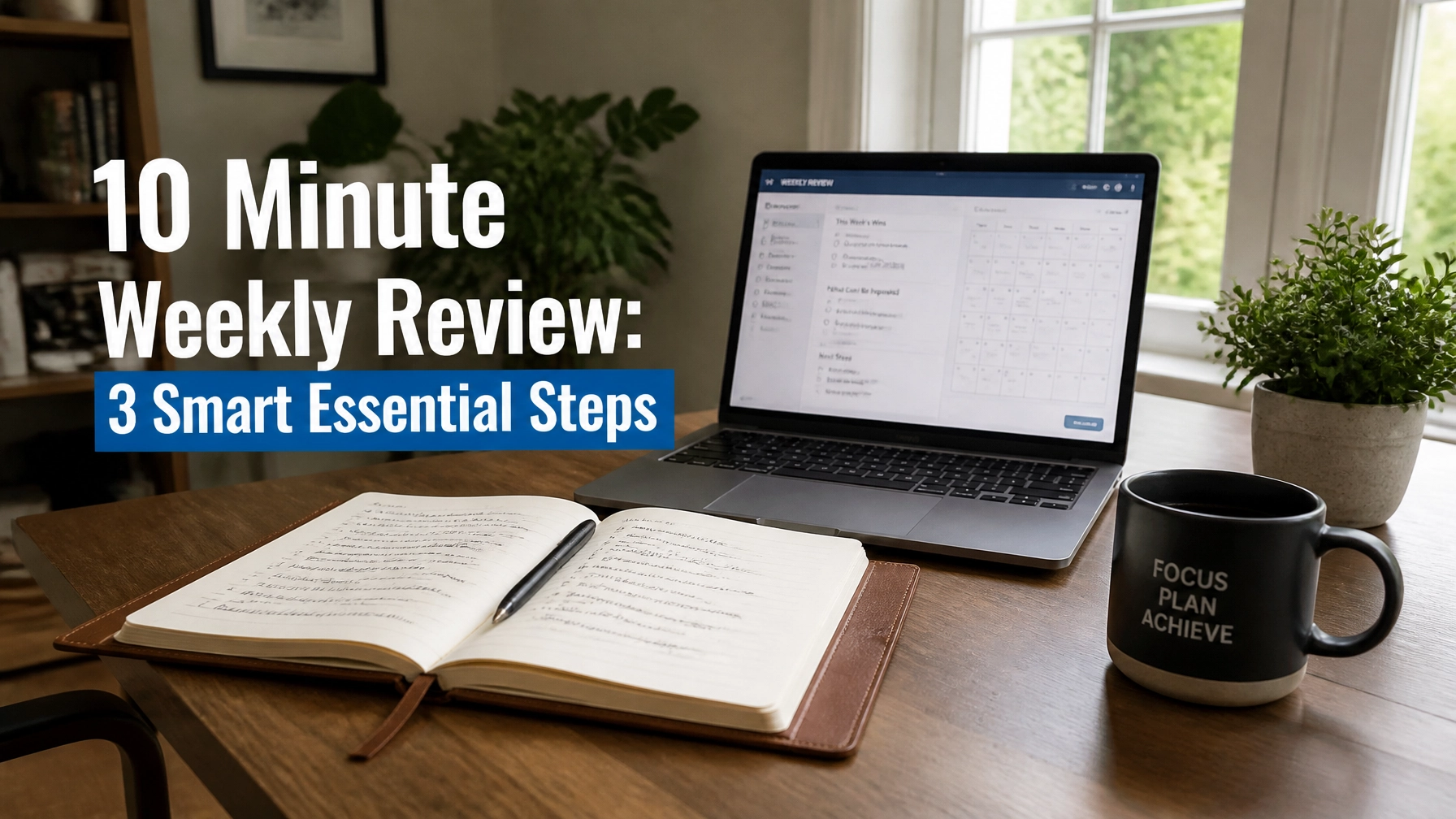
10 Minute Weekly Review: 3 Smart Essential Steps
You are losing control of your business because you refuse to look at it. You spent all of last week reacting to the loudest fire instead of following a plan. Your calendar is a graveyard of things you intended to do but never actually started.
Your truck is full of unorganized invoices that should have been billed three days ago. A customer called three times about a warranty claim and you still have not checked the status. You are lying in bed at 11 PM wondering if you actually scheduled the crew for that 7 AM install tomorrow.
Stop doing this to yourself. There is a better way to run a service business without losing your sanity. You do not need a three hour strategy session to fix this. You need a 10 minute weekly review that actually works.
The Chaos of the Unexamined Week
Running a business without a 10 minute weekly review is like driving a truck with a cracked windshield during a hail storm. You can see just enough to keep from hitting a tree, but you have no idea where the road is going. Most contractors and small business owners think they are too busy to sit down for ten minutes. They think that every second not spent on a job site or on a sales call is a second wasted.
This is a lie you tell yourself to justify the chaos. The truth is that you are afraid of what you will find when you actually look at your numbers and your calendar. You are afraid to see how much money you left on the table. You are afraid to realize that you are the bottleneck in your own company.
When you skip a 10 minute weekly review, the small leaks in your business turn into floods. A missed follow up on a quote might seem small on Tuesday. By Friday, that missed follow up is a five thousand dollar job that went to your competitor. A forgotten invoice on Wednesday means you are short on payroll by the following Monday.
The Agitation of Administrative Neglect
The stress of admin does not happen all at once. It is a slow, grinding pressure that builds up over weeks of neglect. You start the week with good intentions. You tell yourself that this is the week you will finally get organized. You might even buy a new planner or download a new app.
By Tuesday afternoon, the phone starts ringing. An HVAC unit goes out for a regular customer. A pipe bursts in a commercial building. A SaaS server goes down. You drop everything to fix the immediate problem. You tell yourself you will get back to the admin later tonight.
But tonight never comes. You are too tired to look at a screen at 8 PM. You just want to eat dinner and sleep. So the invoices pile up. The emails go unread. The 10 minute weekly review you promised yourself never happens.
Now you are living in a state of constant, low level anxiety. You are always waiting for the other shoe to drop. You know you are forgetting something important, but you do not have the mental energy to figure out what it is. This is not how you build a legacy. This is how you build a prison.

The Worst Case Scenario
What happens when you let this chaos continue for months or years? The worst case scenario is not just a bad month. It is the total collapse of your reputation and your revenue. You stop being the expert and start being the guy who never shows up.
In the HVAC or plumbing world, word travels fast. If you miss a scheduled maintenance appointment because you did not do a 10 minute weekly review, that customer is not going to wait for you. They are going to call the next person on Google. They are going to leave a one star review that stays on your profile forever.
Eventually, the stress takes a physical toll. You stop sleeping. You become irritable with your team. You start making mistakes on technical jobs because your mind is occupied with the administrative mess you left behind. You are working eighty hours a week but you have less money in the bank than when you started. This is the path to burnout and bankruptcy.
In the Wild: The Maintenance Meltdown
In the Wild: An appliance repair company in the St. Louis metro area had four trucks on the road and a growing list of maintenance contracts. The owner, whom we will call Mike, was a brilliant technician but a disorganized manager. He relied entirely on his memory to manage the schedule and the billing.
Mike thought he was saving money by doing all the admin himself. He would spend his Saturdays trying to catch up on paperwork, but he never actually looked at the upcoming week. He was constantly shifting jobs around at the last minute because he realized he had double booked himself or a technician.
The breaking point happened on a Tuesday morning. Mike had promised a high value commercial client a full system audit. He forgot to put it on the shared calendar and did not check his notes from the previous Friday. He sent his best tech to a residential repair across town instead.
When the commercial client called wondering where the tech was, Mike had no answer. He tried to move things around, but it was too late. He lost a contract worth twenty thousand dollars a year because he could not spare ten minutes to look at his schedule. Mike realized he was not running a business. He was just surviving it.
The Fix: The 10 Minute Weekly Review
You do not need a complex project management system. You do not need a fancy consultant to tell you how to work. You need to stop making excuses and commit to a simple, repeatable process.
The psychological barrier here is the belief that you are too busy to plan. You feel like planning is “passive” work and you only value “active” work. You need to flip that script. A 10 minute weekly review is the most active thing you can do for your profit margin.
You do not need more hours in the day. You need more focus in the hours you already have. Reframing your week starts with a commitment to these three steps.
Step 1: Clear the Mental and Physical Deck
The first part of a successful 10 minute weekly review is getting everything out of your head and onto paper or a screen. Your brain is a terrible storage device. It is meant for processing, not for holding onto a list of thirty things you need to do.
Open your truck door and grab every scrap of paper you have accumulated. Find the receipts, the handwritten notes from customers, and the business cards from suppliers. Open your email inbox and scan for anything that requires an action.
Do not try to solve the problems yet. Just gather them. If you use a system like ServiceTitan or QuickBooks, check for any unfiled jobs or open estimates. This process should take exactly three minutes. You are not doing the work. You are identifying the work.
Once you have everything in front of you, you will immediately feel a sense of relief. The “unknown” is always scarier than the “known.” Even if the list is long, seeing it clearly allows you to prioritize. This is the foundation of the 10 minute weekly review.
Step 2: Calibrate the Compass for the Next Seven Days
Now that you know what is outstanding, you need to look at what is coming. Open your calendar. Look at every single day for the upcoming week.
Ask yourself three questions during this part of your 10 minute weekly review:
- Do I have the parts and tools needed for every scheduled job?
- Is the crew fully briefed and ready to go?
- Have I confirmed the appointments with the customers?
If the answer to any of these is “no,” you have a problem that will explode on Wednesday if you do not handle it now. Use this time to move things around if the schedule is physically impossible. It is much better to call a customer on Friday afternoon to reschedule for next week than to call them ten minutes after you were supposed to arrive.
This step keeps you proactive. It ensures that when you wake up on Monday morning, you are not wondering what to do. You already have a map. The 10 minute weekly review turns your calendar into a weapon instead of a wishlist.

Step 3: Confirm the Cash and Crew
A business that does not watch its cash flow is a business that is dying. The final three minutes of your 10 minute weekly review must be spent on the numbers. Look at your bank balance and compare it to your upcoming expenses like payroll and supplier bills.
Identify which invoices are overdue. If you are a plumber who just finished a big renovation, ensure that the final bill was sent and received. If you are an NHA trainer with an upcoming seminar, check that the venue is paid and the materials are shipped.
Finally, look at your team. Do they have what they need to succeed? If you are a solo operator, look at your own energy levels. Are you overbooked? Do you need to block out time for rest so you do not crash?
This confirmation step closes the loop. It gives you the confidence to enjoy your weekend because you know exactly where the business stands. You have done your 10 minute weekly review, and you are ready for whatever the week throws at you.
Why a Human Team Beats a Software Solution
You might think that you can just set up automated reminders to do this for you. You might think that your CRM will handle the 10 minute weekly review on its own. It will not. Software is a tool, not a teammate.
Software cannot tell you that a technician sounds burnt out. It cannot realize that a specific customer is likely to be difficult and needs a more experienced lead on the job. It cannot suggest that you delay a non-essential purchase because you have a large tax payment coming up.
At YROS (Your Remote Office Space), we provide the human element that software lacks. We do not just answer your phones. We help you maintain the systems that make a 10 minute weekly review possible. We can be the ones gathering the receipts, updating the CRM, and flagging the overdue invoices so that when you sit down for your ten minutes, the data is already there.
You do not need more apps. You need a 100% US-based team that speaks your language and understands the trades. We handle the admin so you can handle the expertise.

In the Wild: The Success of the Systematic Owner
Let’s go back to Mike, our appliance repair owner. Mike decided he could not keep living in chaos. He reached out to YROS to take over his phone handling and his basic scheduling. But more importantly, he committed to the 10 minute weekly review.
Every Friday at 4 PM, Mike pulls over his truck. He opens the digital dashboard we maintain for him. He sees a clean list of completed jobs, a list of quotes that need following up, and a preview of next week’s schedule.
Because we are handling the “gather” phase of the review, Mike can focus entirely on the “calibrate” and “confirm” phases. He spends his ten minutes making high level decisions. He decides which quotes to prioritize. He spots a scheduling conflict for Wednesday and asks us to move a residential call to Thursday morning.
The result? Mike has not missed a commercial audit in six months. His revenue is up thirty percent because his quotes are actually being followed up on. His technicians are happier because they always have the parts they need. Mike is actually home for dinner by 6 PM every night.
The 10 minute weekly review changed his business because it gave him the one thing he was missing: clarity. He stopped being a victim of his schedule and started being the leader of his company.
The Mental Load of Business Ownership
Being a small business owner involves carrying a heavy mental load. You are responsible for the livelihoods of your employees and the satisfaction of your customers. When you skip a 10 minute weekly review, that mental load becomes unbearable. It feels like you are carrying a hundred loose bricks in your arms.
When you do the review, you are putting those bricks into a backpack. They still weigh the same, but they are organized. They are easier to carry. You can move faster.
This is especially true for NHA trainers and SaaS founders who deal with abstract tasks. Without a 10 minute weekly review, your “to-do” list becomes a vague cloud of guilt. You know you should be working on that new training module, but you end up answering emails instead because you do not have a clear plan.
The ten minutes you spend on Friday or Sunday will save you five hours of “spinning your wheels” on Tuesday. It is the highest ROI activity in your business.
Breaking the Cycle of “Maybe Next Week”
You have probably read advice like this before. You might have even tried to do a weekly review in the past. But you stopped because it felt like too much work. You tried to make it a one hour deep dive and you failed.
The secret is the “10 minute” part. Do not try to solve everything. Do not try to reorganize your entire filing system. Just do the three steps. Clear. Calibrate. Confirm.
If you find a massive problem during your 10 minute weekly review, do not fix it right then. Schedule a time on Monday morning to fix it. The goal of the review is awareness, not execution. Once you have awareness, the anxiety disappears.
You deserve to have a business that serves you, rather than a business that consumes you. You deserve to take a Saturday off without worrying about what you forgot. That freedom starts with ten minutes.

How YROS Empowers Your Review Process
When you partner with YROS, your 10 minute weekly review becomes even more powerful. We act as the stewards of your administrative data. We are the ones making sure the CRM is up to date and the messages are logged.
We provide the “clean deck” for you. Instead of you hunting for receipts and emails, we provide a summary of the week’s activity. We flag the urgent items. We show you exactly where the gaps are.
Our team is trained in the software you use, from ServiceTitan to Housecall Pro to QuickBooks. We understand the workflow of a roofing contractor, a pest control specialist, and a commercial cleaner. We know that your time is better spent on a ladder or in a boardroom than it is looking for a lost phone number.
A 10 minute weekly review is much easier to complete when the preparation has been done by professionals. We give you the clarity you need to make the right calls.
Stop Guessing and Start Growing
The difference between a business that stays small and a business that scales is systems. A 10 minute weekly review is the most basic system you can implement. It requires zero financial investment. It only requires ten minutes of discipline.
If you can not find ten minutes a week to look at your business, you do not have a business. You have a job that owns you. It is time to take your life back. It is time to look the chaos in the eye and say “no more.”
Do not wait until next month. Do not wait until things “quiet down.” Things will never quiet down on their own. You have to be the one to quiet them. Start your first 10 minute weekly review this Friday.
A Practical Checklist for Your 10 Minute Weekly Review
To make this even easier, follow this exact timeline for your next 10 minute weekly review:
Minutes 1-3: The Brain Dump (Clear)
- Scan your physical workspace for loose papers and notes.
- Check your text messages and emails for missed requests.
- Look at your “pending” list in your CRM or project tool.
- Write everything down on one list.
Minutes 4-7: The Calendar Audit (Calibrate)
- Look at every appointment for the next seven days.
- Check for travel time between jobs.
- Verify that you have the staff assigned to every task.
- Ensure you have a block of time for yourself to handle admin or billing.
Minutes 8-10: The Vital Signs (Confirm)
- Check your bank balance.
- Identify the three most important invoices to follow up on.
- Send one “thank you” or “follow up” text to a high value client.
- Commit to your top three priorities for the week.
That is it. You are done. You have completed a 10 minute weekly review. You are now ahead of ninety percent of your competitors.
The Long Term Impact of Consistency
The first time you do a 10 minute weekly review, it might take fifteen or twenty minutes because you have so much backlog. That is okay. Do not get discouraged. By the third or fourth week, you will hit that ten minute mark easily.
Over time, you will start to see patterns. You will realize that certain types of jobs always cause scheduling conflicts. You will see that certain customers always pay late. This data allows you to make better business decisions.
You might decide to stop taking certain types of jobs. You might decide it is time to hire that extra technician. These are the moves that lead to real growth. And they all started with a simple 10 minute weekly review.
Your sanity is worth ten minutes. Your profit margin is worth ten minutes. Your family’s future is worth ten minutes. Stop making excuses and start planning.
You have the skills to do the work. You have the drive to build the company. Now, give yourself the system to actually succeed. The 10 minute weekly review is the missing piece of your puzzle.
Reach Out for Real Support
If you are tired of the administrative grind and want a team that actually understands the pressure of running a trade or service business, we are here to help. At YROS, we take the admin off your plate so you can focus on the work that matters. No rigid contracts, no offshore nonsense, just real support for real businesses.
Related Blogs
- Lost Call Revenue: 5 Shocking Brutal Truths
- Calendar Management Support: 5 Smart Essential Tips
- Client Intake System: 7 Smart Essential Steps
- Speed to Lead Home Services: 4 Smart Essential Rules
- Weekly Planning Systems That Actually Stick
- Quarterly Planning Sessions: What to Actually Plan
- The Strategic Review Dashboard: Five Metrics You Should Check Weekly, Not Daily
- Monthly Financial Review Routines for Non-Accountants
- Time Audits: Where Your Day Really Goes
- How to Audit Your Time – and Why You Should
- The Owner Interruptions Audit: What’s Pulling You Off Revenue
- The Invisible Work Owners Don’t Track
- Mental Load Management for Small Business Owners
- Decision Fatigue and How to Reduce It in Your Business
- Goal Setting That Actually Drives Daily Action
- Calendar Blocking Templates for Maximum Productivity
- Peak Performance Hours: Scheduling Around Your Energy
- Deep Work Blocks: Protecting Time for Strategic Thinking
- The Two-Minute Rule Applied to Business Administration
- Batching Administrative Tasks for Maximum Efficiency
- Creating Your “Stop Doing” List
- Reactive vs Proactive: The Operational Divide in Small Business
- Process Audits: Finding Hidden Operational Bottlenecks
- Gap Analysis: Finding Operational Weaknesses
- The Compound Effect of Small Process Improvements
- Continuous Improvement Mindset for Busy Owners
- Invoice Aging Reports: The Dashboard That Stops the “Who Owes Me?” Spiral
- How to Use Aging Reports to Predict Slow-Season Pain
- Revenue Forecasting for Service-Based Businesses
- Cash Flow Forecasting for Small Businesses: Stop Guessing, Start Planning
- Estimate Follow-Up: The Easiest Money You’re Not Collecting
- The 24-Hour Invoicing Rule for Trade Businesses
- Scheduling Rules Your VA Needs Before They Touch the Board
- Job Start Packets: The One-Page Checklist That Prevents Missing Information
- Equipment Maintenance Logs Without Spreadsheet Chaos
- Supply Chain Coordination: Never Run Out of Materials Again
- Field Service Customer Updates: The Five Touchpoints Customers Expect
- Status Update Systems That Don’t Require Constant Meetings
- Building a Single Source of Truth for Your Business
- Weekly Team Coordination Without the Weekly Meeting
- Why Live Meetings Should Not Replace Good Documentation
- Human Support vs Technology: Where Each Actually Wins
- Building a Business That Runs Without You – even for a Week
- The Weekly Ops Review Every Founder Needs