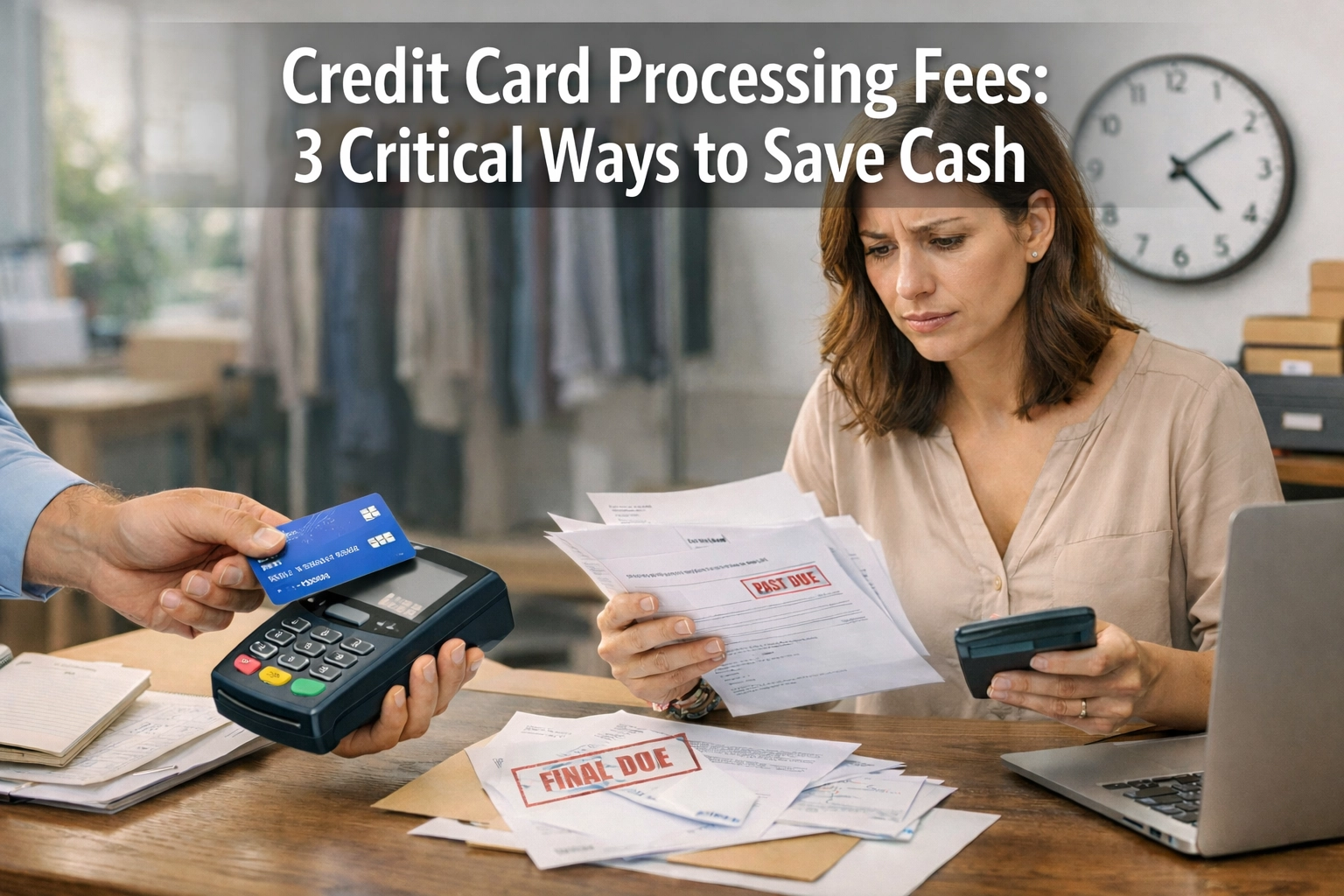
Credit Card Processing Fees: 3 Critical Ways to Save Cash
You are obsessed with the wrong number. You look at your profit and loss statement at the end of the month, see the line item for merchant service costs, and you feel a physical pang in your chest. You see three thousand dollars, five thousand dollars, or ten thousand dollars vanished into the pockets of banks and processors. You call it a waste. You call it a necessary evil. You tell your office staff to push for checks or ACH because you want to avoid those Credit Card Processing Fees at all costs.
You keep saying the same phrase, too: credit card processing fees. You say it like it is the problem. You say it like the whole business would be fine if those credit card processing fees disappeared. But while you are busy calculating how to save three percent on a five thousand dollar invoice, your cash flow is bleeding out from a dozen different wounds.
You are ignoring the massive, looming shadow of delayed payment risk. You are ignoring the cost of the four hours your office manager spent last Tuesday calling customers who promised the check was in the mail. You are ignoring the interest you are paying on your line of credit because your bank account is empty while your accounts receivable folder is full.
Here is the quiet part nobody wants to admit: this is also a customer service problem. When payments drag, customers get confused, receipts get missed, and callbacks start piling up. If you do customer service outsourcing for small business the right way, your team can set expectations upfront, run card-on-file correctly, and close the loop fast. Customer service outsourcing for small business is not about sounding nice on the phone. It is about getting paid cleanly and keeping customers calm.
Perfectionism in your accounting is a liar. It tells you that a hundred dollars saved on fees is a hundred dollars earned. It is not. If it takes you thirty days longer to get that money, you have lost. If you have to send a technician back to a house to pick up a paper check, you have lost. If you are a roofing contractor, a plumber, or an HVAC owner, your business lives and dies by cash velocity. Credit Card Processing Fees are not a cost. They are a convenience tax that buys you the most valuable asset in your business: immediate liquidity.
There is a better way to look at your numbers. It is time to stop being afraid of the merchant statement and start being afraid of the aging report.
The Brutal Reality of the Paper Check Trap
Why are you still letting customers dictate your cash flow? You think you are being savvy by avoiding Credit Card Processing Fees, but you are actually providing an interest free loan to your clients. When you finish a job, pack up the tools, and tell the customer you will send them an invoice that they can mail a check for, you have just entered a high risk gambling scenario.
Here is the problem: The moment you leave that job site without payment, the value of your work begins to depreciate in the mind of the customer. On day one, they are thrilled their AC is working. On day ten, they have forgotten the heat and are looking at their own credit card bill. On day twenty, your invoice is buried under a pile of junk mail. By day thirty, you are a nuisance.
When you refuse to accept cards because of credit card processing fees, you add friction to the transaction. You require the customer to find a checkbook, find a stamp, find an envelope, and remember to walk to the mailbox. Every one of those steps is a point of failure. Each step increases the delayed payment risk. This is why the obsession with credit card processing fees is backwards. The friction costs more than the fee.
Now layer in the customer experience. A customer who cannot pay the easy way does not feel taken care of. They feel like they are doing your paperwork. This is exactly where customer service outsourcing for small business can change the outcome. Customer service outsourcing for small business gives you a consistent voice that sets payment expectations before the tech shows up, confirms the email for the receipt, and makes the payment step feel normal. No awkwardness, no chasing, no confusion.
Compare this to the technician who carries a tablet. The job is done. The invoice is presented. The card is swiped. The money is in your account in forty eight hours. Yes, you paid the fee. But you also closed the file. You do not have to think about that customer again. You do not have to track them. You do not have to worry if their check will bounce. You have traded a small, predictable percentage for the elimination of a large, unpredictable risk.
The Hidden Math of Delayed Payment Risk
Let us look at the actual numbers because the math does not lie. Suppose you are a roofing repair and maintenance owner with a ten thousand dollar project.
Scenario A: You accept a credit card. You pay roughly 3% in credit card processing fees. You receive $9,700 in your bank account within two business days. Your cash is ready to buy materials for the next job or pay your crew. Clean. Fast. Done. This is the part people miss when they fixate on credit card processing fees.
Scenario B: You insist on a check to save that $300. The customer says they will mail it. It takes five days for them to write it. It takes three days in the mail. It takes two days for your office to realize it arrived. It takes another three days to get to the bank and for the bank to clear the funds. You now have $10,000, but it took thirteen days longer than Scenario A.
During those thirteen days, did you have to pay your suppliers? Did you have to run payroll? If you had to dip into a business line of credit at an 8% or 10% interest rate to cover those costs while waiting for the “free” check, your savings just evaporated. If you spend even two hours of administrative time chasing that payment, your savings are gone.

This is also where customer service outsourcing for small business pulls real weight. When you have customer service outsourcing for small business in place, the follow-up is immediate and consistent: receipt sent, payment confirmed, questions answered, balance closed. You are not wondering who called who, or whether the customer got the invoice link.
At Your Remote Office Space, we see trade owners falling into this trap every single week. They focus on the visible cost of Credit Card Processing Fees and ignore the invisible cost of administrative friction. If your office support team is spending time on aging reports instead of booking new estimates, you are losing more than 3%.
The Management Tax: Chasing Money is Not Free
What is your time worth? What is the time of your office staff worth? This is what we call the Management Tax. When you avoid Credit Card Processing Fees, you are essentially hiring your office staff to be a collection agency. You might think you are saving on credit card processing fees, but you are paying in labor, stress, and distraction.
Think about the workflow of a “free” payment.
- The technician records the job but does not take payment.
- The office staff must review the job notes to ensure the invoice is correct.
- The office staff emails the invoice.
- The office staff waits.
- After 15 days, the office staff checks the bank for the payment.
- The office staff calls the customer to “follow up.”
- The customer claims they sent it.
- The office staff waits another 5 days.
- The office staff calls again.
- The customer finally pays via a portal or a check.
This process can easily consume sixty to ninety minutes of cumulative labor per delayed invoice. If you are paying an office member twenty five dollars an hour, plus taxes and benefits, that “free” payment just cost you nearly forty dollars in labor alone. On a thousand dollar job, that is 4%. You have now paid more in labor to collect the money than you would have paid in Credit Card Processing Fees to get it instantly. That is the real math behind credit card processing fees. The fee is predictable. The chase is not.
Customer service outsourcing for small business is the pressure release valve here. With customer service outsourcing for small business, your team has the time and the consistency to handle card-on-file policies, send receipts, and close balances the same day. That is not fancy. That is how you stop turning your office into a collections desk.
You are not just losing money; you are losing opportunity. Every minute spent on a collection call is a minute not spent on billable hour optimization. You are paying for a high level of stress and a low level of efficiency just to avoid a transparent fee on your merchant statement.
In the Wild: The Plumber Who Hated Fees
Let us look at a real scenario. We worked with a plumbing contractor in the St. Louis area named Greg. Greg was adamant about avoiding Credit Card Processing Fees. He did about $1.2 million in annual revenue. He estimated that by pushing for checks, he was saving about $30,000 a year in fees. He was very proud of this number. In his head, those credit card processing fees were the enemy.
However, when we performed an audit of his operational debt, the picture changed. Greg had over $140,000 in accounts receivable that was over 45 days old. Because he did not have a system for immediate payment, he was constantly short on cash.
To keep his trucks running, Greg was using a high interest merchant cash advance to cover payroll during slow months. He was paying an effective interest rate of over 20% on that borrowed money. He was paying roughly $28,000 a year in interest to borrow money because his own money was sitting in his customers’ checkbooks.
On top of that, Greg’s wife, who handled the office, was spending fifteen hours a week on the phone “reminding” people to pay. That is 780 hours a year. Even at a modest valuation of $30 an hour, that is $23,400 in lost labor time.
Now add the customer side. Customers were calling back asking, “Did you get my check?” or “Can you resend that invoice?” or “Why does the portal not work on my phone?” That is customer service work. Greg did not think of it that way, but it was. This is exactly why customer service outsourcing for small business matters. Customer service outsourcing for small business keeps the payment conversation professional, fast, and consistent, so the owner is not the default problem solver.
Greg thought he was saving $30,000. In reality, his fear of Credit Card Processing Fees was costing him over $51,000 in interest and labor, plus the massive emotional toll on his marriage because his wife hated being the “bill collector.” When Greg finally implemented a proactive business systems guide that prioritized immediate credit card payment on site, his aging AR dropped by 80% within sixty days. He paid the fees, but he stopped paying the “stress tax.”
Why Your Office Should Control the Payment Process
The technician in the field is there to fix the pipe, the wire, or the roof. They are often uncomfortable asking for money. They want to be the hero who saved the day, not the guy asking for a credit card. If you leave the collection of payments solely to the field staff without a rigid system, you will see your Credit Card Processing Fees go down and your bad debt go up. You will also see your customer experience get sloppy, because nobody owns the payment conversation end to end. That sloppiness creates more callbacks, more confusion, and more complaints that have nothing to do with the quality of the work.
The fix is to move the customer conversation to a trained office team and make payment expectations boring and consistent. When your office handles the scheduling systems, they can set the expectation for payment before the tech even arrives.
“We require a card on file to book the appointment, and payment is processed upon completion.”
This one sentence, delivered by a professional office assistant, eliminates 90% of your delayed payment risk. It makes the Credit Card Processing Fees a planned, baked in part of your overhead rather than a surprise. It also protects your technicians from awkward conversations and allows them to focus on the technical work they are trained for.
If you are looking for the practical structure behind that, customer service outsourcing for small business is one of the cleanest ways to make it happen without hiring a full-time in-house team. Customer service outsourcing for small business means the same message is delivered every time, receipts go out automatically, and payment questions get answered fast. The result is fewer payment delays and fewer angry customers. Your credit card processing fees stay predictable, and your cash flow stops swinging.

The Inflation of Delayed Payments
We are in an economy where the value of a dollar today is higher than the value of a dollar thirty days from now. When you wait for a check to avoid Credit Card Processing Fees, you are also losing purchasing power.
If your material costs are rising, which they are for almost every trade, waiting thirty days to get paid means the money you eventually receive buys less copper, less lumber, or less refrigerant than it would have a month ago. In a high inflation environment, the 3% you pay in Credit Card Processing Fees is often less than the price increase you will see from your suppliers in the time it takes to collect a paper check.
Professionalism means understanding the time value of money. Hobbyists worry about the 3%. CEOs worry about the cash cycle. You need to decide which one you are.
Credit Card Processing Fees vs. The Risk of Non-Payment
The worst case scenario of a delayed payment is not that it is late; it is that it never arrives. Every day an invoice remains unpaid, the likelihood of collecting it drops significantly.
Data shows that once an invoice hits the 90-day mark, you have less than a 50% chance of ever seeing that money in full. If you have a $3,000 job and the customer disappears, you haven’t just lost the $90 in Credit Card Processing Fees you were trying to save. You have lost the $3,000. You have lost the materials cost. You have lost the labor hours. You have lost the fuel.
By insisting on credit card payments at the point of service, you verify that the customer has the funds immediately. If the card declines, you know right then and there while your truck is still in their driveway. You can address the issue before you leave. Once you drive away, you lose all your leverage.
Pricing for the Fees
If the 3% really bothers you, there is a simple solution: Raise your prices by 4%.
Most business owners are terrified to do this. They think the customer will leave over a few percentage points. But your customers are already paying for convenience in every other part of their lives. They pay more for DoorDash. They pay more for Amazon Prime. They will pay an extra few dollars to have a seamless, professional experience with their HVAC company.
When you bake the Credit Card Processing Fees into your standard pricing model, the fees become invisible. You are no longer “losing” money; you are simply operating a modern, professional business. If you are struggling with how to structure this, looking at effective delegation for trade owners can help you free up the mental space to fix your pricing strategy.
Modern Customers Want Modern Payments
Think about your own behavior as a consumer. Do you enjoy writing checks? Do you even know where your checkbook is?
For the modern homeowner, being asked to pay by check is a burden. They want to use their credit card to earn points or miles. They want a digital receipt emailed to them instantly. They want the security of knowing that if the job isn’t done right, they have the protection of their credit card company.
When you refuse to accept cards or make it difficult to do so because you hate Credit Card Processing Fees, you are signaling that your business is stuck in 1995. You are hurting your brand. You are making yourself the “difficult” contractor to work with.
A straightforward business makes it easy for people to give them money. If you make it hard to pay you, eventually people will stop trying.
The Fix: Building a Payment-First Culture
You don’t need a miracle to fix your cash flow. You need a system. The fix is a combination of technology and human oversight that treats credit card processing fees like a normal cost of doing business, not a crisis.
- Mandatory Card on File: Every customer provides payment info during the client intake forms process.
- Instant Invoicing: Technicians finalize the work order on their tablet and trigger the payment immediately.
- Automated Follow-up: If a payment fails, your office team is notified immediately to resolve it within minutes, not weeks.
- Receipt and Closeout Discipline: The receipt is emailed or texted immediately, and the job is closed in your system the same day, so nothing lingers.
This is where Your Remote Office Space (YROS) comes in. We provide customer service outsourcing for small business that is built for real-world trades and small teams. Customer service outsourcing for small business is how you enforce card-on-file politely, send receipts without fail, and handle payment questions before they turn into bad reviews. We don’t just answer phones; we protect your revenue. We make sure that your fear of Credit Card Processing Fees doesn’t turn into a catastrophe of unpaid bills, and we make credit card processing fees predictable so you can price correctly.
Stop trying to be the hero who saves three cents while losing a dollar. Be pragmatic. Be profitable.

Frequently Asked Questions
Is it legal to pass Credit Card Processing Fees onto the customer?
In most states, yes, as long as it is disclosed properly. However, it is often better for your brand to simply raise your overall rates. This avoids the “nickel and diming” feel that customers hate.
What if my customers are older and only use checks?
You can always make exceptions, but an exception should be a rarity, not the rule. Even many seniors now prefer the ease of a card over hunting for a stamp.
Are ACH payments a better middle ground?
ACH fees are lower than Credit Card Processing Fees, but they still have a delay. They are better than a paper check, but they don’t offer the same instant verification as a credit card.
How do I track which payments are still outstanding?
You need a clean aging report. If you don’t have one that is updated daily, you have no idea how much money you are actually losing to delayed payment risk.
Won’t my technicians hate being “collectors”?
They shouldn’t be collectors. They should be service providers who use a tool to process a transaction. If the system is set up correctly by your office, it’s just one click at the end of the job.
You Have to Decide
You have to decide what kind of business you are running. Are you a collector of paper or a collector of profit?
Credit Card Processing Fees are a transparency tool. They show you exactly what it costs to move money from your customer’s pocket to your bank account. Delayed payment risk is a hidden tax that fluctuates, grows, and eventually destroys businesses from the inside out.
You cannot manage what you cannot see. You can see your merchant fees. You cannot easily see the cost of your stress, the cost of your office staff’s wasted hours, or the cost of the opportunities you missed because you didn’t have cash on hand.
Stop fighting the banks and start fighting the inefficiency in your own office. At Your Remote Office Space, we speak your language. We protect your revenue. We restore your life.
If you are ready to stop chasing checks and start scaling your business, it is time to get your back office in order. We have seen the patterns, and we know the fix.
Stop trying to be Superman. Be a business owner.
Schedule Your 30-Minute Strategy Call
Related Blogs
- Aging Reports: The Heartbeat of Your Cash Flow
- Operational Debt: The Silent Killer of Small Businesses
- Billable Hour Optimization: Stop Wasting Your Team’s Time
- Proactive Business Systems: A Guide for Growth
- Aging Reports: The Heartbeat of Your Cash Flow
- Why Credit Card Processing Fees Are Not Your Real Payment Problem
- The Hidden Cost of Delayed Payments in Trade Businesses
- Why Chasing Checks Costs More Than Merchant Fees
- The Cash Flow Trap Created by Paper Checks
- How Delayed Payment Risk Quietly Kills Small Business Profit
- Why Fast Payment Matters More Than Cheap Payment
- The Real Cost of Avoiding Credit Card Processing Fees
- How Payment Friction Slows Down Growth
- Why Trade Businesses Need a Payment-First System
- Credit Card Processing Fees for Contractors: What Actually Costs More
- Why HVAC Owners Lose More to Slow Payments Than Merchant Fees
- How Plumbers Protect Cash Flow Without Fighting Every Fee
- Roofing Payment Systems: Stop Waiting on Checks
- Why Electrical Contractors Need Faster Money, Not Cheaper Money
- The Payment Delay Problem in Field Service Businesses
- How Service Companies Stop Acting Like Their Own Collections Department
- The Cash Velocity Problem Most Contractors Ignore
- Why Older Payment Habits Hurt Modern Trade Businesses
- How Small Service Businesses Make It Easier to Get Paid
- Accounts Receivable Management for Contractors Who Hate Chasing Money
- The Aging Report Problem That Keeps Owners Awake at Night
- How Slow Collections Strangle Small Business Cash Flow
- Why Your AR Balance Is More Dangerous Than Your Merchant Statement
- How to Reduce Outstanding Invoices Without Becoming a Bill Collector
- The Cash Flow Leak Hidden Inside “Checks in the Mail”
- Why Payment Delays Cost More Than Most Owners Realize
- The Collections Workflow Every Trade Business Needs
- How to Spot Payment Friction Before It Becomes a Cash Crisis
- Why Unpaid Invoices Destroy More Growth Than Processing Fees Ever Will
- Why Your Office Should Control the Payment Process, Not the Technician
- Card on File for Contractors: Why It Works
- How to Build a Same-Day Payment Process for Service Calls
- Why Payment Collection Must Be Part of the Scheduling Process
- The Office System That Keeps Invoices From Lingering
- Instant Invoicing: How Small Businesses Get Paid Faster
- Receipt and Closeout Discipline: The Small System That Protects Cash Flow
- Why Payment Questions Need a Real Workflow, Not Guesswork
- How Better Payment Systems Reduce Customer Confusion
- What Happens When No One Owns the Payment Conversation
- Why Easy Payment Improves Customer Experience
- The Customer Confusion Problem Caused by Slow Billing
- How Better Payment Communication Prevents Bad Reviews
- Why Customers Pay Faster When Expectations Are Clear
- The Payment Conversation Your Team Keeps Avoiding
- How to Set Payment Expectations Before the Truck Rolls Out
- Why Modern Customers Expect Modern Payments
- How Clean Payment Processes Make Your Business Feel More Professional
- The Hero Complex of Owners Who Still Chase Checks
- Why Saving 3 Percent Can Cost You 10 Percent
- Management Tax: 3 Brutal Costs Of Failing Cleaning Ops
- How Owners Get Trapped in Low-Value Payment Tasks
- Why Business Owners Obsess Over the Wrong Costs
- The Difference Between Cheap Transactions and Healthy Cash Flow
- Minimalist Business Tools: 10 Incredible Ways to Build Your Brave Stop Doing List
- The Silent Revenue Loss Behind “I’m Just Trying to Save Fees”
- How a Remote Office Team Helps Contractors Get Paid Faster
- Why Human Payment Follow-Up Beats Another Automation Tool
- How YROS Helps Small Businesses Reduce Delayed Payment Risk
- The Difference Between Accepting Payments and Managing Cash Flow
- Why Customer Service Outsourcing for Small Business Protects Revenue
- How YROS Handles Payment Follow-Up, Receipts, and Aging Reports
- What Real Back-Office Support Looks Like for Payment Control
- How Remote Office Support Keeps Cash Moving Without Full-Time Overhead