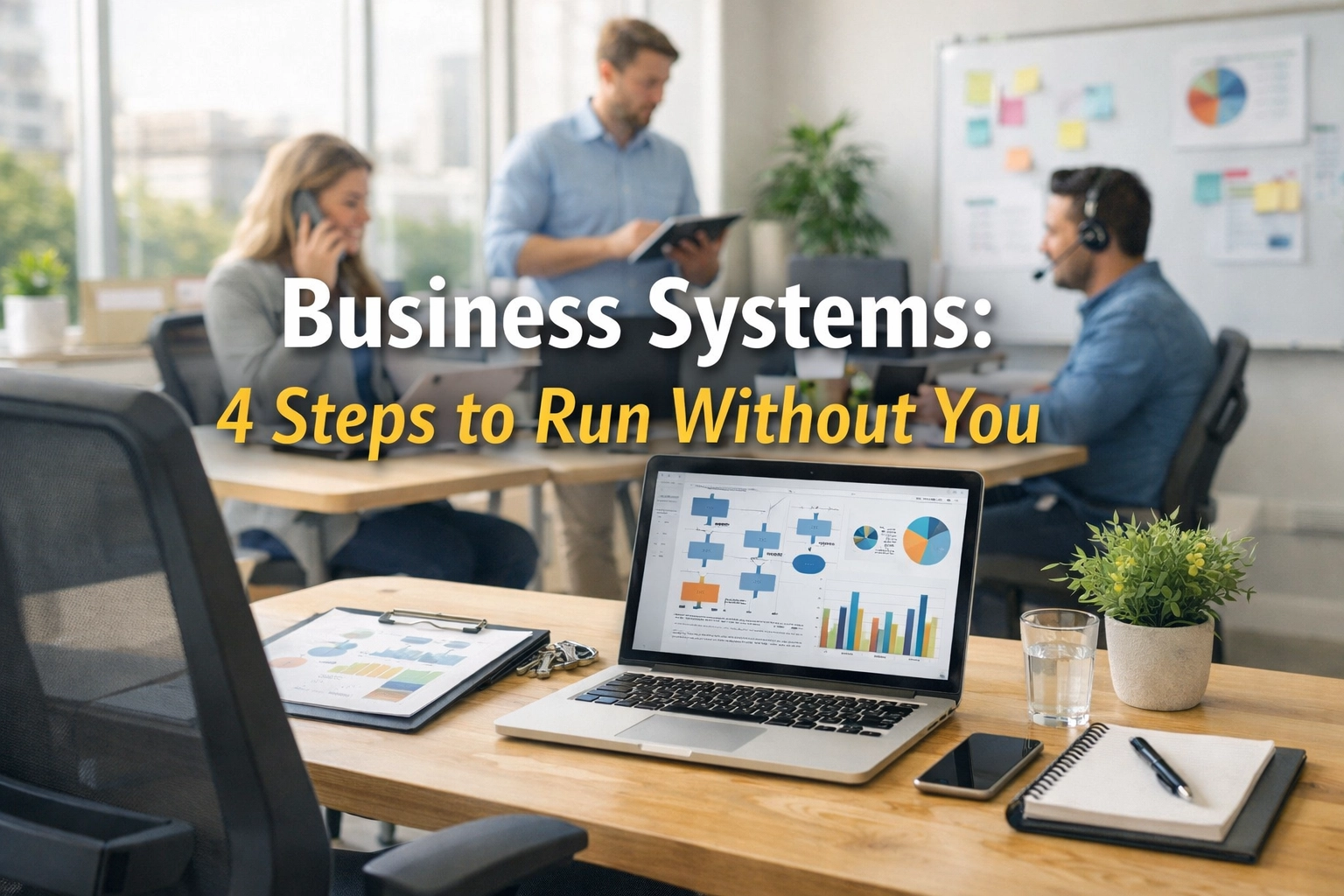
Business Systems: 4 Brutal Steps to Proven Freedom
You do not own a company. You own a job that refuses to let you sleep. You are the only person who knows how to quote a complex electrical job, the only one who can talk a grumpy customer off a ledge, and the only one who knows where the spare keys to the third van are kept.
If you stopped working for two weeks, your bank account would go into a coma. Your technicians would sit in the driveway waiting for instructions that never come. Your customers would take their plumbing leaks and roof repairs to the guy down the street who actually answers his phone.
This is not a business. This is a house of cards held together by your personal exhaustion. There is a better way to operate that does not involve you working until 10:00 PM every night on invoices. Stop acting like the hero and start acting like an architect.
The Lie of the Heroic Owner
You probably think that being involved in every decision is a sign of high standards. You tell yourself that no one can handle the dispatching or the billing quite like you can. This mindset is exactly why you are tired, grumpy, and plateaued at five trucks.
When you make yourself the center of every process, you become the ultimate bottleneck. Every question has to pass through your brain before work can get done. This kills your speed and makes it impossible to scale your revenue.
True freedom only comes when you implement Business Systems that work while you are at a ball game or on a beach. These Business Systems act as the connective tissue of your company. They ensure that the right work happens at the right time without you needing to point a finger.


In the Wild: The Contractor Who Couldn’t Leave
Consider the story of a garage door repair owner named Mike. Mike had built a great reputation in his town over ten years. He had four talented techs and a yard full of inventory. However, Mike was also the only person who handled the scheduling and the final job costing in QuickBooks.
Last summer, Mike tried to take his family on a five day camping trip where cell service was spotty. By day two, his lead technician had called him fourteen times because a custom part had not been ordered. By day three, a major commercial client was threatening to cancel their contract because an invoice was three days late.
Mike spent the rest of his vacation sitting in the front seat of his truck with a single bar of LTE service. He was trying to navigate his dispatch software while his kids went hiking without him. He returned home more stressed than when he left.
The failure was not the technician or the client. The failure was that Mike had zero Business Systems in place to handle his absence. He was the system, and when he went offline, the business broke.
The Fix: Build Your Architecture
You do not need more coffee or a better to-do list app. You need to build a structure that functions independently of your physical presence. This requires a shift from doing the work to designing how the work gets done.
Your Remote Office Space helps owners move from the front lines to the observation deck. We see the same patterns in HVAC, plumbing, and roofing companies across the country. The path to freedom follows four specific phases of development.
Step 1: Audit the Internal Chaos
You cannot fix what you have not documented. The first step in creating Business Systems is a brutal analysis of your current operations. You need to look at every repetitive, rule based task that currently sits on your plate.
Start by tracking your time for one full week. Every time you answer a phone call, send an invoice, or update a schedule, write it down. You will quickly see that 80 percent of your day is spent on tasks that do not require your specific expertise.
- Identify the most common customer questions.
- List the steps for every recurring administrative task.
- Pinpoint where information gets lost between the field and the office.
- Find the rule based tasks that a trained professional could handle for you.
Once you have this list, you can begin to see where your Business Systems are leaking money. This analysis phase is about understanding the infrastructure of your day. You are looking for the bottlenecks that keep you from doing the high level work.


Step 2: Implementation through Delegation
Documentation is useless if the work stays on your desk. The second phase of building Business Systems is moving those tasks to a dedicated support team. You need to create a detailed list of functions and provide the necessary system access.
Many owners struggle here because they think they need to hire a local, full time employee. That often leads to more overhead and more management headaches. Instead, look at how a part time virtual assistant can take over the heavy lifting.
- Hand over the initial client intake and lead saving.
- Assign the daily invoicing and payment follow ups.
- Let someone else manage your technician schedules.
- Delegate the mundane data entry that kills your Saturday mornings.
At YROS (Your Remote Office Space), we call this the hand off. We take those documented steps and put them into action. By moving these tasks to Your Remote Office Space, you ensure they get done every single day. This is how you begin to separate your time from your company’s output.
Step 3: Integrating the Tech Stack
Your Business Systems need a digital home to be effective. Most field service businesses already use tools like ServiceTitan or QuickBooks. The problem is that these tools are often poorly managed or underutilized.
Integration means ensuring that your administrative support and your software are talking to each other. Your office support team should be experts in the tools you use every day. If you use specialized software, you need a ServiceTitan virtual assistant who knows how to navigate the platform.
- Sync your field notes with your billing software.
- Automate the follow up messages for open quotes.
- Centralize your customer communication in one dashboard.
- Ensure your financial records are updated in real time.
When your tech stack is properly integrated, data moves seamlessly from the field to the office. You no longer have to chase down paper folders or wait for a technician to call in. The Business Systems handle the flow of information automatically.

Step 4: Maintenance and Governance
A system that is not monitored will eventually break. The final phase of creating Business Systems is establishing a regular review cycle. You need to define ownership and set performance metrics for every process.
This does not mean you go back to doing the work yourself. It means you spend thirty minutes a week reviewing the results. You are looking at task completion times, error rates, and customer feedback.
- Set up a weekly meeting to review administrative progress.
- Audit your phone logs to ensure no leads are falling through the cracks.
- Update your documentation as your business grows and changes.
- Adjust workflows when you add new services or more trucks.
Continuous monitoring ensures that your Business Systems remain aligned with your goals. It allows you to catch small issues before they become expensive disasters. This is how you maintain the freedom you worked so hard to build.
Why Your Business Systems Will Fail
Most owners fail because they try to do everything at once. They spend a weekend writing manuals and then go right back to answering the phones on Monday. Or, they buy expensive software and expect it to solve their management problems without human oversight.
Business Systems are not just about software. They are about people and processes working in harmony. If you do not have a team to execute the systems, the systems will sit on a shelf gathering dust.
You also cannot expect perfection on day one. Your first attempt at a new dispatch process will likely have a few hiccups. The key is to refine the process rather than jumping back in to do it yourself. Trust the structure you are building.

Reclaiming Your Sanity with Your Remote Office Space
Building Business Systems is the difference between being a laborer and being an owner. It is the difference between constant stress and a calm, profitable operation. You deserve to have a business that provides for your family without stealing your soul.
Your Remote Office Space provides the professional support you need to make these systems a reality. We specialize in helping trade businesses and small firms offload the administrative weight. Whether you need help with a CEO calendar or full scale office support, we are here.
Imagine a Monday morning where you do not wake up to a dozen urgent voicemails. Imagine knowing that every quote is being followed up on and every invoice is being sent. That is the power of well designed Business Systems.
Stop being the bottleneck in your own success. Start building the architecture that will allow your company to thrive without you. The four steps are clear, and the path to freedom is waiting for you to take it.
Related Blogs
- The Real Cost of Answering Your Own Phone
- Client Intake Service for Small Business: 7 Ways to Save Leads
- How to Build Repeatable Handling for Repetitive Office Work
- The Owner Bottleneck Problem (And How to Fix It)
- Why Doing Everything Yourself Is Costing You Growth
- The Hero Operator vs System Owner: The Real Difference
- Building a Business That Runs Without You (Even for a Week)
- The Psychological Trap of Being “Needed” in Your Business
- Analyze Daily Schedule: 5 Ways Your Lucrative Day Vanishes
- Decision Fatigue and How to Reduce It in Your Business
- The Hidden Cost of Context Switching
- Deep Work Blocks: Protecting Time for Strategic Thinking
- Why “I’ll Handle It Later” Is Costing You Thousands
- Standard Operating Procedures: Creating Them Without the Pain
- Scaling systems: 6 proven powerful wins for massive growth
- Creating Task Handoff Systems That Actually Work
- Workflow Documentation for Growing Businesses
- Process improvements: 5 Proven Massive Easy Wins
- Business Owner Delegating: 5 Essential Proven Success Steps
- Onboarding Your First Virtual Assistant: Week-by-Week Guide
- Managed Office Help: 5 Powerful, Proven, Bad Mistakes to Avoid
- When Your Business Is Too Small for an Employee But Too Big to DIY
- Starting With a VA and Transitioning to an Employee
- Cost of DIY Administration: 3 Bold Masterful Joys
- Administrative Tasks Eating Your Profit Margin
- CRM Data Entry: Why It Matters More Than You Think
- Database Cleanup: Why It Matters and How to Maintain It
- Office Systems for Small Service Businesses
- Integrating Your CRM, Dispatch, and Accounting Systems
- Managing Your Tech Stack Without Overwhelm
- ServiceTitan Optimization for Growing Companies
- Automating Follow-Ups Without Losing Control
- Centralizing Communication Across Your Business
- Scaling From One Truck to Multiple Crews Without Chaos
- Operational Maturity: What Changes at Each Growth Stage
- Building Infrastructure Before You Break
- From Operator to CEO: The Transition Most Owners Avoid
- When to Hire Your First Operations Manager
- Client Intake Systems That Capture Every Opportunity
- Missed Calls Are Costing You Thousands
- Follow-Up Systems That Close More Jobs
- Lead Tracking Systems for Service Businesses
- Customer Communication Systems That Build Trust
You should be able to go to lunch without your phone vibrating off the table. If you are ready to stop the chaos and start the growth, let’s talk about how to get your time back. We can help you find your sanity again.