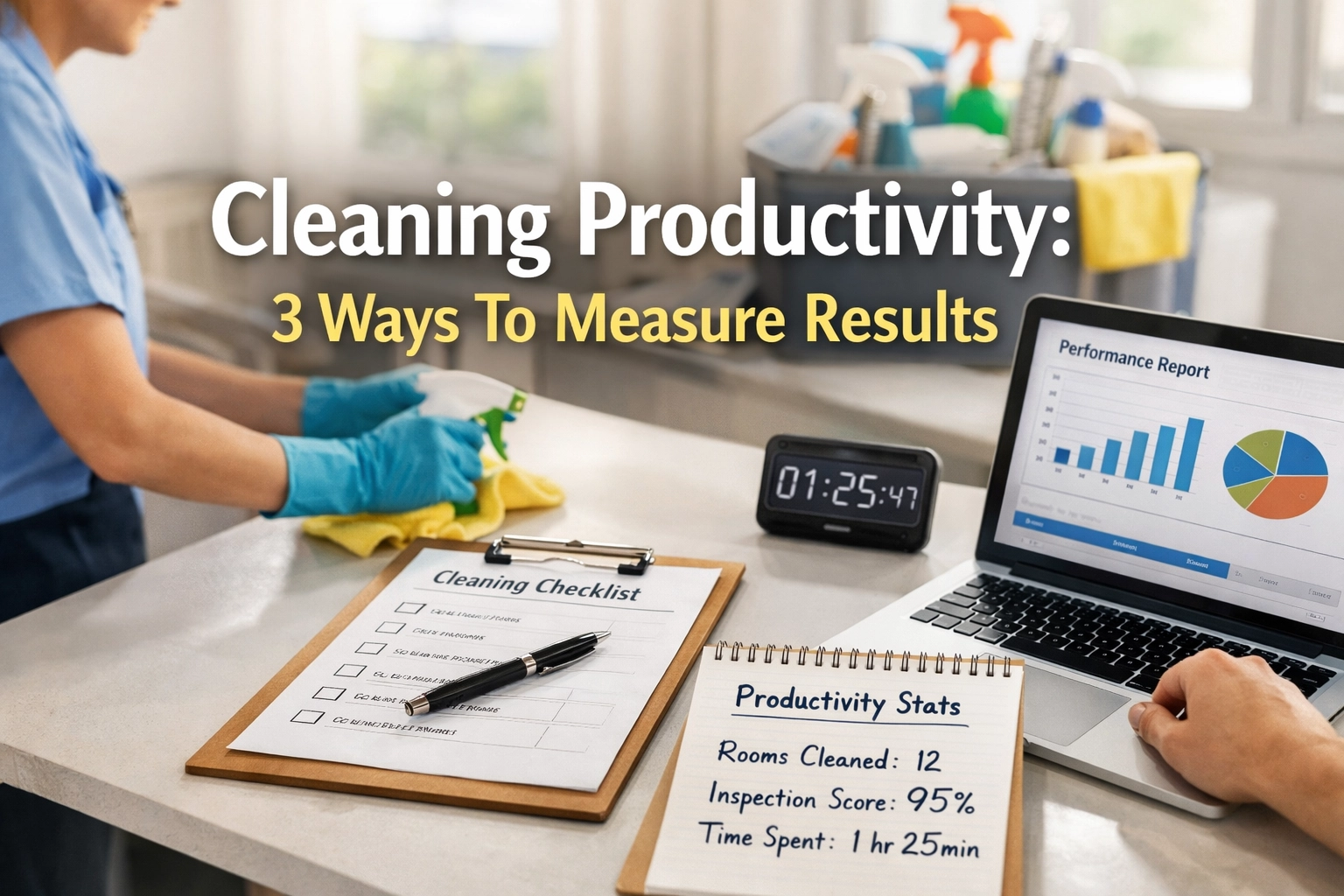
Cleaning Productivity: 3 Proven Ways To Measure Essential Results
You are losing money every single time a cleaner steps onto a job site without a clear metric for success. It is happening right now while you read this. A crew is taking ninety minutes to finish a floor that should take forty-five, and you are the one writing the check for that wasted time. You feel it in your gut when the payroll numbers come in higher than the bid suggested they should be. You see it when a client calls to complain about a missed trash can despite your team claiming they were on-site for three hours.
There is no middle ground in this industry. You are either measuring your cleaning productivity or you are slowly going out of business. Most owners operate on vibes and “good enough” visual checks. They assume that if the building looks shiny and the staff isn’t quitting, the operation is efficient. This is a lie that will eventually bank-rupt you.
Stop guessing. Your gut is a terrible accountant, and your eyes are easily deceived by a fresh coat of floor wax. There is a better way to run your commercial cleaning company.
The High Cost Of Operating In The Dark
Labor is your largest expense. In the commercial cleaning world, it usually accounts for 50 percent to 70 percent of your total revenue. If your cleaning productivity slips by even 10 percent, your entire profit margin for that contract vanishes. You cannot fix what you do not track. When you do not have hard data, you cannot hold your team accountable.
You end up in a cycle of “management by crisis.” You react to complaints instead of preventing them. You hire more people because the current team says they are overwhelmed, but you have no idea if they are actually working at capacity. This creates a bloated payroll that anchors your business to the ground. You want to scale, but every new contract feels like adding more weight to a sinking ship.
The worst-case scenario is not just losing money. It is losing your reputation. When cleaning productivity drops, the first thing to go is the detail work. The high-dusting gets ignored. The baseboards get skipped. Eventually, the client notices the decline in quality and fires you. Now you have a bloated staff and no revenue to support them.

Are Your Cleaners Moving Or Just Occupying Space?
The first way to measure cleaning productivity is through time-based metrics. This is the foundation of every high-performing service business. You need to know exactly how long it takes to clean a thousand square feet of various surface types. If you are still bidding jobs based on a “walkthrough and a guess,” you are gambling with your livelihood.
You must track labor hours per square foot. This metric tells you the truth about your efficiency regardless of the building size. For example, if a 50,000 square foot office building takes 25 labor hours to clean, your production rate is 2,000 square feet per hour. Is that good? You cannot answer that question unless you have established internal benchmarks for your cleaning productivity.
Time studies are the only way to establish these benchmarks. You need to record how long it takes a focused, well-trained technician to perform specific tasks. This includes emptying trash, vacuuming, and sanitizing restrooms. Once you have an “expected time,” you can compare it to the “actual time” recorded on your GPS-enabled time tracking software.
If the actual time is consistently higher than the expected time, you have a cleaning productivity problem. It might be a training issue. It might be an equipment issue. Or it might be a motivation issue. But without the time study, you are just blaming the staff without proof. You need to know if your team is working hard or just staying busy until the clock runs out.
Quality Testing That Goes Beyond The Naked Eye
The second way to measure cleaning productivity is through objective quality assessments. Visual inspections are the bare minimum. They are subjective and prone to bias. Your supervisor might be friends with the lead cleaner and “miss” a dirty corner. Or they might be having a bad day and find problems that do not exist. You need tools that remove human emotion from the equation.
ATP meters are a game changer for commercial cleaning owners. These devices detect Adenosine Triphosphate, the energy molecule found in all living cells. By swabbing a surface, you get a numerical value of how much organic matter is left behind. This turns cleaning productivity into a scientific result. You can show a client exactly how much cleaner their facility is after your team finishes.
Chemical testing and colorimetric indicators provide another layer of accountability. These tests look for specific residues like protein or detergents. If your team is “cleaning” but leaving behind a film of dirty soap, their cleaning productivity is actually negative. They are making the surface harder to maintain in the long run.
Integrating these tests into your standard operating procedures creates a culture of excellence. Your cleaners know that “clean” is not an opinion; it is a number on a screen. This pressure forces them to refine their techniques. They start focusing on the areas that actually harbor bacteria and grime. Their cleaning productivity increases because they are no longer wasting time on low-impact activities.

Benchmarking Against The Giants
The third way to measure cleaning productivity is by comparing your data to industry standards. You do not have to reinvent the wheel. Organizations like ISSA provide massive amounts of data on average cleaning times. If the industry standard for cleaning a restroom is 3 minutes per fixture and your team is taking 6 minutes, you are failing.
Benchmarking allows you to identify where your systems are broken. Are your tools outdated? Do your cleaners have to walk back to the supply closet too often? High-performing cleaning teams use high-performance equipment. If a $3,000 floor scrubber can do the work of three people with mops, the investment pays for itself in months. You only know this if you are tracking your cleaning productivity metrics against what is possible with better technology.
Labor utilization is the key to scaling without adding payroll risk. This metric looks at the percentage of paid time that is actually spent on revenue-generating cleaning tasks. If your team spends two hours a day driving between sites or searching for supplies, your cleaning productivity is being sabotaged by bad logistics. You are paying for them to sit in traffic, not to clean.
You need to look at your route density. Scattered clients create hidden overhead that kills your cleaning productivity. If you can tighten your routes so that a crew spends more time on-site and less time in the van, your margins will skyrocket. This requires a level of administrative oversight that most cleaning owners simply do not have time for because they are too busy putting out fires.
In The Wild: The Janitorial Ghost
Consider the case of a commercial cleaning owner we will call James. James had a thriving business with twelve large medical office contracts. On paper, he was a success. He was generating over $80,000 a month in revenue. But at the end of every month, his bank account was nearly empty. He could not figure out where the money was going.
James felt like he was constantly hiring. His staff always complained that the jobs were too big for the allotted time. He believed them and added more labor hours to the contracts. But the complaints didn’t stop, and the quality didn’t improve. He was a victim of the “Janitorial Ghost”: labor hours that existed on the payroll but did not translate into cleaning productivity on the job site.
He decided to perform a surprise time study. He sat in his truck outside one of his largest accounts and watched his crew. They arrived twenty minutes late. They spent thirty minutes in the breakroom before starting. They left forty-five minutes early. James realized he was paying for seven hours of labor but only receiving four hours of actual work.
The failure was not just in the crew; it was in James’s lack of systems. He had no way to track cleaning productivity remotely. He was so overwhelmed with answering phones, scheduling, and invoicing that he had not visited a job site in months. By trying to do everything himself, he had lost control of the one thing that mattered: the work. He had no administrative support to help him monitor the data.
The Fix: You Do Not Need More Cleaners, You Need Better Data
You do not need to hire another supervisor to breathe down your cleaners’ necks. You need to build an operational structure that makes it impossible for inefficiency to hide. This starts with getting the administrative weight off your shoulders so you can actually look at your numbers. You cannot analyze cleaning productivity while you are also trying to figure out a ServiceTitan scheduling conflict or handling a missed call.
The first step is a radical time audit of your own day. How much time are you spending on $15-an-hour tasks? If you are the one entering payroll data or sending out invoices, you are the bottleneck. You are the reason your cleaning productivity is unmeasured. You are too busy being a clerk to be a CEO.
You do not need a full-time office manager who sits in a physical building and costs you $50,000 a year plus benefits. You need a dedicated support team that understands the commercial cleaning industry. You need someone who can take the raw data from your time-tracking software and turn it into a weekly productivity report. This is where YROS comes in.
By offloading the back-office grind to YROS, you free up twenty to thirty hours a week. That is time you can spend in the field performing quality audits with ATP meters. That is time you can spend analyzing your route density and firing “bad” clients who are killing your margins. You need a partner who handles the admin so you can handle the cleaning productivity.

Stop Measuring By The Mile And Start Measuring By The Minute
Most cleaning owners think in terms of “the job.” They bid a flat monthly rate for a building and hope for the best. This is a recipe for disaster. You need to break every job down into minutes. If a contract is for $2,000 a month, and your goal is a 50 percent gross margin, you have $1,000 for labor. If your average cost per hour is $20, you have 50 hours a month to get the job done.
That is 12.5 hours a week. If your crew is spending 15 hours a week at that site, you are losing money. It does not matter how happy the client is. It does not matter how clean the building is. Your cleaning productivity is too low to sustain the business. You must either raise the price or find a way to finish the job in the allotted time.
This level of granular detail is what separates the companies that stay stuck at a few hundred thousand in revenue from the ones that break into the millions. The big players know their numbers to the penny. They use remote support teams like YROS to manage the inflow of data so the owners can make high-level decisions. They treat cleaning productivity like a manufacturing process where every second counts.
You need to implement a “minutes-per-task” mindset across your entire organization. When a new cleaner starts, they should be given a list of tasks with the associated time limits. This sets the expectation from day one. If they cannot meet the cleaning productivity standards, they are not the right fit for your company. Do not apologize for having high standards. Your profitability depends on them.
The Psychological Barrier To Efficiency
Many owners resist measuring cleaning productivity because they are afraid of what they will find. They are afraid to realize they have been overpaying their staff for years. They are afraid to confront the fact that their favorite supervisor is actually lazy. It is easier to stay busy in the chaos than it is to look at the cold, hard truth of a spreadsheet.
You have to get past the “hero complex.” You think that by working fourteen-hour days, you are proving your dedication. In reality, you are proving your inefficiency. A successful cleaning business should run without the owner being present. That only happens when you have systems to measure results. If you are the only one who knows what “clean” looks like, you will never be able to step away.
Structure creates freedom. When you have a remote office team like YROS handling your scheduling and customer communication, you can stop reacting and start leading. You can move from being a “firefighter” to being a “fire marshal.” One stops fires; the other prevents them from starting by enforcing standards. Your cleaning productivity will only improve when you stop being the most important worker in the company.

Building A Productivity-First Culture
Once you have the data, you must use it to incentivize your team. Why should a cleaner work faster if they just get more work piled on them for the same pay? If you want to see a massive jump in your cleaning productivity, you should share the wins with your staff. If a crew can maintain high quality standards while finishing a job under the allotted time, they should get a bonus.
This creates a self-policing team. The “fast” cleaners will stop tolerating the “slow” cleaners because the slow ones are costing them money. They will start finding their own ways to be more efficient. They will suggest better equipment or different chemicals because they are now invested in the cleaning productivity of the company.
This shift in culture requires consistent communication. You cannot just drop a productivity report on them once a quarter and expect changes. You need weekly huddles where you discuss the numbers. You need to show them the ISSA benchmarks and challenge them to beat them. You need to make it a game.
This is only possible if you have a back-office team that is generating these reports for you in real-time. If you are trying to crunch the numbers yourself on a Sunday night, you will give up after two weeks. You need the consistency of a professional support team like YROS to keep the data flowing. When your team knows the numbers are being watched every day, their behavior changes permanently.
Why Software Is Not The Total Solution
You probably have a stack of software tools that promised to fix your business. You might have ServiceTitan for scheduling, QuickBooks for accounting, and a GPS tracking app for your crews. But software is just a tool; it is not a system. If no one is looking at the data, the software is just an expensive digital filing cabinet.
Most cleaning owners use about 10 percent of their software’s capabilities. They have the data on cleaning productivity sitting right there in the dashboard, but they never click the button to see it. They are too busy answering the phone. This is the “software trap.” You buy the tool hoping it will solve the problem, but the problem is actually a lack of human support to manage the tool.
You do not need more apps. You need more operational capacity. You need humans who can navigate your software, pull the relevant reports, and present you with the three things you need to know each morning. That is the difference between having a bunch of tech and having a streamlined operation. YROS provides the human element that makes your tech stack actually worth the investment.
When your admin is handled, your tech starts working for you. You can set up automated alerts for when a job goes over time. You can track cleaning productivity across different crews and different locations. You can see which accounts are your most profitable and which ones are draining your resources. This is how you build a business based on facts, not feelings.
Your Sanity Is Worth More Than Your Admin
The constant stress of unmeasured work is a weight you were not meant to carry. Every day that you allow your cleaning productivity to go untracked is a day you are choosing to stay small. You are choosing to be a “self-employed cleaner” instead of a “business owner.” There is a massive difference between the two.
Imagine waking up on a Monday morning and knowing exactly what your labor efficiency was for the previous week. Imagine seeing a 15 percent increase in your profit margins because you finally caught the “Janitorial Ghost” that was haunting your payroll. Imagine being able to take a vacation without checking your phone every ten minutes because you know your YROS team is handling the office and your productivity systems are holding the crew accountable.
This is not a fantasy. It is the standard operating procedure for the most successful companies in the field service industry. They have moved past the DIY phase and into the scaling phase. They understand that their time is better spent on strategy and growth than on data entry and phone calls. They have realized that their cleaning productivity is the only metric that truly matters.
Stop being the hero. Stop being the bottleneck. Start measuring what matters. You do not need to do this alone. There is a team ready to help you take back your time and fix your margins.
The Fix:
You do not need a new marketing plan or more expensive equipment right now. You need relief from the administrative grind so you can focus on your cleaning productivity. You need to stop answering every phone call and starting every invoice. Give yourself the space to be the CEO your company deserves.
You do not have to figure out how to build these tracking systems by yourself. We have helped countless owners in the commercial cleaning space move from chaos to clarity. If you are ready to see what your business looks like when the admin is off your plate and the numbers are in your favor, let’s talk. No sales pitch, just a conversation about how to get your life back.
Schedule a time to find your sanity again.
Related Blogs
- 7 Operations Systems Every Small Business Must Have
- How Remote Support Helps Cleaning Companies Scale Without Adding Payroll Risk
- The Admin Weight That Keeps Cleaning Businesses Stuck
- Time Audit: See Where Your Hours Are Actually Going
- Why Density Beats Volume in Commercial Cleaning
- Labor Hours Per Square Foot: The Metric That Controls Cleaning Profit
- Time Studies for Cleaning Businesses: How to Set Real Benchmarks
- Commercial Cleaning KPIs: What to Track Weekly
- Why Your Cleaning Payroll Is Too High (And How to Fix It)
- Labor Utilization in Cleaning Companies: Stop Paying for Downtime
- Quality Control Systems for Cleaning Businesses: Beyond Visual Checks
- ATP Testing in Commercial Cleaning: Is It Worth It?
- Cleaning Efficiency Standards: What Top Companies Actually Hit
- Job Costing for Cleaning Contracts: Know If You’re Profitable
- Why Your Cleaning Team Feels Busy but Isn’t Productive
- The Hidden Cost of Overstaffing Cleaning Jobs
- Cleaning Route Density: How Travel Time Kills Productivity
- Standard Operating Procedures for Cleaning Crews: Where to Start
- Training Cleaning Staff for Speed Without Losing Quality
- Benchmarking Cleaning Performance Against Industry Standards
- Why “Good Enough” Cleaning Is Destroying Your Margins
- Time Tracking Systems for Cleaning Businesses: What Actually Works
- Cleaning Crew Accountability Systems That Don’t Require Micromanaging
- How to Identify Inefficient Cleaners Without Guessing
- Building a Productivity-First Culture in Cleaning Companies
- Why Owners Lose Control of Job Sites as They Scale
- From Reactive to Proactive: Managing Cleaning Operations with Data
- Cleaning Business Profit Margins: What’s Actually Healthy
- How to Reduce Non-Billable Time in Cleaning Crews
- Equipment ROI in Cleaning: When Tools Replace Labor
- The Janitorial Ghost Problem: Paying for Work That Isn’t Happening
- Weekly Reporting Systems for Cleaning Business Owners
- How Remote Admin Support Improves Cleaning Productivity
- Why Software Alone Won’t Fix Your Cleaning Operations
- Scaling a Cleaning Business Without Increasing Payroll Risk