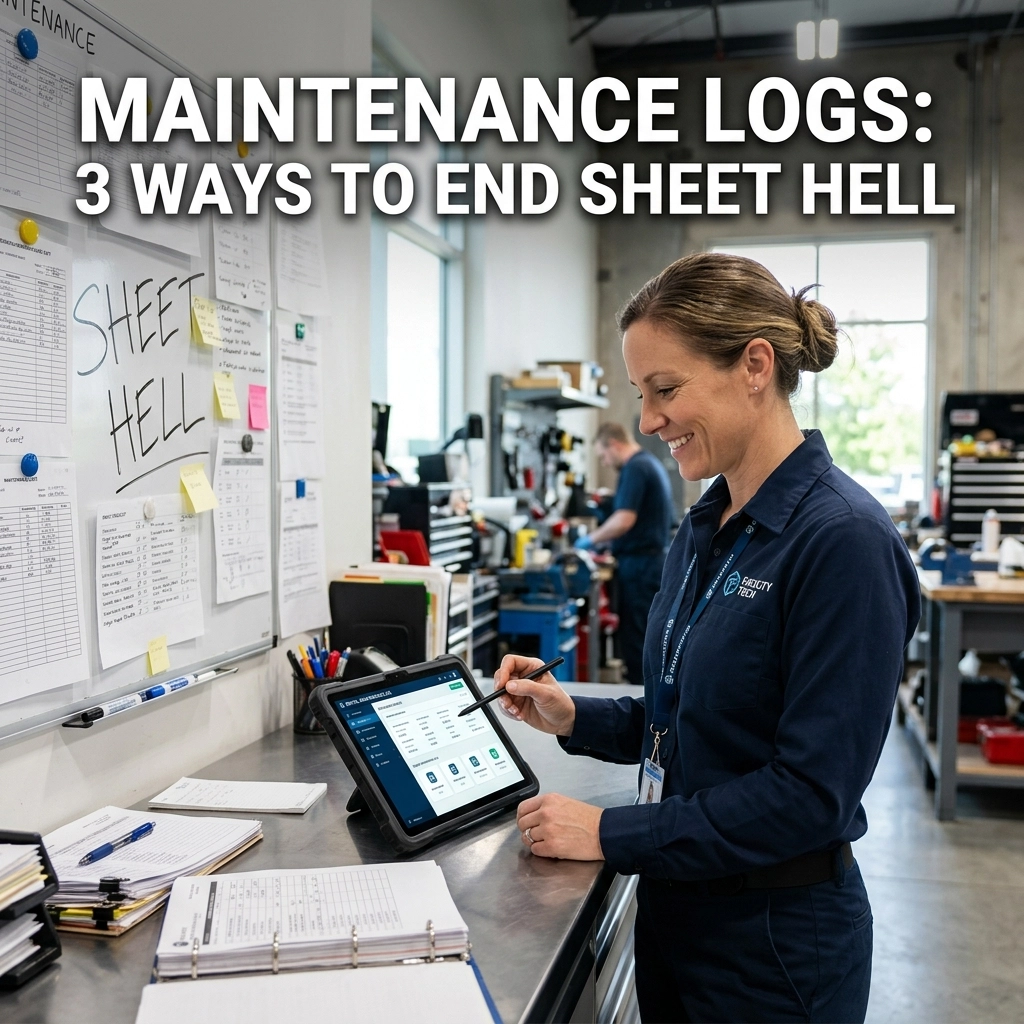
Equipment maintenance logs: 3 brutal ways to end sheet hell
You are losing money every time a technician opens a laptop to find a spreadsheet. You are leaking profit every time a service truck sits idle because a simple oil change was forgotten in a buried cell of an Excel document. You are one major equipment failure away from a reputation disaster that no amount of marketing can fix.
Your spreadsheet is not a system. It is a digital graveyard where information goes to die.
Stop pretending that your color coded rows are keeping your fleet and tools safe. If you have to spend your Sunday night cross referencing three different tabs just to see which generator needs a filter change, you do not have a process. You have a second job that pays zero dollars an hour.
There is a better way.
The silent killer of field service margins
The reality of managing a growing trade business is that equipment maintenance logs are often the first thing to fall through the cracks. You focus on the big wins like closing new contracts and getting crews to the job site on time. Meanwhile, the very assets that make your work possible are slowly grinding to a halt.
When you rely on manual spreadsheets, you are betting your business on the hope that every person on your team is as detail oriented as you are. They are not. Your lead electrician is worried about the wiring in a new commercial build, not whether he updated the row for his van maintenance. Your HVAC tech is focused on the refrigerant leak, not the mileage on the vacuum pump.
Spreadsheets create a barrier between the work being done and the record of that work. They require a level of administrative discipline that most field crews simply do not possess. This creates a feedback loop of misinformation. You think a tool is ready for the field because the sheet says so, but the sheet has not been touched in three weeks.

Why your spreadsheet is actually a liability
Most business owners start with a spreadsheet because it is free and familiar. It feels like you are being organized. But as you scale from two trucks to ten, that familiarity becomes a trap.
Spreadsheets are static. They do not send alerts. They do not talk to your dispatching software. They do not hold anyone accountable. If someone deletes a cell or enters a typo, the entire history of your equipment maintenance logs is compromised. You cannot build a multi-million dollar service company on a foundation of “I think we updated that sheet.”
The worst case scenario is not just a broken tool. It is the liability that comes with it. If a piece of safety equipment fails and you cannot produce clear, dated, and verified equipment maintenance logs, your insurance company will look for any reason to deny your claim. Sheet hell is not just annoying. It is a legal and financial risk that you are carrying every single day.
In the Wild: Mark’s HVAC Disaster
Mark owned a residential HVAC company in St. Louis that was finally hitting its stride. He had five crews on the road and a backlog of work that stretched out for two months. He managed everything through a complex series of Google Sheets. He prided himself on his equipment maintenance logs and spent hours every weekend making sure they were updated.
One Tuesday in the middle of a July heatwave, his primary crane truck experienced a total engine failure. The technician had reported a strange noise two weeks prior, but the note was buried in a comments cell on row 452 of the maintenance sheet. Mark had missed it.
Because the truck was down, three major installations had to be rescheduled. Those customers, sweltering in 95 degree heat, did not wait for Mark to fix his truck. They called the competition. Mark lost fifteen thousand dollars in immediate revenue and likely triple that in lifetime customer value. All because he thought he could manage equipment maintenance logs on a spreadsheet while running a full scale operation. The engine was a total loss, but the system failure was what actually broke the business.
The Fix: You do not need better spreadsheets, you need a process that removes the friction of documentation entirely.
Way 1: Transition to a centralized human oversight model
The most effective way to manage equipment maintenance logs is to take the responsibility out of the hands of the people who are too busy to do it. You need a dedicated administrator who lives outside the chaos of the field. This is where YROS provides the most significant relief.
Instead of asking your field team to navigate a spreadsheet, they simply send a photo of a service receipt or a quick voice note to your remote office support team. The remote professional then updates the equipment maintenance logs in real time. This ensures that the data is entered accurately and consistently without slowing down the technicians.
You do not need a new software subscription that your team will ignore. You need a human being whose primary job is to ensure those equipment maintenance logs are pristine. When the documentation is handled by a professional, you can pull a report at any moment and know exactly where your assets stand.

Way 2: Implement a proactive alert system that bypasses the screen
If you are looking at a spreadsheet to see what needs to be done, you are already behind. Professional equipment maintenance logs should find you, not the other way around. By moving away from sheets and toward a managed administrative system, you can set up a rhythm of proactive reporting.
Your remote office support at YROS can track the intervals for every piece of gear you own. Instead of you checking a list, you receive a concise summary every Monday morning of exactly what equipment needs attention that week. This turns maintenance from a reactive fire drill into a scheduled, predictable part of your operations.
When you move your equipment maintenance logs into a managed system, you create a layer of accountability. You can see exactly when a task was flagged and when it was completed. This transparency is impossible to achieve in a shared document where anyone can change a date or hide a mistake.
Way 3: Standardize the input without the complexity
One of the biggest reasons equipment maintenance logs fail is that they are too hard to update. If a tech has to log into a computer, find the right file, and navigate to the right tab, they will find an excuse to skip it. You have to make the input as simple as a text message.
By utilizing remote administrative support, you can create a “push” system for data. Your team in the field pushes information to your YROS coordinator. The coordinator then organizes that information into the official equipment maintenance logs. This keeps the field team focused on billable work while ensuring the back office has the data it needs for long term planning.
This method also allows for better historical tracking. Your remote office support can look at the equipment maintenance logs over time to identify which brands or models are costing you the most in repairs. This kind of high level business intelligence is nearly impossible to extract from a messy spreadsheet, but it is essential for making smart purchasing decisions as you grow.
The compound effect of clean documentation
When your equipment maintenance logs are accurate and up to date, your entire business runs smoother. You stop overpaying for emergency repairs because you caught the issue during a scheduled check. Your technicians feel more professional because they are driving well maintained vehicles and using tools that actually work.
Clean equipment maintenance logs also increase the value of your business. If you ever decide to sell your company, a potential buyer is going to look at your records. A folder full of spreadsheets looks like a hobby. A verified history of equipment maintenance logs managed by a professional team looks like a scalable, valuable asset.
You are not just keeping a list of oil changes. You are building a culture of excellence. You are showing your team and your customers that you care about the details. This is the difference between a contractor who is constantly putting out fires and a business owner who is in total control of their operation.

Stop treating your assets like afterthoughts
Every piece of equipment you own is a tool for generating revenue. When those tools are sidelined, your revenue stops. Relying on spreadsheets for your equipment maintenance logs is essentially saying that your revenue is not worth the cost of professional management.
You might think you are saving money by doing it yourself on a spreadsheet. You are not. You are spending your most valuable resource, your time, on a task that a professional administrative partner could do better, faster, and for a fraction of the cost of a single major repair.
The mental energy you spend worrying about your fleet and your gear is energy you are not spending on growing your company. You deserve the peace of mind that comes with knowing your equipment maintenance logs are being handled with the same level of care you give to your clients.
Why YROS is the solution to sheet hell
At YROS, we understand that trade businesses are built on the strength of their equipment. We also know that you did not get into this business to become a data entry clerk. Our remote office support services are designed to step into the gap between your field operations and your administrative needs.
We do not just offer a place to store your equipment maintenance logs. We provide the human intelligence to manage them. We look for the patterns, we send the reminders, and we ensure that your records are audit ready at all times. We help businesses in St. Louis and beyond move from the chaos of spreadsheets to the clarity of professional management.
Our team takes over the tedious tasks that keep you from scaling. Whether it is tracking vehicle registrations or managing the equipment maintenance logs for a fleet of HVAC vans, we handle the details so you can handle the growth. You do not need a more complicated spreadsheet. You need a team that takes the spreadsheets off your plate.
The psychological relief of an empty inbox and a clean log
Imagine waking up on a Monday morning and knowing exactly which trucks need service, which tools are in for repair, and that every single one of your equipment maintenance logs is 100 percent accurate. You do not have to check anything. You do not have to chase anyone down. The information is already there, summarized and waiting for you.
This is the level of sanity that professional administrative support provides. It is not just about the data. It is about the freedom to focus on what you do best. When you delegate the management of your equipment maintenance logs to YROS, you are reclaiming your time and your focus.
The “sheet hell” you are living in is optional. You can choose to keep struggling with manual entries and broken formulas, or you can choose to move your business into a more professional era. Your equipment is an investment. Protect that investment with professional equipment maintenance logs.
Standardizing for the future of your field service company
As you look toward the future, ask yourself if your current systems can support a business twice your current size. If the answer is no, then the time to change is right now. You cannot fix a broken foundation while the house is still being built. Moving your equipment maintenance logs into a managed administrative system today will save you hundreds of hours of frustration next year.
Your team will thank you. Your bank account will thank you. And most importantly, your stress levels will finally start to drop. You have built something impressive. Do not let a lack of professional equipment maintenance logs be the thing that brings it all down.

Real world implications for specialized trades
For specific industries like fire and security systems or appliance repair, the importance of equipment maintenance logs is even higher. In fire and security, your testing equipment must be calibrated and documented with extreme precision. A spreadsheet is simply not a defensible record in a high stakes environment.
In the plumbing and electrical trades, the variety of specialized tools can make manual tracking a nightmare. From snakes and cameras to high end testers, every item needs its own entry in the equipment maintenance logs. A remote administrator can categorize these by department, crew, or even by individual technician, providing a level of granular detail that no spreadsheet can match without becoming unreadable.
Even for B2B service providers and commercial cleaners, the equipment maintenance logs for floor scrubbers and industrial vacuums are critical for maintaining contract compliance. When a commercial client asks for proof of your maintenance standards, handing them a professional report generated by your YROS team is a powerful way to demonstrate your reliability.
The hidden costs of the “I will do it later” mentality
Every time you tell yourself that you will update the equipment maintenance logs later, you are borrowing against your future success. That “later” rarely comes until something breaks. The cost of a proactive administrative partner is negligible compared to the cost of a missed maintenance window.
Consider the cost of labor. If your technicians are spending thirty minutes a week fighting with a spreadsheet, and you have ten technicians, that is five hours of billable time lost every single week. Over a year, that is 260 hours of lost revenue. You could pay for a year of professional support from YROS just with the money you are currently wasting on “free” spreadsheets.
Professional equipment maintenance logs are not a luxury for big companies. They are a necessity for any company that wants to become big. The transition away from sheet hell is the first step in moving from a job that you own to a business that works for you.
Establishing a new standard of administrative excellence
It is time to draw a line in the sand. Decide today that your business is too important to be run on outdated, manual documents. Decide that your equipment maintenance logs deserve to be managed by professionals who understand the stakes of your industry.
When you make the shift to working with YROS, you are not just outsourcing a task. You are upgrading your entire operational philosophy. You are choosing clarity over chaos. You are choosing growth over stagnation. And you are finally putting an end to the brutal cycle of sheet hell.
The tools are ready. The crews are waiting. The only thing missing is the professional oversight to ensure it all keeps moving forward. Let us take the burden of equipment maintenance logs off your shoulders so you can get back to the work that actually matters.

Take back your time and your sanity
You do not have to do this alone. You do not have to be the CEO, the lead tech, and the data entry specialist all at once. There is a team ready to help you organize your business and protect your assets.
The relief of knowing your equipment maintenance logs are handled is only one phone call away. Stop the spreadsheets. Stop the guessing. Stop the stress.
Related Blogs
- Creating a Company Wiki That People Actually Update
- File Naming Conventions That Save You Hours of Searching
- How to Delegate When You Have Always Done Everything Yourself
- Building Systems Before You Need Them
- Virtual Assistants for Blue Collar Businesses: The Complete Guide
- Accounts Receivable Systems That Fix Cash Flow Problems
- Invoicing Systems That Get You Paid Faster
- Payment Terms: 5 Proven Critical Rules That Protect Your Cash Flow
- Progress Billing Systems for Service-Based Businesses
- Retainage tracking: 5 fatal, costly traps you missed
- Change Order Documentation: 2 Proven Vital Successes
- Job Costing Systems That Show True Profit
- Estimating Systems That Protect Your Margins
- Expense Tracking Systems for Field Service Businesses
- Financial Dashboards for Small Business Owners
- Cash Flow Forecasting for Contractors
- Revenue Leakage: Where Your Money Is Actually Going
- Matching Expenses to Revenue: Why It Matters
- Budgeting Systems for Growing Service Businesses
- Monthly Financial Review Systems for Owners
- The Hidden Cost of Poor Financial Processes
- Pricing Models That Actually Work in Trade Businesses
- Flat Rate vs Time and Materials: Financial Impact
- Payment Collection Systems That Reduce Delays
- Customer Financing Options and Cash Flow Impact
- Vendor Payment Scheduling Systems
- Payroll Timing vs Cash Flow Management
- Tax-Ready Bookkeeping Systems for Small Businesses
- Financial SOPs Every Service Business Needs
- Delegating Your Bookkeeping Without Losing Control
- Cost of DIY Administration: 3 Bold Masterful Joys
- Scaling Financial Systems as You Grow
- Profit First vs Traditional Accounting Methods
- Financial Visibility Systems for Better Decision Making
- The Compound Effect of Small Financial Fixes
You do not need to hire another office manager to sit in a cubicle and wrestle with your old files. You need the freedom to breathe again. If you are tired of feeling like your business is running you instead of you running the business, let us talk about how to get your life back. No high pressure sales pitch, just a conversation about sanity.