Proactive Communication: 10 Fast Ways to Stop Phone Stress
You are a prisoner to a piece of plastic in your pocket. It is pathetic. You have spent years building a legitimate HVAC or field service business, but you are still letting a sixty dollar tune-up call dictate when you can eat dinner with your family. You are sitting at the table, your phone vibrates, and you feel that jolt of cortisol. You know that if you do not answer, that lead is gone. But if you do answer, your spouse gives you that look: the one that says you are never really present. You are a slave to the ringtone, and it is killing your profit, your sanity, and your relationships.
Proactive Communication is not just a corporate buzzword. For a field service owner, it is a survival mechanism. Right now, you are reactive. You wait for the crisis to hit your screen before you react. You wait for the customer to call and ask where the technician is. You wait for the billing dispute to land in your inbox. Every one of those calls is a failure of your system. Every time your phone rings with a question you could have answered two hours ago, you are losing money. It is time to stop the bleeding.
The Brutal Reality of Your Phone Addiction
Think about your last week. How many times did you pull over on the shoulder of the highway to handle a “quick” question? How many times did you drop a wrench in a crawlspace because your pocket started buzzing? This is not how you scale a company. This is how you create a high-paying, high-stress job for yourself.
The problem is that you think you are being “available.” You tell yourself that being on-call 24/7 is the secret to your success. You are wrong. Being constantly available just teaches your customers that your time has no value. It teaches them that they can interrupt your life for any minor whim. It creates a cycle of dependency where you are the only person who can solve problems.
The agitation is constant. You feel it in your chest every time the screen lights up. You are worried about the one star review. You are worried about the missed emergency call. But the worse case scenario is already happening: you are becoming the bottleneck. If you get sick, the business stops. If you take a vacation, the business stops. You have built a cage, and the phone is the lock.


The Hidden Cost of Every Interruption
Let us look at the math, because the numbers do not lie. At Your Remote Office Space (YROS), we see this every day.
If you are a business owner whose time is worth at least $150 per hour, every “quick” five minute call actually costs you more than just time. It costs you “context switching” energy. It takes about 23 minutes to get back into a state of deep focus after an interruption.
The ROI of Silence:
- 10 “Quick” Calls per day: 50 minutes of talk time.
- Context Switching Loss: 230 minutes of lost productivity.
- Total Daily Waste: 4.6 hours.
- Weekly Cost at $150/hr: $3,450.
- Annual Cost of Phone Stress: $179,400.
You are literally lighting nearly two hundred thousand dollars on fire every year because you refuse to implement Proactive Communication. That is the price of two new service vans or a high-level manager who could run the whole show for you.
In the Wild: The HVAC Owner Who Almost Lost Everything
Take Mike, an HVAC contractor in the St. Louis Metro Area. Mike was a “hustler.” He answered every call personally. He was proud of it. He told himself it was his competitive advantage.
By July 2025, Mike was vibrating with anxiety. He was answering 40 calls a day while trying to supervise three crews. He missed a major commercial installation bid because he was on the phone with a residential customer complaining about a $20 air filter. His marriage was on the rocks because he was taking calls at 9:00 PM on a Tuesday.
One afternoon, while trying to look up a part number on his phone and drive to a job site in Alton, he clipped a curb and blew out two tires. He sat on the side of the road and realized he was one distracted second away from a much worse accident. He was “available” to everyone except himself and his family.
The fix was not “working harder.” The fix was Proactive Communication. He needed to stop the calls before they started. He needed a system that spoke for him when he was busy. He needed Your Remote Office Space to handle the front line so he could focus on the bottom line.
1. Script Your Way to Freedom
The first way to use Proactive Communication is to stop “winging it” on every call. When you answer the phone without a plan, the customer controls the conversation. They ramble. They complain. They take twenty minutes to tell a two minute story.
The Fix: You need scripts. Not robotic, soulless scripts, but frameworks. Every call should have a clear beginning, middle, and end. By setting expectations at the start of the call, you reduce the customer’s need to call back later.
If you use a service like YROS, our team uses these scripts to ensure every piece of data is captured the first time. No more calling the customer back because you forgot to ask if they have a crawlspace or an attic. Proactive Communication means getting it right the first time so you do not have to do it a second time.
2. Practice Box Breathing Before You Pick Up
This sounds like some “new age” nonsense, but it is a biological necessity. When your phone rings, your heart rate spikes. You are in “fight or flight” mode. If you answer in that state, you sound rushed, annoyed, and stressed. The customer picks up on that, their own anxiety rises, and a simple scheduling call turns into a confrontation.
The Fix: Use the 4-7-8 method. Inhale for four seconds, hold for seven, exhale for eight. Do this before you touch the green button. It grounds you. It makes you the authority in the room. A calm contractor is a trusted contractor. When you communicate from a place of peace, the customer trusts you more and questions you less. This is Proactive Communication with your own nervous system.
3. Automated Status Updates: The “Where Are You?” Killer
The most common, most annoying call in field services is: “Where is my tech?” It is a waste of everyone’s time. Your tech is in traffic. Your tech is finishing up a job. Your tech is getting gas.
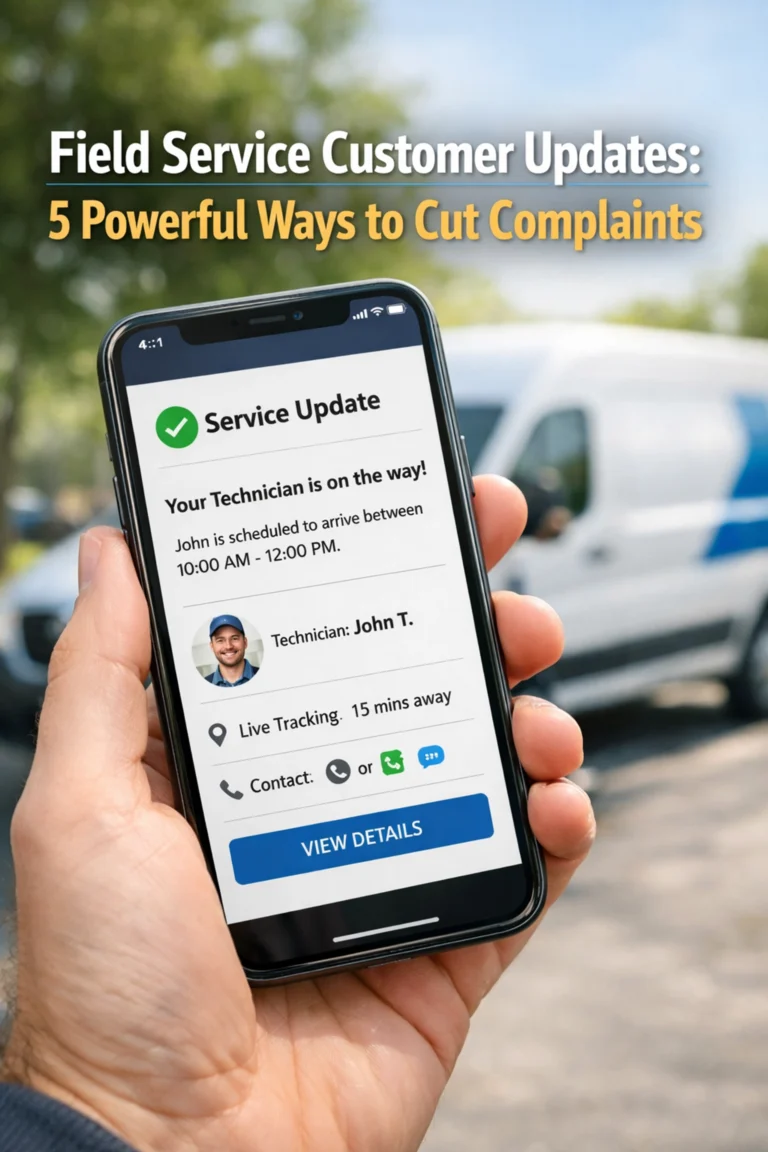
The Fix: Proactive Communication via automated updates. Whether you use ServiceTitan or another platform, you must have “On My Way” texts and emails. But do not stop there. Send a “We will be there in 30 minutes” text. Send a “Here is your technician’s name and photo” email.
When the customer knows exactly what is happening, they do not call you. You have effectively “killed” that phone call before it was even born. That is the power of a proactive system. If you are not tech-savvy, this is where Your Remote Office Space comes in. We can manage these touchpoints for you, ensuring the customer feels “seen” without you ever having to look at your phone.

4. Optimize Your Physical Environment for Success
Most HVAC owners are trying to run a multi-million dollar business from the driver’s seat of a Ford F-150. You have papers flying around the dashboard, a half-eaten sandwich in the console, and a Bluetooth headset that cuts out every three minutes. This environment breeds stress.
The Fix: Stop trying to be an office manager while you are a driver. If you must take calls in the field, pull over. Keep a clean, organized folder for your active jobs. But better yet, do not take the calls at all.
Redirect your business line to a dedicated support team like YROS. Let us handle the chaos of the “initial intake” so you only see the “final result” on your calendar. Your truck should be for driving and thinking, not for frantic data entry on a tablet while sitting at a red light.
5. Establish Rapport Early to Prevent Later Disputes
Most phone stress comes from conflict. Conflict usually happens because the customer feels like a number, not a person. If the first time they hear from you is a bill, they are going to find something to complain about.
The Fix: Proactive Communication starts with the “Welcome.” Use their name. Reference a detail from their last service. “Hey Mrs. Smith, I see we were out there last year for your furnace, is it the AC giving you trouble now?”
This small effort builds a “trust bank.” When you have a trust bank, the customer is much more likely to be patient if a part is backordered or a technician is running late. They are calling a “friend” instead of a “vendor.” It is much harder to scream at a friend.
6. Active Listening: The Anti-Stress Tool
You are probably a “fixer.” You hear three words of a problem and you start giving a solution. The customer, however, wants to be heard. If they do not feel heard, they will keep talking. They will repeat themselves. They will call back three times to “make sure you understood.”
The Fix: Paraphrase. “So what I am hearing is that the unit is making a grinding noise, but only when the fan kicks on, is that right?”
This simple act of Proactive Communication confirms you have the right info. It shuts down the customer’s need to keep explaining. It shortens the call. It lowers the stress. It makes you look like a professional instead of a harried worker.
7. Take Strategic Breaks Between Call Batches
You cannot be “on” all day. If you jump from a stressful customer call straight into a high-stakes meeting with a supplier, you are going to carry that “phone stress” with you. It compounds. By 3:00 PM, you are a ticking time bomb.
The Fix: Batch your calls. Tell your office or your YROS team that you are only available for callbacks between 10:00 AM and 11:00 AM and 3:00 PM and 4:00 PM.
This creates “Deep Work Blocks” where you can actually get things done without the constant vibration in your pocket. Knowing that you have a dedicated time to handle issues reduces the “all day” anxiety of the phone. You are in control of the schedule, not the callers.
8. Start Your Day With Low-Pressure “Warm Up” Calls
Do not start your morning by calling the angriest customer on your list. That is a recipe for a miserable day. Your brain will associate the phone with pain for the next eight hours.
The Fix: Make a couple of easy calls first. Call a happy customer for a follow-up. Call a vendor you like. Get your “communication muscles” moving in a positive direction.
Proactive Communication is easier when you are in a good mood. Once you have a couple of “wins” under your belt, you will have the mental fortitude to handle the “Problem Child” customer without letting it ruin your afternoon.
9. Visualize Success for Difficult Conversations
We all have those calls we dread. The “I need to tell them the part is $2,000” call. We put them off. They sit on our to-do list like a heavy weight, causing constant low-level stress.
The Fix: Stop procrastinating. Spend 60 seconds visualizing the call going well. Imagine the customer saying, “Okay, thanks for explaining that, let us get it fixed.”
Then, make the call. Most of the time, the reality is 10% as bad as the version in your head. Proactive Communication means facing the “bad news” head-on before it turns into a “why did not you tell me sooner?” crisis.
10. Celebrate the Wins (Even the Small Ones)
You focus on the 2% of customers who are jerks and ignore the 98% who are great. You finish a hard call and immediately move to the next stressor. You never give your brain a reward for navigating the “phone stress” minefield.
The Fix: When you handle a tough situation with Proactive Communication, take a second to acknowledge it. “I handled that well. I stayed calm. I saved that account.”
This positive reinforcement slowly retrains your brain to see the phone as a tool you master, not a monster that masters you.

Why You Can’t Do This Alone
You are probably reading this thinking, “This sounds great, but I do not have time to ‘box breathe’ or ‘visualize success.’ I have 14 voicemails and a tech who just quit.”
That is the point. You cannot implement Proactive Communication while you are drowning in the very tasks that are causing the stress. You need a partner. You need a back office that acts as a filter.
At Your Remote Office Space, we do not just “answer phones.” We implement systems. We use the tools you already have, like ServiceTitan or QuickBooks, and we turn them into Proactive Communication engines. We handle the “Where are you?” calls so you never hear them. We handle the initial intake scripts so the data is perfect. We give you back your “windshield time” so you can actually drive without endangering yourself or others.

The Business Case for Proactive Communication
Let us look at the ROI again. When you move from reactive to proactive, three things happen:
- Lead Conversion Increases: Most leads are lost because of slow response times. With YROS handling your Proactive Communication, every lead is touched within minutes, not hours.
- Customer Lifetime Value (CLV) Goes Up: Customers who feel informed stay longer. They do not shop around for the “cheapest guy” because they value the peace of mind you provide.
- Owner Burnout Decreases: This is the big one. What is it worth to actually sleep through the night? What is it worth to go to your kid’s baseball game without checking your phone every three innings?
Estimated Annual Benefit:
- Increased Lead Conversion: +15% ($45,000 based on $300k revenue).
- Reduced Owner Waste: $179,400 (from previous calculation).
- Reduced Employee Turnover (due to less stress): $25,000.
- Total Potential Gain: $249,400 per year.
You are not “saving money” by doing the admin work yourself. You are paying a quarter of a million dollars a year for the privilege of being stressed out. That is a bad deal.
Stop Fighting the Phone and Start Managing the Business
You have a choice. You can keep doing what you are doing. You can keep letting the phone be the prison warden of your life. You can keep “stepping over dollars to pick up pennies” by handling $20-an-hour tasks while your $150-an-hour brain rots from stress.
Or, you can decide that 2026 is the year you finally become a business owner instead of a glorified dispatcher.
Proactive Communication is the “secret sauce” of every seven and eight-figure field service company. They do not have “smarter” owners; they just have better systems and better support. They have realized that they cannot be the hero on every phone call. They have outsourced the “front line” so they can focus on “strategic growth.”
Your Remote Office Space is that support. We understand the trades. We understand the St. Louis market. We understand that when a pipe bursts at 2:00 AM, the customer does not want an “assistant,” they want a solution. We provide that solution with professional, human-based remote office support.
Frequently Asked Questions
Does “Proactive Communication” mean I have to spend more time on the phone?
No. It means you spend less time on the phone because you are solving problems before they require a long, stressful conversation. One “On My Way” text can save a ten minute “Where are you?” phone call.
Will my customers be upset if they do not talk to “The Boss” every time?
Quite the opposite. Your customers want efficiency and professional service. If “The Boss” is always harried, distracted, and rushing them off the phone, that is a bad customer experience. A professional support team provides a better experience than a stressed-out owner.
Can YROS really understand my specific trade?
Yes. Whether you are in HVAC, plumbing, pest control, or commercial cleaning, the core administrative pains are the same. We speak your language. We know the software. We know the pressure of the “busy season.”
Is this just another expense?
If you think of your time as having zero value, then yes, everything is an expense. But if you value your time at $100, $200, or $500 an hour, then YROS is a massive cost-saving measure. We are the “leverage” that allows you to scale.
The Decision is Yours
You can keep pretending that you can handle it all. You can keep telling yourself that “next month” things will slow down and you will finally get organized. But you know that is a lie. The busy season is coming. The calls are only going to increase.
Stop trying to be Superman. Superman does not have a “where are you” call from a frustrated homeowner while he is trying to save the world.
Be pragmatic. Be profitable. Be proactive.
If you are ready to stop the phone stress and start reclaiming your life, it is time to have a conversation. Not a stressful, “where’s my tech” conversation, but a strategic one about the future of your business.
Click Here to Schedule Your 30-Minute Strategy Call with YROS
It is time to put the phone down and pick the business up. Your Remote Office Space is ready when you are. Stop the bleeding today. Stop the phone stress. Start the growth.
Related Blogs
- Security System Workflows: 9 Brutal Powerful Fixes
- Stop Dispatching Through Text Messages: Why It’s Costing You $2,000 a Month
- The Hidden Revenue Leak: Why Your Technicians Shouldn’t Be Your Office Staff
- Field Service Call Handling: 7 Scripts That Shorten Every Intake
- Automated Status Updates: The Simple Fix for “Where Is My Tech?” Calls
- After-Hours Calls: 3 Shocking Reasons You’re Losing Money
- Why Slow Response Times Kill HVAC Lead Conversion
- Deep Work Blocks: 7 Proven Ways to Reclaim Strategic Time
- You Are the Bottleneck: How Reactive Leadership Stalls Growth
- Task Handoff Systems: Stop Running Your Business From Your Memory
- Calendar Management for Contractors: Take Back Control of Your Day
- Why Being “Available” 24/7 Is Bad Business Strategy
- Contractor Burnout: The Warning Signs You’re Ignoring
- From Hustler to CEO: The Mindset Shift Field Service Owners Must Make
- Capacity Planning for HVAC Companies: Can Your Systems Handle 2.5× Growth?
- Internal Communication Systems: Stop Answering the Same Question 10 Times
- Service Business Growth Systems: Why More Leads Create More Chaos
- The True Cost of Context Switching for Business Owners
- Lead Conversion Math: Why Every Missed Call Is a Missed $500 Opportunity
- Job Costing for HVAC Contractors: Busy Doesn’t Mean Profitable
- Revenue Leakage in Field Service Businesses: Where Your Profit Is Disappearing