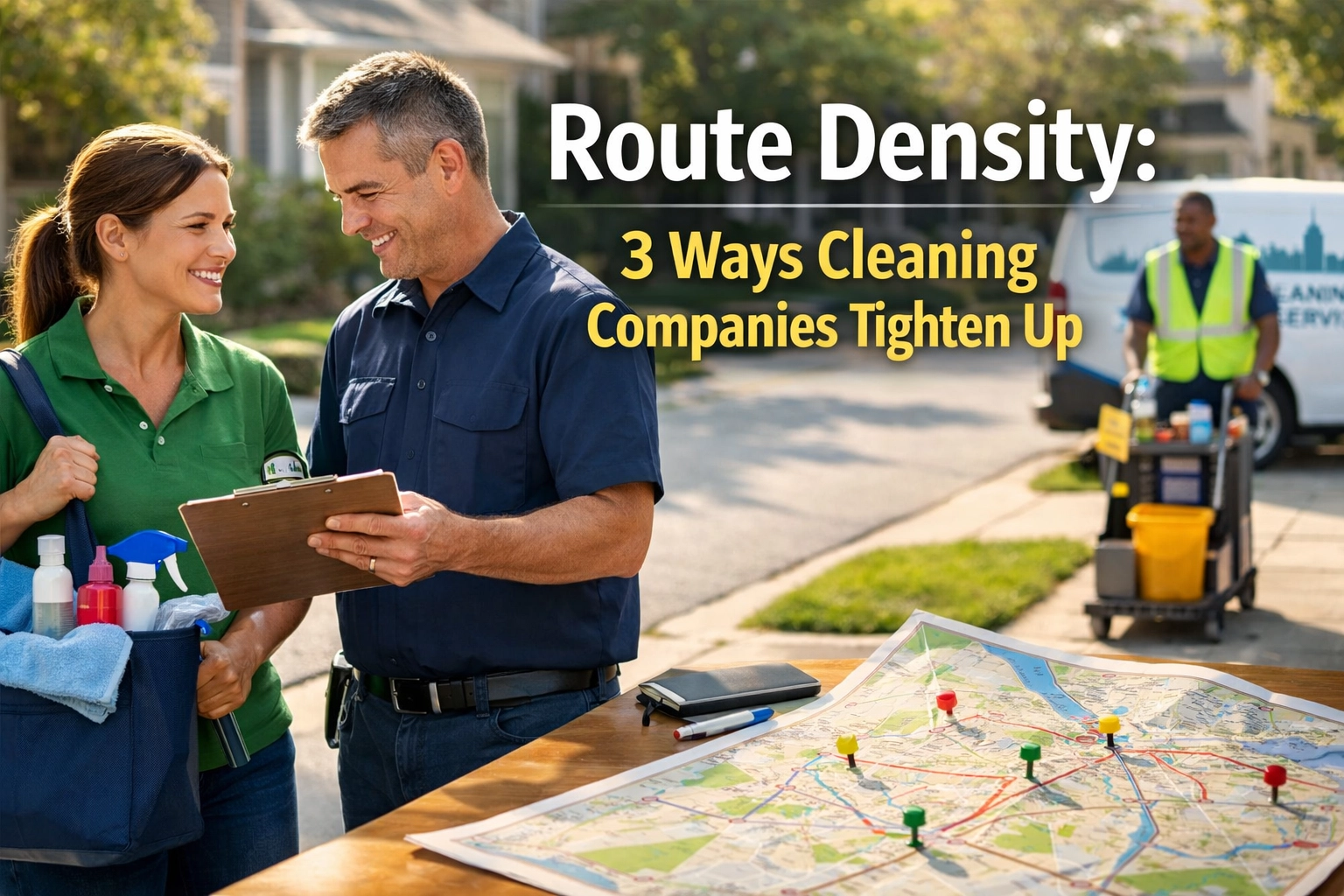
Route Density: 3 Powerful Ways to Tighten Your Profits
You are bleeding cash every time your service van pulls onto the highway. Your technicians are spending forty minutes listening to podcasts between jobs while you pay them twenty dollars an hour to do nothing but stare at a bumper. Your profit margin is not being eaten by high chemical costs or expensive vacuum repairs. It is being left on the pavement of the interstate because you lack the discipline to enforce strict route density.
Every minute spent in traffic is a minute where zero revenue is generated. If your team services a client on the north side of town at nine in the morning and a second client on the south side at eleven, you have effectively nuked your profitability for that day. You are running a logistics company that happens to clean floors, but you are running it poorly.
There is a better way to structure your service area. You must stop accepting every job that comes through the phone and start curating your schedule for maximum proximity.
The Slow Bleed of the Open Road
You likely started your cleaning business by saying yes to everyone. You needed the revenue and you were willing to drive an hour each way to secure a recurring office contract. That desperation was a survival tactic in the beginning, but it has now become a shackle that prevents you from scaling.
When you look at your profit and loss statement, you see labor costs as a single line item. You fail to see that a significant chunk of that labor is “windshield time.” Windshield time is the silent killer of the commercial cleaning industry. It inflates your payroll without adding a single cent to your top line.
If your cleaners spend 25 percent of their shift driving, you are essentially paying a 25 percent tax on your own business. Route density is the only lever you have to reclaim that money. By tightening the physical distance between your accounts, you turn non-billable drive time into billable cleaning time.
The Referral Trap That Ruins Your Schedule
Most cleaning owners suffer from what I call the referral trap. A great client in the downtown district refers you to their brother who owns a warehouse forty miles away in the suburbs. Because you want to be helpful and you value the relationship, you take the job.
Now you have a geographic outlier. To service that one suburban warehouse, you have to send a crew out of their normal orbit. This creates a ripple effect across your entire week. You start moving other appointments to accommodate the drive time for that one outlier.
Pretty soon, your map looks like a game of connect the dots played by a toddler. There is no logic, no clusters, and no route density. You are operating at the mercy of your inbox rather than the efficiency of your map.
The Fix: You Do Not Need More Clients, You Need a Grid
You do not need to hunt for more leads to fix your cash flow. You need to stop the hemorrhaging by imposing a geographic grid on your operations. The goal is simple: maximize the number of stops in the smallest possible area.
YROS helps cleaning companies identify these gaps by looking at the hard data of their schedule. We see where the outliers are and we help you develop the discipline to stop the drift. Route density is not just a buzzword. It is a mathematical requirement for a healthy cleaning business.

1. Enforce Zone-Based Logic for Every New Lead
The first way to tighten your route density is to divide your city into specific zones. You must assign each day of the week to a specific zone. For example, Mondays and Wednesdays are for the East Side. Tuesdays and Thursdays are for the West Side.
When a prospect calls from the West Side and asks for a Monday cleaning, the answer must be no. You offer them Tuesday or Thursday. If they insist on Monday, you must be willing to walk away or charge a significant “out-of-zone” premium.
You are not being difficult. You are protecting the health of your company. When you cluster clients in a single zone, your team can often walk from one job to the next or drive less than five minutes. This level of route density allows a single crew to handle 20 percent more volume in the same eight-hour shift.
Why Saying No Is Your Most Profitable Move
Most owners are terrified of the word no. They think every lead is a gift. In reality, a lead that sits twenty miles away from your existing accounts is a Trojan horse. It brings in revenue but consumes more in overhead than it provides in profit.
By enforcing zone-based scheduling, you create a predictable rhythm for your staff. They know where they are going to be. They spend less time dealing with city traffic and more time focusing on the quality of their work.
YROS works with business owners to set these boundaries. We help you define your service territory so that you never accidentally say yes to a profit-killing contract. We provide the administrative backbone to hold the line on your route density goals.
2. Implement Day-Batching to Consolidate Travel
Route density is not just about where you go, it is about when you go there. If you have five clients in the same office park but you visit them on five different days, you are still failing. You are forcing your van to make that trip five times when it could have made it once.
Day-batching is the process of moving all recurring clients in a specific area to the same service window. This requires a difficult conversation with your customers. You have to explain that in order to maintain your high level of service and keep rates stable, you are moving their service to a specific block of time.
Most customers will understand if you frame it correctly. They want a reliable cleaning company that is not constantly stressed and rushed. High route density leads to a more stable workforce, which leads to better results for the client.
The Cost of Convenience vs. The Price of Profit
You have been selling convenience at the expense of your own bank account. You have let the client dictate the schedule because you were afraid to lead. True leadership in a service business involves setting the terms that allow the business to thrive.
When you batch your days, you reduce the wear and tear on your vehicles. You lower your fuel consumption. Most importantly, you reduce the mental fatigue of your drivers. Navigating traffic is one of the most stressful parts of the job. High route density eliminates that stress.
YROS specializes in the heavy lifting of calendar reorganization. We can look at your current client list and identify the batching opportunities you are missing. We help you move the pieces on the board so that your route density reaches its full potential.

3. Build a Human Shield Around Your Territory
The final and most effective way to maintain route density is to have a dedicated professional managing your intake. You cannot be the one answering the phone if you want to maintain geographic discipline. As the owner, your instinct is to close the sale. You will make excuses for a bad lead because you want the win.
You need a human shield who evaluates every prospect based on their location before they even get a quote. This person needs to be trained to look at your service map and determine if the lead fits your route density requirements.
If the lead is outside the zone, the intake professional provides the pre-set zone options or declines the work. This removes the emotional component from the decision. It ensures that your route density remains the priority.
Why Software Alone Is Not the Answer
There are dozens of route optimization apps on the market. They are great for calculating the shortest distance between points A and B. However, they cannot talk to a pushy prospect who demands a Friday afternoon slot in a Monday zone.
Software cannot explain the value of your zone-based system to a potential client. You need a human who understands your business goals. You need someone who is invested in your profit margins, not just checking boxes on a digital map.
YROS provides that human element. We do not just look at a map. We understand the strategy behind route density. We act as the gatekeeper for your schedule, ensuring that every new job adds to your density rather than diluting it.
In the Wild: The Case of the Wandering Van
Mike owned a growing commercial cleaning company in St. Louis. He had twelve employees and a fleet of four vans. On the surface, Mike was doing great. He was billing sixty thousand dollars a month. But at the end of every month, his bank account was nearly empty.
When we performed a deep dive into his operations, we found the culprit. One of his crews was starting their day in the city, driving forty-five minutes to a suburban school, then driving thirty minutes back toward the city for a medical office. They were spending nearly three hours a day in the van.
Mike’s route density was nonexistent. He was paying for twelve hours of unproductive drive time every single day across his entire team. That is sixty hours a week of pure waste. At an average wage of eighteen dollars an hour, Mike was losing over four thousand dollars a month just in wages, not including fuel and maintenance.
The Fix:
You do not need more technicians. You need a tighter map. We worked with Mike to implement a strict three-zone system. We helped him send a polite but firm letter to his suburban clients, moving them to a dedicated “Suburban Tuesday.” Two clients canceled because they wanted their specific time slots. Mike panicked, but we showed him the math.
Even with the lost revenue, Mike’s profit went up. Why? Because the remaining crews were suddenly able to fit an extra small office into their day because they weren’t stuck on Highway 40. His route density improved so much that he was able to take one van off the road entirely, saving him on insurance and fuel.
Mike stopped being a victim of his own map. He started using route density as a weapon for profitability. He realized that sixty thousand in revenue with high density is much better than eighty thousand in revenue with a scattered team.

The Psychological Barrier to Efficiency
The biggest obstacle to achieving high route density is your own ego. You want to be the big company that services the whole region. You like seeing your vans in different parts of town. It makes you feel like you have arrived.
But the most successful cleaning companies are often the ones you never see. They are the ones who dominate a single ten-mile radius. They have so much route density that their competitors cannot touch their prices because their overhead is so much lower.
You have to get over the fear of “missing out” on work that is too far away. Every time you drive past a potential client to get to an existing one, you are failing at route density. Your goal should be to own your neighborhood, not to visit every neighborhood.
How Fuel Costs Mask Operational Weakness
Many owners blame the price of gas for their dwindling margins. While fuel prices are a factor, they are often just a symptom of poor route density. If your route density is high, a twenty-cent increase in gas prices barely moves the needle. If your route density is low, that same increase can put you in the red.
Don’t wait for gas prices to drop to fix your business. Fix the distance your vans are traveling. When you prioritize route density, you become resilient to external economic shocks. You create a lean, mean cleaning machine that can survive any market condition.
YROS focuses on these operational fundamentals. We don’t care about flashy marketing or “growth hacking.” We care about the boring, structural details like route density that actually determine if you get to keep the money you make.
The Impact of Turnover on Geographic Logic
When you have a scattered route, your staff gets burnt out. No one likes spending their life in a company vehicle. By improving your route density, you actually improve your employee retention.
Cleaners who can stay in one general area are happier. They have more predictable end times for their shifts. They feel more productive because they are actually cleaning instead of sitting in traffic. High route density creates a virtuous cycle where your team stays longer, which reduces your hiring costs, which further increases your profit.
You cannot afford to ignore the human cost of poor logistics. Your best people will leave if you keep sending them on cross-county treks for a two-hour cleaning job. Route density is a tool for culture as much as it is a tool for finance.

Real-Time Adjustments vs. Strategic Planning
Many people confuse route density with route optimization. Optimization is about finding the fastest way to get through a list of stops. Density is about ensuring that the list of stops makes sense in the first place.
You can optimize a bad route all day long and you will still have a bad route. You must start at the strategic level. You must decide where you will work and where you will not. This is where most owners fail because it requires making hard choices.
YROS acts as your strategic partner in these decisions. We provide the outside perspective needed to see that your “best” client might actually be your most expensive one due to their location. We help you rebalance your portfolio for maximum route density.
Measuring What Matters: Stops Per Mile
If you want to track your progress, you need a new metric. Stop looking at total revenue and start looking at stops per mile. Or better yet, revenue per mile traveled.
If your revenue per mile is decreasing, your route density is failing. You are working harder for less money. This is the definition of the owner bottleneck. You are so busy managing the chaos of a spread-out business that you cannot see the obvious solution right in front of you.
Improving your route density is the fastest way to give yourself a raise. It requires zero new equipment. It requires zero new hires. It only requires a change in how you manage your calendar and your intake process.
The Hidden Cost of “Quick” Estimate Trips
Route density applies to you, the owner, just as much as it applies to your crews. If you are driving all over the city to give estimates, you are wasting your own most valuable resource: your time.
You should be grouping your estimates geographically. If you have a lead on the north side, you wait until you have two more in that area before you head out, or you handle the initial discovery via a remote office professional. This protects your calendar and keeps you focused on high-level growth.
YROS helps owners reclaim their time by managing the initial lead qualification process. We make sure that by the time you leave your office for an estimate, it is a lead that fits your route density goals and is worth your time.

Structure Creates the Freedom You Crave
You started this business because you wanted freedom. But right now, you are a slave to a chaotic schedule. You are constantly putting out fires caused by travel delays, van breakdowns, and stressed-out cleaners.
Route density is the path to the freedom you want. When your business is tightly clustered, it is easier to manage. It is easier to supervise. It is easier to scale. You don’t need to be everywhere at once. You just need to be in the right places at the right times.
Stop trying to be the hero who can service the entire state. Be the specialist who owns the zip code. That is where the real money is made in commercial cleaning.
Your Next Move for Profit Protection
The road is eating your profits. You can keep ignoring the math, or you can start tightening your map today. You do not have to do this alone. You do not need to spend your weekends staring at Google Maps trying to figure out how to fix the mess.
You need a team that understands the value of route density and has the discipline to enforce it. You need the sanity that comes from knowing your vans are moving efficiently and your profit margins are protected.
Stop the drift. Stop the waste. Start building a business that works for you instead of one that drives you into the ground.
If you are tired of paying for windshield time and want to see how a dedicated back-office team can tighten your operations, we should talk. We are not here to sell you a fancy system. We are here to give you your life back.
Related Blogs
- The Real Reason Your Business Isn’t Growing (Hint: It’s Admin)
- The Admin Weight That Keeps Cleaning Businesses Stuck
- Why Commercial Cleaning Owners Should Stop Doing Their Own Scheduling
- How to Measure Real Cleaning Productivity Instead of Guessing
- The Office Manager You Think You Don’t Need (But Already Are)
- Sales Territory Planning: How to Stop Wasting Fuel
- Route Optimization vs Route Density: What Actually Matters
- How Windshield Time Is Destroying Your Profit Margins
- Geographic Scheduling Strategies for Cleaning Companies
- Why Your Cleaning Routes Feel Chaotic (And How to Fix Them)
- Dispatching Systems for Commercial Cleaning Businesses
- How to Build High-Density Service Routes That Scale
- The Hidden Cost of Low Route Density in Field Services
- Why Saying Yes to Every Job Is Costing You Money
- Cleaning Business Scheduling: From Chaos to Control
- How to Group Clients for Maximum Route Efficiency
- The Real Cost of Poor Scheduling in Service Businesses
- Why Your Labor Costs Feel Too High (It’s Not Labor)
- Zone-Based Scheduling for Cleaning Companies
- How to Reduce Drive Time Without Losing Revenue
- Stops Per Mile: The KPI You’re Not Tracking
- Field Service Routing Mistakes That Kill Profit
- How to Structure a Service Area for Maximum Efficiency
- Why Bigger Service Areas Lead to Smaller Margins
- Administrative Support for Route Management
- How to Eliminate Outlier Clients That Break Your Schedule
- The Relationship Between Route Density and Employee Retention
- Why Your Vans Are Always Late (And What to Fix First)
- Cleaning Operations Systems That Actually Work
- The Cost of Convenience Scheduling in Service Businesses
- How to Batch Jobs for Higher Profit Per Day
- Fixing Disorganized Routes Without Losing Clients
- Why Your Calendar Is Lying About Productivity
- From Scattered to Structured: Cleaning Route Systems
- How to Build a Cleaning Business That Runs on Systems