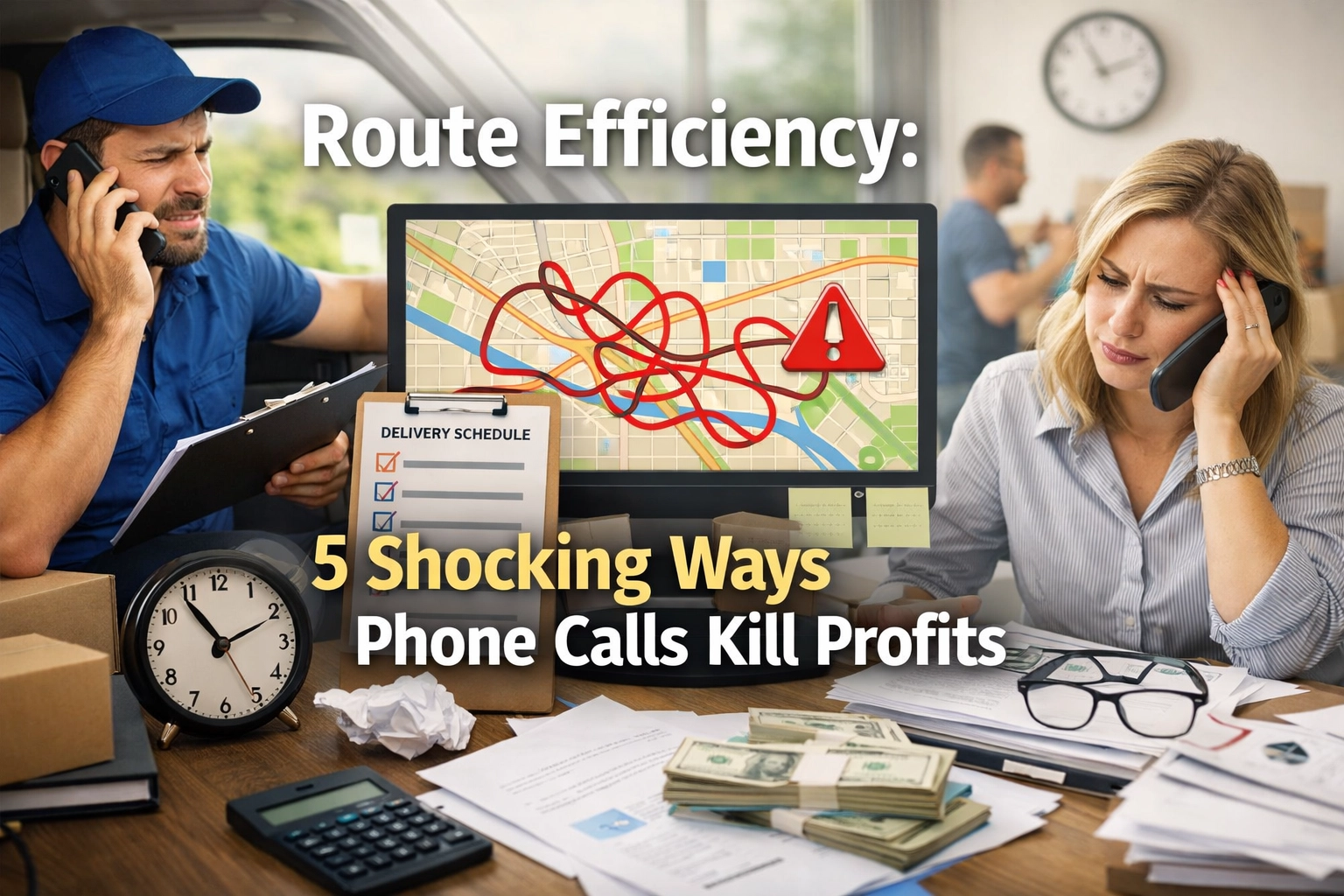
Route Efficiency: 5 Shocking Ways Phone Calls Kill Profits
You are lying to yourself. You think that being accessible to your customers at every second of the day is the hallmark of a great business owner. You believe that answering your cell phone while you are white-knuckling the steering wheel of your service van is a sign of dedication. You are wrong. It is a sign that you are sabotaging your own bank account.
Every time that phone rings and you pick it up, your route efficiency takes a hit that you cannot recover. You are not being a hero. You are being a bottleneck. You are the reason your technicians are frustrated, your fuel bill is skyrocketing, and your profit margins are thinner than a worn-out head gasket.
Field service is a game of minutes and miles. When you stop to talk, the clock does not stop with you. The overhead keeps ticking. The insurance premiums keep mounting. The sun keeps moving across the sky. By the time you hang up that “quick” five-minute call, you have lost fifteen minutes of momentum. Do that four times a day and you have flushed an entire hour of billable time down the toilet.
There is a better way. It is time to stop pretending that you can be a dispatcher, a technician, and a CEO all at the same time. You are failing at all three because you refuse to let go of the one tool that is killing your business: your phone.
Is Your Phone Actually an Expensive Paperweight?
Here is the problem: route efficiency is not just about having a GPS on your dashboard. It is about the flow of work from one job to the next without friction. Phone calls are the ultimate friction. They are the grit in the gears of your operation.
Think about your last Tuesday. You had five jobs lined up. You were on track. Then, at 10:15 AM, a “quick” call came in from a customer who wanted to argue about a quote from three weeks ago. You took the call. You pulled over into a gas station parking lot because you could not hear them over the engine. You spent twenty minutes digging through your memory because you did not have their file in front of you.
By the time you got back on the road, traffic had picked up. You hit three extra red lights. You arrived at your next job twenty-five minutes late. That delay cascaded through the rest of your day. Your last customer was furious because you showed up at 5:30 PM instead of 4:00 PM. You ended up giving them a ten percent discount just to keep them from leaving a one-star review.
That single phone call did not just cost you twenty minutes. It cost you a discount, your reputation, and your sanity. That is how phone calls destroy route efficiency.
1. The Fifteen-Minute Ghost of Every Interaction
You think a call takes five minutes. It never does. There is the time spent answering, the time spent talking, and then the “ghost time” spent getting back into the flow of your actual work. In the world of HVAC and Pest Control, this ghost time is a profit killer.
When you are focused on a route, your mind is on the next stop. You are thinking about the tools you need, the gate code you have to remember, and the specific problem the customer reported. When the phone rings, that mental map is wiped clean. You have to switch contexts immediately.
The brutal reality is that it takes the human brain an average of twenty-three minutes to return to deep focus after a distraction. Even if you are just driving, your route efficiency drops because you are no longer proactive. You are reactive. You miss the turn. You forget to check the traffic app for the accident three miles ahead. You become a passive participant in your own schedule.
If your technicians are the ones answering the calls, the situation is even worse. You are paying them a high hourly wage to perform skilled labor. Every minute they spend talking to a lead or a complaining customer is a minute you are paying for office work at technician rates. That is a recipe for bankruptcy.

2. The “Just One More Stop” Trap
We have all done it. You are on your way to a scheduled maintenance call when a “high-priority” emergency call comes in. Because you are the one answering the phone, you feel the pressure to say yes. You tell yourself that you can squeeze it in. You think you are increasing your revenue for the day.
In reality, you are detonating your route efficiency. You turn a logical, tight route into a zig-zag across the city. You send your van twenty miles out of the way for a fifty-dollar service call, ignoring the three hundred-dollar job that was right next to your original destination.
When you don’t have a buffer between the phone and the driver, every whim of a customer becomes a command for the vehicle. This is where the gas tank leak happens. You are burning fuel and wearing out tires because you lack the discipline to say “no” or the systems to schedule that call for tomorrow when you are actually in that neighborhood.
Your Remote Office Space (YROS) sees this pattern every day. Owners think they are being flexible. They are actually just being disorganized. True route efficiency requires a gatekeeper who can look at the map, look at the schedule, and place the new job where it makes sense, not just where the loudest customer wants it.
3. The Information Gap and the Return Trip
What happens when you answer a call while you are on a rooftop in 95-degree heat? You don’t take notes. You don’t update the CRM. You don’t check the parts inventory. You say, “Yeah, I’ll be there,” and you hang up.
Then you show up at the job site. You realize you don’t have the right filter. You realize the customer actually has a three-phase system and you only brought parts for a single-phase. Now you have to leave the job site, drive to the supply house, and drive back.
Your route efficiency has just plummeted to zero. You have turned one stop into three. This happened because the phone call was handled in a vacuum. There was no intake process. There was no verification of the job requirements.
If that call had gone to Your Remote Office Space, a professional would have gathered the model number, checked the history, and ensured that the technician had everything they needed before the van ever left the driveway. You cannot achieve route efficiency if you are constantly backtracking to fix mistakes made during a distracted phone call.
4. The Customer Experience Fallacy
You think customers love that you answer the phone. They don’t. They love results. They love it when you show up on time. They love it when you fix the problem on the first visit. They love it when your communication is clear and professional.
When you answer the phone while you are out in the field, you sound distracted. You sound unprofessional. The customer can hear the wind, the traffic, or the clanking of tools in the background. This does not build trust. It makes you look like a “man in a van” rather than a legitimate business.
Worse, while you are talking to a new lead, the customer you are currently serving is watching you. They are paying for your time. They see you leaning against your truck talking on the phone instead of fixing their AC. They feel neglected.
This leads to “Where are you?” calls from your existing clients. Those calls take up even more time. It is a vicious cycle. You answer the phone to get new business, which causes you to be late for current business, which causes current business to call you to complain, which makes you even later. Your route efficiency is sacrificed on the altar of “good customer service” that is actually anything but.
5. The Fatal Domino Effect of the Late Arrival
Route efficiency is a house of cards. If the first job of the day starts thirty minutes late because you were on the phone with a vendor, the entire day is compromised. In the trades, especially Pest Control and HVAC, windows are tight.
When you are late, you rush. When you rush, you make mistakes. When you make mistakes, you get callbacks. A callback is the ultimate enemy of route efficiency. It is a job that you have to do twice but only get paid for once. It requires you to disrupt a future route to fix a past error.
The stress of being behind schedule also takes a physical toll. You drive faster. You take more risks. You skip the safety check. One minor accident caused by the stress of a collapsing schedule can cost you more than a year’s worth of profit. The cost of a wrecked van and an insurance hike is the ultimate “hidden fee” of poor route efficiency.
ROI Calculation: The Cost of the “Owner-Operator” Phone Addiction
Let’s look at the actual numbers. If you think you are saving money by not hiring help, you need to see this math.
Assume your billable rate is $150 per hour.
Assume you spend 90 minutes a day on “quick” calls and the resulting administrative “ghost time.”
- Daily Loss: 1.5 hours x $150 = $225
- Weekly Loss (5 days): $1,125
- Monthly Loss: $4,500
- Annual Loss: $54,000
This does not even account for the extra fuel spent on inefficient routes or the lost revenue from leads that you missed because you were already on the phone with someone else. Research shows that 85% of people whose calls aren’t answered will not call back. They call your competitor.
If you are missing just two jobs a week because you are on the phone or driving, and those jobs have an average ticket of $500:
- Lost Revenue: $1,000 per week
- Annual Lost Revenue: $52,000
Total Annual Cost of Handling Your Own Calls: $106,000.
You are paying over a hundred thousand dollars a year for the privilege of being stressed out and inefficient. Does that sound like a smart business decision? It’s time to stop.

In the Wild: The Story of “Too Busy” Bill
Bill owned a Pest Control company in the St. Louis Metro Area. He had three trucks on the road. Bill was proud of his “hustle.” He answered every call on his personal cell. He prided himself on being the guy who was always available.
By mid-2025, Bill was a wreck. His route efficiency was non-existent. His technicians were constantly calling him to ask where they should go next because the schedule changed every hour. Bill was so busy answering the phone that he stopped looking at the map. He was sending a tech from Alton to South County, then back to Granite City, then back to Kirkwood.
His fuel bill was $1,200 higher per month than it should have been. His technicians were quitting because they were tired of ten-hour days that only included five hours of actual work. Bill was “stepping over dollars to pick up pennies.” He was so focused on the $75 service call on the phone that he was losing $2,000 a month in technician turnover costs.
The breaking point came when Bill missed a call for a large commercial contract because he was under a crawlspace and didn’t have a signal. That contract went to a competitor who had a professional answering service. Bill realized that his “hustle” was actually a ceiling. He was the reason his business couldn’t grow.
Bill reached out to Your Remote Office Space. We took over his calls and his dispatching. We implemented a strict rule: no one in a truck answers a phone.
The result? Within three months, his route efficiency improved so much that his technicians were finishing their 8-hour days in 6.5 hours. He didn’t cut their pay; he gave them the option to take more jobs or go home early. They stayed and took more jobs. His revenue jumped 22% without adding a single new vehicle. Bill stopped being a dispatcher and started being an owner.
The Fix: How YROS Restores Your Route Efficiency
You don’t need a robot. You don’t need a complicated software suite that takes six months to learn. You need a human being who understands the trades and can manage your communication so you can manage your work.
Your Remote Office Space provides the buffer you need to reclaim your time and your profits. Here is how we fix the five problems we discussed:
- Eliminating the Ghost Time: We handle the calls, the scheduling, and the follow-ups. You or your technicians receive a clear, concise notification of the next job. No distractions. No context switching. Just work.
- Optimizing the Route: We don’t just “squeeze people in.” We use your dispatching software to ensure that new calls are placed in the most logical order. We protect your fuel budget and your technicians’ time.
- Closing the Information Gap: We perform a thorough intake. We get the model numbers. We check the history. We ensure the tech is prepared before they arrive. This eliminates the “return trip” profit killer.
- Professional Presence: Your customers get a calm, professional voice every time they call. No wind noise. No traffic. Just high-level service that builds your brand’s reputation.
- Maintaining the Dominoes: By managing the morning calls and the “emergency” interruptions, we keep your day on track. We proactively call customers if a tech is running ten minutes late, so the tech doesn’t have to deal with a frustrated client upon arrival.
This is not a luxury. This is a fundamental requirement for any field service business that wants to scale past the “one man and a truck” stage. If you are serious about route efficiency, you have to be serious about who is answering your phone.
Why You Are Still Hesitating
You might be thinking, “But nobody knows my business like I do.” You are right. And that is exactly why you shouldn’t be the one answering the phone. Your knowledge is too valuable to be wasted on “What time will you be here?” or “Do you take credit cards?”
Your job is to solve the complex problems, train your team, and grow the company. Every time you answer the phone to give a price on a standard tune-up, you are devaluing your expertise. You are acting like a $15-an-hour clerk instead of a $150-an-hour consultant.
You might also worry about the cost. Go back to the ROI calculation. YROS costs a fraction of the $106,000 you are currently losing. It is not an expense; it is a revenue generator. When your route efficiency increases, your capacity increases. When your capacity increases, your profit increases.
The Brutal Reality: You Have to Decide
You have two choices.
You can keep doing what you are doing. You can keep answering the phone while you drive. You can keep apologizing to customers for being late. You can keep watching your fuel bill eat your profits. You can keep being the bottleneck that prevents your business from ever reaching its potential.
Or, you can be pragmatic. You can admit that you cannot do it all. You can decide that your time is worth more than what you are currently getting for it. You can invest in a partner that speaks your language and understands your world.
Your Remote Office Space is that partner. We aren’t a massive, faceless call center. We are a team of professionals who specialize in supporting field service businesses like yours. We know HVAC. We know Pest Control. We know that every minute on the road counts.
Stop letting your phone kill your profits. Stop pretending that your “hustle” is helping when it is actually hurting. Reclaim your route efficiency and take your life back.

Frequently Asked Questions
Will my customers know they are talking to a remote service?
No. We represent your brand exactly how you want us to. We use your software, follow your scripts, and act as a seamless extension of your office. To your customers, we are just your highly professional office staff.
Can you handle emergency dispatching?
Absolutely. We follow your specific protocols for what constitutes an emergency. We can contact your on-call technicians directly or follow your priority list to ensure that the most urgent jobs get handled without blowing up your entire route efficiency for the day.
Do you work with my current software?
Yes. We are experienced with the major tools used in the trades, from ServiceTitan to Housecall Pro and everything in between. We don’t want to change how you work; we want to make your work more efficient.
What if I only have one or two trucks?
That is actually the best time to start. Building these systems early allows you to scale without the “growing pains” that destroy most small businesses. You don’t have to wait until you are drowning to get a life raft.
How fast can we start?
We can typically get your account set up and start taking calls within a week. We take the time to learn your specific business needs so that we can provide value from the very first interaction.
Take Action Today
You don’t need to be Superman. You need to be a business owner. Let us handle the noise so you can focus on the work.
Click the link below to schedule a 30-minute discovery call. Let’s look at your current “phone habit” and see exactly how much money we can put back in your pocket by fixing your route efficiency.
Schedule Your 30-Minute Strategy Call
You have to decide. You can be the guy on the phone, or you can be the guy with the profitable business. You cannot be both. Be pragmatic. Be profitable. Choose Your Remote Office Space.
Related Blog
- Route Density: The Unsexy Metric That Decides Your Profit Margin
- Dispatching Systems: Why “Schedule Tetris” Burns Fuel and Wrecks Your Day
- The Callback Tax: How Repeat Trips Destroy Route Efficiency
- Emergency Calls vs. Smart Scheduling: How to Stop Detonating Your Route
- Technician Downtime: The Hidden Hours You’re Paying For
- Stop Zig-Zagging: 5 Route Optimization Rules for Trades Businesses
- The “Last Minute Add-On” Problem: When One Job Ruins the Whole Board
- GPS Isn’t a System: The Dispatch Workflow That Actually Improves Routes
- The Phone Is Your Prison: How Call Interruptions Keep You Stuck at 1–3 Trucks
- Field Service Customer Updates: The Simple System That Stops “Where Are You?” Calls
- The “Just Text Me” Lie: Why SMS Dispatch Creates Operational Chaos
- Team Bottlenecks: Why Capable Techs Freeze Without Clear Priorities
- Deep Work Blocks: How to Stop Being Everyone’s On-Call Help Desk
- Gatekeeper Setup: How to Protect Your Time Without Ignoring Customers
- Administrative Backlog: The Quiet Reason Your Profit Never Grows
- Invoicing Lag: The Cash Flow Leak That Makes You Feel Broke
- Cleaning Revenue: 3 Secrets to Incredible Fast Growth
- Warranty Claims Management: The 5-Figure Paperwork Leak
- Job Costing for Contractors: Busy Doesn’t Mean Profitable
- The Fuel Bill Lie: Why Your Trucks Cost More Than They Should
- Security System Workflows: 9 Brutal Powerful Fixes
- SOPs for Field Service: 1-Page Checklists That Stop Repeat Mistakes
- Intake Scripts That Work: How to Capture the Right Info Every Time
- The Autonomous Zone: How to Empower Staff Without Losing Control
- Hiring a Dispatcher vs. Outsourcing: The Real 5-Year Cost Comparison