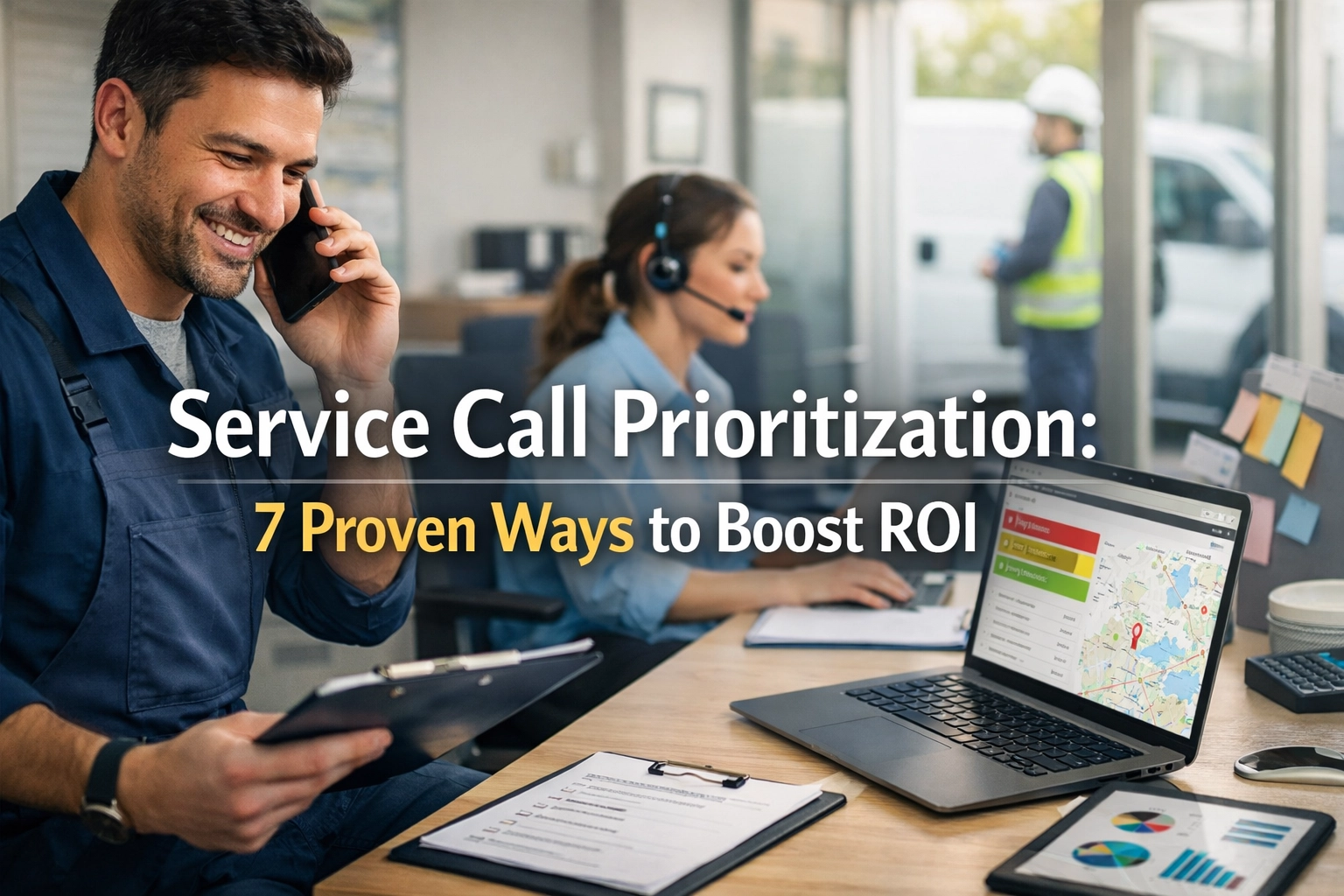
Service Call Prioritization: 7 Proven Ways to Boost ROI
You are running your business like a chaotic emergency room that treats a paper cut before a heart attack. It is a harsh truth, but you know it is true. You wake up, check your phone, and see sixteen missed calls. You start at the top of the list and work your way down because that feels fair. You think you are being a good business owner by helping the first person who called. You are wrong. You are actually sabotaging your profit margins and burning out your best technicians.
Service Call Prioritization is not about being nice. It is about being profitable. Every time you send a lead technician across town to handle a fifty dollar wasp nest while a two thousand dollar termite contract sits in the queue, you are lighting money on fire. You are missing the forest for the trees. You are choosing activity over achievement.

The Problem: The First-In First-Out Death Spiral
Most field service companies, especially in the pest control and HVAC worlds, operate on a first-in, first-out basis. It feels logical. It feels like good customer service. But in reality, it is a death spiral for your bottom line. When you treat every call with the same level of urgency, you lose control of your schedule. Your technicians end up spending more time behind the wheel than they do on a job site.
This lack of Service Call Prioritization creates a reactive environment. You are constantly putting out fires instead of building a fireproof business. Your customers are frustrated because your arrival windows are more like arrival suggestions. Your technicians are frustrated because their routes make no sense. You are frustrated because, despite the phone ringing off the hook, the bank account is not growing the way it should.
The brutal reality is that not all customers are created equal. A customer who has paid you for a recurring maintenance contract for five years is worth more than a one-time caller who is shopping for the lowest price. A job that requires specialized equipment and carries a high profit margin should always take precedence over a low-margin task that anyone could do. If you do not understand this, you will always be a slave to your ringing phone.
The Agitation: Stepping Over Dollars to Pick Up Pennies
What happens when you ignore Service Call Prioritization? You start stepping over dollars to pick up pennies. You send your top earner to a minor repair because they happened to be free, and then an hour later, an emergency call comes in from your biggest commercial account. Now your top earner is tied up, and you have to send a rookie to handle a complex issue. The rookie fails. The commercial account gets angry. You lose a ten thousand dollar annual contract because you wanted to finish a eighty dollar service call.
This is where it gets worse. Your technicians see the chaos. They see that you do not value their time or their expertise. They start to realize that their day is dictated by whoever yells the loudest on the phone, not by what makes sense for the company. They lose motivation. They stop looking for upsell opportunities. They just want to get through the day without you calling them to change their route for the fifth time.

The Worse Case: The Reputation Ruin
In the field service industry, your reputation is everything. When you fail at Service Call Prioritization, you fail at meeting expectations. You promise a three-hour window and show up in five. You cancel on a long-term client to chase a new lead. Word spreads. In small communities or niche industries like specialized pest control, a few bad reviews about your reliability can sink you.
Imagine a scenario where a local restaurant has a sudden infestation. They are a loyal client. They call you, but you are busy sending your crew to do routine residential sprays that could have been moved to tomorrow. The restaurant gets shut down by the health inspector. They do not just fire you; they tell every other restaurant owner in the city that you were not there when they needed you. That is the cost of poor Service Call Prioritization. It is not just the lost revenue of one day; it is the lost potential of an entire market.
In the Wild: The Tale of Two Pest Control Owners
Let us look at a real-world scenario. Meet Mike. Mike runs a pest control business in the St. Louis Metro Area. Mike is a “yes man.” Every time the phone rings, he says “we will be there.” His dispatching is a mess. His techs are driving from Alton to Chesterfield and back to Florissant in a single afternoon. Mike thinks he is a hero. He is actually earning less than minimum wage when you factor in his stress and overhead.
Then there is Sarah. Sarah uses Your Remote Office Space for her back-office support. Sarah has a strict Service Call Prioritization protocol. Her YROS team triages every call. High-value commercial clients and contract holders go to the front of the line. Routine sprays are batched by zip code. If an emergency call comes in, the YROS team knows exactly which low-priority residential call can be rescheduled without causing a riot.
Last July, during a massive heatwave, both Mike and Sarah saw a 40% spike in calls. Mike had two technicians quit due to burnout and lost three major commercial accounts because of delays. Sarah, on the other hand, saw her highest-grossing month ever. Her technicians were productive, her high-value clients were happy, and her YROS team handled the rescheduling of lower-priority jobs with professionalism. Sarah did not work harder; she worked smarter by focusing on Service Call Prioritization.
The Fix: 7 Proven Ways to Boost Your ROI
You need to stop guessing and start implementing a system. Here is how you reclaim your time and your profit through effective Service Call Prioritization.
1. Define Your Value Tiers
You cannot prioritize if you do not know what matters. You must categorize your services and your customers into tiers. Tier 1 should be your high-revenue, high-margin, or long-term contract clients. Tier 2 consists of standard recurring services. Tier 3 are the one-off, low-margin calls.
When a call comes in, your first step is to identify the tier. If a Tier 1 client has an issue, the schedule shifts to accommodate them. This is not being unfair; it is protecting the revenue that keeps your lights on. Your Remote Office Space can help you set up these tiers within your existing software like ServiceTitan or QuickBooks.
2. Implement a “First Call Resolution” Bonus
Service Call Prioritization is not just about the order of calls; it is about the quality. Every time a technician has to go back to a job site because they did not have the right part or did not finish the job, your ROI plummets. Prioritize jobs based on the likelihood of a first-call resolution.
Equip your team with the data they need before they arrive. If a technician is already near a Tier 1 job and has the parts on the truck, that job becomes the priority. Reducing “call-backs” is the fastest way to increase your capacity without hiring more staff.
3. Use Geographic Batching to Kill Windshield Time
Your trucks are not profit centers when they are on the highway. They are profit centers when they are in a customer’s driveway. Service Call Prioritization must account for geography.
Stop sending techs across town for minor issues. Use a system where “anchor jobs” (high-value or long-duration) dictate the route, and smaller, lower-priority calls are filled in around them based on proximity. If a low-priority call is thirty miles away from everything else, it waits until you have a cluster in that area.
4. Protect Your Maintenance Contracts
Your recurring revenue is the lifeblood of your business. It is what makes your company sellable in the future. Yet, many owners deprioritize these “boring” routine calls in favor of the “exciting” new lead. This is a mistake.
Your Remote Office Space ensures that your contract clients never feel ignored. We prioritize their scheduled maintenance and ensure that if an emergency arises for them, they are moved to the top of the list. Loyal customers should always feel like VIPs.

5. Establish Emergency Triage Protocols
Not every “emergency” is an emergency. A homeowner seeing one spider is an emergency to them, but it is not a business emergency for you. You need a set of questions to triage the actual urgency of a call.
- Is there an immediate threat to property?
- Is there a health and safety risk?
- Is this a commercial client whose operations are halted?
If the answer is no, the call is scheduled for the next available slot, not squeezed into an already full day. Your YROS team can handle these difficult conversations for you, protecting your time while still making the customer feel heard.
6. Leverage Human-Based Remote Support (YROS)
You cannot do Service Call Prioritization while you are under a sink or in an attic. You need a dedicated person whose only job is to watch the board and make the right calls.
This is where Your Remote Office Space shines. We provide human-based support that understands the nuances of your specific industry. We do not just read a script; we understand that a “termite swarm” in May is a different priority level than a “regular checkup.” We manage your dispatching, handle the rescheduling, and keep your technicians focused on billing hours, not checking their GPS.
7. Analyze the Data Weekly
Service Call Prioritization is a living process. Every week, you should look at your revenue per hour and your technician utilization rates. Which calls were the most profitable? Which ones cost you the most in travel time?
Use this data to refine your prioritization rules. If you find that a certain type of call consistently results in low ROI, move it down the priority list or raise the price. You have to be ruthless with your data if you want to be profitable.

ROI Calculations: The Real Math of Prioritization
Let us look at the numbers. Most owners do not realize how much they are losing to poor dispatching.
The “Chaos” Model (No Prioritization):
- Technician Hourly Rate (Fully Burdened): $45
- Average Revenue per Hour: $120
- Daily Windshield Time: 3 hours
- Billable Hours: 5 hours
- Daily Revenue: $600
- Daily Labor Cost: $360
- Daily Gross Profit: $240
The “YROS Optimized” Model (Service Call Prioritization):
- Technician Hourly Rate (Fully Burdened): $45
- Average Revenue per Hour: $155 (Focusing on Tier 1 & 2)
- Daily Windshield Time: 1.5 hours
- Billable Hours: 6.5 hours
- Daily Revenue: $1,007.50
- Daily Labor Cost: $360
- Daily Gross Profit: $647.50
By simply implementing Service Call Prioritization and reducing windshield time while focusing on higher-value jobs, you have increased your daily gross profit per technician by $407.50.
Multiply that by 5 technicians and 22 working days per month:
- Monthly Increase in Profit: $44,825
- Annual Increase in Profit: $537,900
You are not looking for more customers. You are looking for a better way to handle the ones you have. The math does not lie. You are leaving half a million dollars on the table because you are afraid to tell a low-value caller “not today.”
The Fix: Get Out of the Way
The biggest hurdle to Service Call Prioritization is usually you. You think no one else can handle your customers. You think you need to be the one to decide who gets seen first. But your involvement is the bottleneck.
You need to hand off the dispatching and prioritization to a team that is trained to look at the numbers, not the emotions. Your Remote Office Space is that team. We take the burden of the “no” off your shoulders. We manage the expectations. We protect your technicians.
While you are out in the field or trying to scale your business, your YROS team is back in the “office” ensuring that every minute of your day is spent on the highest ROI tasks possible. We are not a call center; we are your remote office. We speak your language. We understand the trades. We know that in the heat of a St. Louis summer, every minute counts.
Stop Trying to Be Superman
You cannot be the lead tech, the salesman, the accountant, and the dispatcher all at once. When you try to do it all, you do it all poorly. Service Call Prioritization is the first step toward building a real company instead of just a high-stress job.
Decide right now. Do you want to continue being a slave to your phone, or do you want to run a profitable, organized business? The choice is simple, but it requires you to be pragmatic. It requires you to stop making excuses about why “my business is different.” It isn’t. Every field service business thrives or dies based on how it manages its time.
Stop letting the loudest voices dictate your profit. Start prioritizing your service calls based on ROI. Let us help you build the systems that will actually set you free.
Be pragmatic. Be profitable. Stop the chaos.
Common Questions About Prioritization
Will I lose customers if I don’t see them immediately?
Yes, you might lose the low-value, high-maintenance customers who demand instant service for a bargain price. Let your competition have them. They will go broke trying to please them while you focus on the clients who actually pay your bills.
Can I really trust someone else to schedule my jobs?
If you have clear rules and protocols, yes. Your Remote Office Space works with you to define those rules. Once the system is in place, a trained remote professional can often make more objective, profitable decisions than an owner who is stressed out and distracted.
How long does it take to see results?
You will see a reduction in fuel costs and an increase in billable hours within the first two weeks of implementing a strict Service Call Prioritization system. The financial impact is almost immediate.
Do I need expensive software for this?
While tools like ServiceTitan help, you can implement prioritization with a simple spreadsheet and a dedicated person managing the calls. The “system” is more important than the software.
Is YROS only for large companies?
No. In fact, small companies with 1-3 technicians often see the biggest percentage-based ROI because they have the most to lose from inefficiency. When you only have one truck, that truck needs to be in the right place at the right time.
Stop waiting for the “right time” to fix your business. The right time was six months ago. The second best time is today. Reach out to Your Remote Office Space and let us help you reclaim your schedule.
Related Blogs
- Dispatch Efficiency: 9 Route Rules to Cut Windshield Time Fast
- Technician Utilization: 7 Fixes to Stop Paying for Drive Time
- Revenue Per Hour: The Field Service KPI That Exposes Your Leaks
- Service Call Triage Script: The 12 Questions That Separate Emergencies From Noise
- The Scheduling Board is a Profit Tool: How to Run It Like a CEO
- Field Service Profit Margins: 6 Ways Dispatch Decisions Kill or Save Your Net
- Emergency Fees That Don’t Start a Fight: How to Price “Right Now” Calls
- Low-Margin Calls Are Lying to You: When to Raise Prices or Stop Offering Them
- Technician Mix Strategy: Stop Sending Your Best Tech to $80 Work
- Pest Control Operations: The Route Optimization Playbook for Peak Season
- Commercial Accounts First: How to Protect High-Value Pest Control Contracts
- Recurring Service Routes: How to Batch Sprays Without Losing Customers
- The Hidden Revenue Leak: Why Your Technicians Shouldn’t Be Your Office Staff
- After-Hours Calls: 3 Shocking Reasons You’re Losing Money
- Admin Transition Path: 7 Secrets to Stop Being Overworked
- Virtual Staff Confidentiality: 5 Critical Rules for YROS