
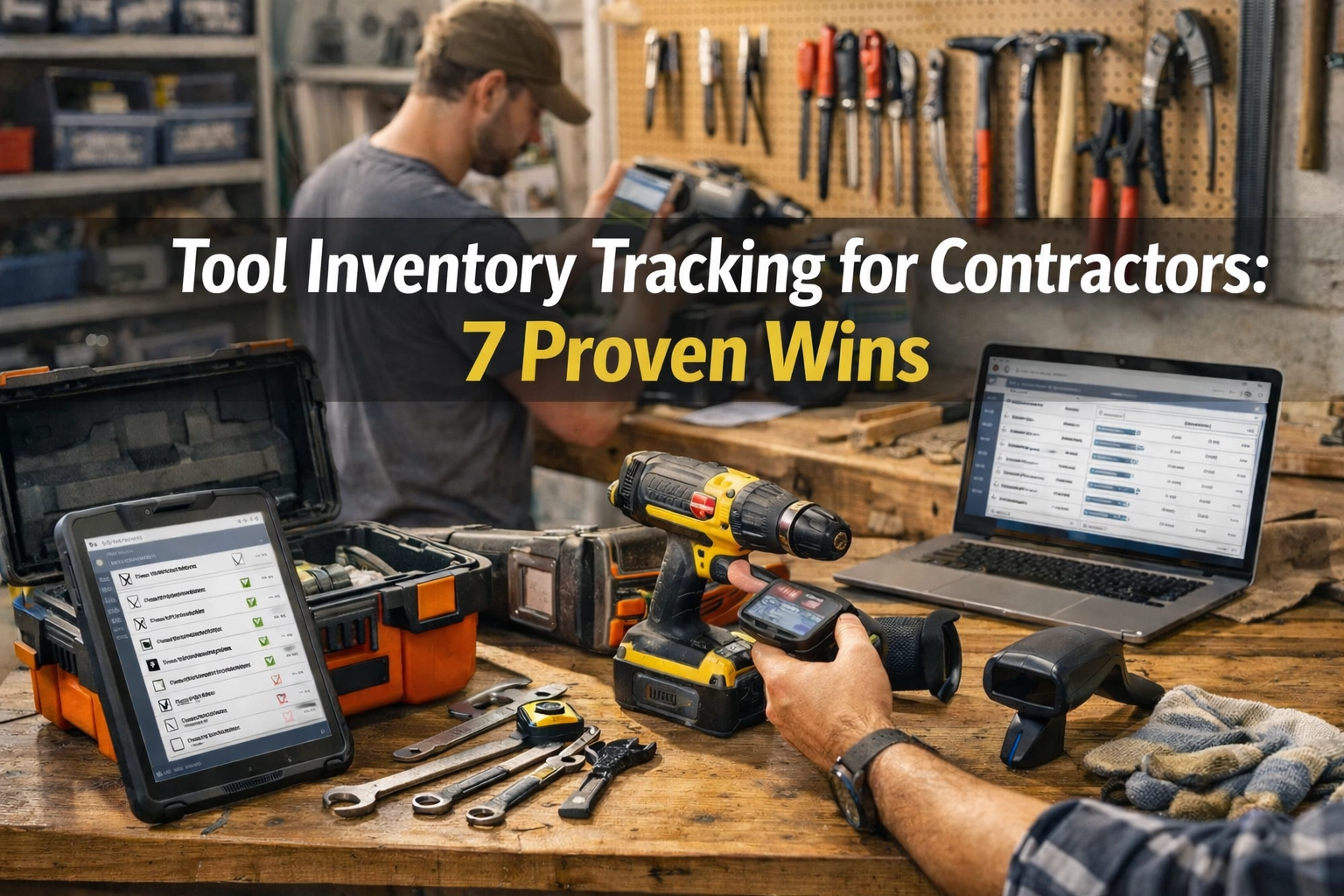
Tool Inventory Tracking for Contractors: 7 Proven Wins
You are losing thousands of dollars every year and you are too busy to notice. You think tool inventory tracking for contractors is a luxury for the big guys with a fleet of fifty trucks. You are wrong. You think that because you have a small team, you can keep track of everything in your head or on a stained notepad in the front seat of your truck. You are lying to yourself.
Every time a technician hits a job and realizes they are missing a specific crimping tool, you lose money. Every time a crew leader drives to the supply house to buy a tool you already own but cannot find, you lose money. Every time a piece of expensive equipment vanishes because nobody was held accountable, you lose money.
This is not “just part of the trades.”
This is avoidable.
And tool inventory tracking for contractors is how you stop it.
There is a better way to run your business. It is not about being a nice guy. It is about being a profitable one. It is about implementing tool inventory tracking for contractors so you can actually see where your overhead is going. If you cannot track it, you cannot manage it. If you cannot manage it, you are just waiting for the day your bank account hits zero.
The High Cost of “Where Is My Drill?”
Here is the problem: you treat tools like disposable items. You assume a few lost drills or a missing saw here and there is the cost of doing business. It is not. It is a symptom of a deeper breakdown in how you run the day-to-day.
When you do not prioritize tool inventory tracking for contractors, you are telling your team, loud and clear, that your resources do not matter. You are also telling the honest people on your crew that the sloppy ones will never get called out.
The brutal reality is that disorganized inventory is a massive revenue leak. Let us look at the math.
If a technician spends 15 minutes a day looking for a tool or driving to get a replacement, that is 1.25 hours per week. At a billable rate of $100 per hour, those 1.25 hours represent $125 per week ($6,500 annually) per technician.
Now multiply it:
- 5 technicians = $32,500 per year
- 8 technicians = $52,000 per year
- 10 technicians = $65,000 per year
That is not “a few drills.” That is a truck payment. That is a shop expansion. That is payroll you could actually breathe around.
This trap convinces you that you are too busy to set up a system. You say you will do it during the slow season. But when the slow season hits, you are exhausted and worried about cash flow, so you push it again.
Result: you keep bleeding money and calling it normal.
Tool inventory tracking for contractors is not about being fancy. It is about not being the person who buys the same hammer three times in the same quarter.

What Tool Inventory Tracking for Contractors Actually Means
Let us make this practical. Tool inventory tracking for contractors is a simple set of habits and records that answer a few questions fast:
- What tools do you own?
- Where are they right now?
- Who had them last?
- What condition are they in?
- What needs repair, replacement, or restocking?
You can do tool inventory tracking for contractors with spreadsheets, QR codes, barcodes, or an asset platform. The “best” system is the one your crew will use on a Tuesday afternoon when they are behind schedule.
The Fix: build a system that is fast, repeatable, and enforced.
That is it.
Now let us talk about the 7 wins you get when you finally take tool inventory tracking for contractors seriously.
Win 1: Real-Time Visibility Across Multiple Sites
Why are you still calling three different foremen to find out who has the heavy duty rotary hammer? You should know the answer in five seconds.
One of the biggest wins of tool inventory tracking for contractors is real-time visibility. When you have a centralized system, you know which truck, tech, job site, or storage cage an item is assigned to at all times.
This visibility prevents delays that ripple through your entire day.
Imagine a high-stakes HVAC install happening in Alton, Illinois. The crew needs the vacuum pump, but it is sitting in the back of a van parked at a residential maintenance call in St. Louis. Without a system, your lead installer burns 20 minutes calling around. Then he burns 45 minutes meeting the other van.
That is over an hour of wasted high-value labor. And you still have to finish the install.
With tool inventory tracking for contractors, that vacuum pump would have been checked out to the Alton job site the night before. If it was not there, the system would have flagged it before anyone rolled out.
You move from reactive to proactive.
You stop being a dispatcher for missing tools.
You start being a manager of productive assets.
Your Remote Office Space (YROS) helps contractors set up the tracking workflow and the follow-through so you are not the one playing detective.
Win 2: Reduction of Tool Loss and Theft
This is where it gets worse: not everyone on your team is as careful as you want to believe. Even when nobody is “stealing,” tools walk off into personal garages when there is no accountability.
If a technician knows no one checks the logs, they are less likely to make sure everything makes it back to the van. If a crew knows nobody audits the cage, tools disappear. Slowly, then all at once.
The Fix: a real check-in and check-out process.
When you implement tool inventory tracking for contractors, every asset is assigned to a specific person, vehicle, or site. If a $500 laser level goes missing, you know exactly who had it last.
Accountability changes behavior.
When employees know the tools are tracked, they treat them with more respect. And the honest techs stop feeling like they are working in a free-for-all.
In the Wild: A plumbing contractor in the St. Louis metro area noticed his annual spend on small power tools was nearly $15,000 for a three-man crew. He assumed the tools were wearing out. Once he started tool inventory tracking for contractors, he discovered two employees were “forgetting” tools at job sites, then grabbing them later for side jobs. After tracking was enforced, his replacement costs dropped by 70% in six months.
That is $10,500 back in his pocket.
Win 3: Automated Stockout Prevention (Yes, Tools and Consumables)
You cannot finish the job if you do not have the materials. While tools are long-term assets, your “inventory” also includes consumables that are just as vital.
Tool inventory tracking for contractors should extend to critical stock levels for things like:
- Wire nuts, connectors, and staples
- Fittings and valves
- Blades, bits, and sandpaper
- Fasteners, anchors, and adhesives
- Tape, caulk, and spray foam
- Common PPE
Nothing kills profit faster than a tech sitting on a job site waiting for a delivery of basic parts.
The Fix: minimum thresholds and alerts.
A centralized system lets you set minimum levels. When stock hits a preset low, the system triggers a reorder reminder.
You stop relying on memory and “a quick glance at the shelf.” You are a contractor, not a warehouse manager.
With tool inventory tracking for contractors managing tools and consumables together, your crews stay equipped and you avoid those emergency retail runs where you overpay because you are out of time.

Win 4: Lowering Your Operational Expenses
Buying what you already own is the height of business stupidity. Yet without tool inventory tracking for contractors, it happens constantly.
You see a deal on a new reciprocating saw, buy it, and then find two working ones buried under scrap in the warehouse. You buy another extension ladder because you cannot find the one you already own. You replace a pressure washer because you assume it is “gone,” and then it shows up behind the shop three weeks later.
Tool inventory tracking for contractors creates data you can actually act on:
- What you truly use
- What sits untouched
- What breaks all the time
- What is worth upgrading
- What you can sell
The Fix: use the data to cut waste.
If you have ten drills but only ever use six at a time, sell four. That is instant cash flow. Put it toward better equipment or debt.
Tool inventory tracking for contractors also helps you track maintenance and repair patterns. If one brand of jackhammer is always down, the pattern shows up. You stop guessing and start buying smarter.
That is how small contractors become stable contractors.
Win 5: Significant Labor and Time Savings
What is your time worth? If you are the owner, it should be worth $150 to $200 per hour in terms of selling, hiring, and keeping the work coming.
Every minute you spend counting hammers is a minute you are not closing a $20,000 contract.
Tool inventory tracking for contractors saves you from the manual audit nightmare.
By using QR labels, barcodes, or simple digital check-outs, the updates happen in the field, in real time. Techs do the work as they load and unload vans. That removes the need for “inventory day” where you shut down production and pay everyone to stand around and count items.
Let us price that out.
A crew of five earning $30 per hour costs you $1,200 in labor for an eight-hour inventory day. Add the lost revenue of at least $4,000 in billable work. Total hit: $5,200.
And the craziest part is you are still not sure the count is accurate.
With a system, your inventory is always live. Tool inventory tracking for contractors means you can see what you own and where it is from your phone.
No shutdown days.
No guessing.
No chaos.
Win 6: Accurate Job Costing and Profitability
If you are not factoring wear and tear of tools into your pricing, you are undercharging.
Most contractors look at labor and materials. They forget:
- Equipment depreciation
- Repairs and maintenance
- Replacement cycles
- Downtime when equipment is missing or broken
Tool inventory tracking for contractors gives you a clear view of true project cost. You can assign equipment usage to jobs and see which kinds of jobs grind your tools into dust.
That matters for trades like:
- HVAC installs that require specialized equipment
- Plumbing sewer jobs that beat up your machines
- Electrical commercial work with heavy testing gear
- Roofing repair crews that chew through blades and fasteners
At YROS, we see contractors who think they are making 40% margins. Once tool usage and replacement reality show up, they are closer to 20%.
That gap is the difference between “stable” and “one bad month away from panic.”
Tool inventory tracking for contractors is not busywork. It is how you stop undercharging without even realizing it.

Win 7: The Competitive Edge of Mobile Field Access
Your team is in the field, not in an office. Any tool inventory tracking for contractors system that requires someone to come back to the shop, fill out a form, and file it somewhere is dead on arrival.
They will forget.
They will rush.
They will “do it later.”
Later never happens.
The Fix: mobile-first updates.
Modern systems let techs scan a QR code, snap a photo, and check an item in or out in seconds. The data is accurate because it is captured at the moment it happens.
When your team has this access, coordination gets easier:
- A tech checks if another truck has a part before driving across town
- A foreman sees if the specialized tool is on-site before scheduling the work
- You stop sending crews out with half the gear they need
Clients notice. You look organized. You look professional. In a world full of “chuck in a truck,” tool inventory tracking for contractors is part of what wins you the higher-end work.
Why You Are Still Resisting
You think this sounds like a lot of work to set up.
You are right. It is work.
You have to catalog assets, label tools, assign locations, and train your team. But you have to decide what hurts more:
- A one-time push to get organized
- A perpetual leak that keeps costing you thousands
Tool inventory tracking for contractors is one of those systems that feels annoying until it is done. Then you wonder how you ever lived without it.
Here is the real reason you resist: you are hiding behind “busy.”
You are doing a million little things to avoid the one big thing. You are using the chaos as a reason not to fix the chaos.
If you cannot walk away for a week without the whole place falling apart because nobody knows where the tools are, you do not own a business. You own a stressful job.
Tool inventory tracking for contractors is one of the fastest ways to stop being the bottleneck.
The Fix: A Simple Setup Plan You Can Actually Execute
You do not need perfection. You need consistency.
Here is a straightforward setup that works for most contractors.
Step 1: Pick a tool list you can finish
Start with the stuff that hurts:
- Power tools
- Diagnostic equipment
- Specialty tools
- High-theft items
- Anything $200+
Tool inventory tracking for contractors does not have to start with every screwdriver. Start where the money is.
Step 2: Choose identifiers your team will not ignore
- QR labels on cases and handles
- Color codes by truck or crew
- Simple numbering for non-scan items
The goal is speed, not beauty.
Step 3: Define “home locations”
Every tool needs a default:
- Truck 1, Truck 2, Truck 3
- Shop Cage A, Cage B
- Job Site Assignment
Tool inventory tracking for contractors fails when tools have no home.
Step 4: Set rules that are not optional
Examples:
- Tools get checked out at the start of the shift
- Tools get checked in at the end of the shift
- Anything missing gets flagged the same day
- Repeated issues trigger a conversation
You are not being mean. You are running a business.
Step 5: Audit like you mean it
Weekly quick checks beat quarterly shutdowns. A 20-minute weekly audit keeps the system honest.
Tool inventory tracking for contractors only works if people believe you will notice.
How Your Remote Office Space Changes the Game
You do not have to do this alone. You probably should not.
You are likely the best salesperson or lead tech in your company. Your time is too valuable to spend building spreadsheets and chasing down tool assignments.
This is where Your Remote Office Space (YROS) comes in.
We provide the day-to-day back office support contractors need without the overhead of hiring in-house. We help implement tool inventory tracking for contractors by:
- Building your tool catalog and baseline list
- Setting up labels, naming rules, and locations
- Keeping records updated as tools get added or retired
- Following up when items are not checked back in
- Keeping reorder reminders moving so crews are not stuck
We do not just point at software and walk away. We help you build the routine that makes tool inventory tracking for contractors actually stick.
We also play the role you should not have to play. We can do the follow-up when someone “forgets” to check something back in. That keeps accountability real without you having to be the bad guy every day.
You win back time.
You reduce waste.
You stop funding the chaos.

The Compound Effect of Small Improvements
Tool inventory tracking for contractors is not just about tools. It is a culture shift.
When you start caring about where the cordless drill went, your team starts caring about the bigger stuff too:
- Leaving job sites clean
- Protecting equipment
- Finishing work right the first time
- Communicating issues early
Efficiency compounds.
Saving an hour a week leads to more jobs per month. More jobs per month leads to higher revenue. Higher revenue leads to better equipment and better people.
It starts with deciding you are done accepting chaos as normal.
The Path Forward
Stop making excuses. Stop being the bottleneck.
You need tool inventory tracking for contractors that works while you sleep. You need support that keeps the system moving without adding full-time overhead. You need to treat equipment like the investment it is, not like a disposable cost.
Reach out to us. We will look at your current situation and help you turn it into something clean, trackable, and profitable.
We speak your language. We protect your revenue. We restore your life.
Schedule Your 30-Minute Strategy Session Now
Stop letting your profits walk out the door in the back of a van. Tool inventory tracking for contractors is how you lock it down and run a tighter operation.
Frequently Asked Questions
Is tool inventory tracking for contractors expensive to set up?
Yes. Up front. But the cost of not doing it is bigger, and it never stops. You are already paying for it through wasted labor and replacement purchases. Tool inventory tracking for contractors turns that ongoing loss into a one-time setup and a simple routine.
Will my technicians actually use it?
They will if it is fast and enforced. Tool inventory tracking for contractors fails when it is slow, optional, or confusing. Mobile-first scanning and clear rules make it doable. Regular audits make it real.
Can YROS help with other parts of my business?
Absolutely. We handle phones, emails, scheduling, customer follow-up, project coordination, and basic bookkeeping support. If it keeps your day from turning into chaos, we can usually take it off your plate.
How long does it take to see results?
Fast. You will see behavior change as soon as people know the tools are tracked. Financial results typically show up within 30 to 90 days as replacement costs drop and crews stop wasting time.
What software do I need?
It depends on your size and how you run jobs. Some contractors do fine with a simple QR-based system. Others need a full asset platform. The best tool inventory tracking for contractors setup is the one your team will actually use.
Related Blogs
- 7 Operations Systems Every Small Business Must Have
- How to Document Your Business Processes When They’re All in Your Head
- Operations Management for Small Businesses: The COO-Level Support You Can Actually Afford
- From Chaos to Calendar: Scheduling Systems for Growing Contractors
- Why Contractors Keep Buying Tools They Already Own
- The Hidden Cost of Missing Tools in Small Trade Businesses
- How Tool Loss Quietly Kills Contractor Profit Margins
- Why Every Contractor Needs a Real Tool Check-In System
- The Tool Accountability Problem Most Owners Ignore
- How Poor Tool Tracking Creates Expensive Job Delays
- What Missing Equipment Really Costs Your Contracting Business
- Why Contractors Waste Thousands Replacing Tools They Never Lost
- The Simple Tool Tracking Rules That Stop Daily Chaos
- Asset Management for Trades: Where Your Money Is Really Going
- Construction Inventory Systems for Small Contractors
- Why Your Vans Feel Understocked Even When You Own the Tools
- How Contractors Track Tools Across Multiple Job Sites
- The Van Stocking Problem That Wastes Billable Hours
- How Tool Tracking Improves Crew Readiness Before the Day Starts
- Why Contractors Need “Home Locations” for Every Tool
- How to Stop Playing Detective for Missing Jobsite Equipment
- The Multi-Truck Tool Tracking Problem No One Wants to Fix
- Why Specialty Tools Need More Accountability Than Consumables
- Reduce Tool Theft in Your Contracting Business Without Creating Drama
- The Real Difference Between Tool Theft and Tool Neglect
- How Accountability Changes Crew Behavior Around Equipment
- Why Honest Technicians Hate Sloppy Inventory Systems
- The Tool Loss Patterns You Miss When Nothing Is Tracked
- How Contractors Cut Replacement Costs With Better Accountability
- Why “Somebody Must Have Taken It” Is Not a System
- The Crew Culture Problem Hidden Inside Missing Tools
- What to Do When Tools Keep Walking Off the Job Site
- The $10,000 Tool Replacement Problem Most Owners Normalize
- How Contractors Lose Billable Hours Looking for Tools
- The 15-Minute Tool Search That Destroys Your Day
- Why Tool Tracking Is Really a Labor Efficiency System
- The Cost of Sending Crews Out Half-Prepared
- How Tool Inventory Tracking Saves Labor Without Cutting Headcount
- Why Inventory Day Is a Terrible Way to Run a Contracting Business
- The Shutdown Audit Problem: Why Manual Counts Cost Too Much
- How Mobile Tool Tracking Saves More Than It Costs
- Why Contractors Need Live Inventory, Not End-of-Month Guessing
- The Hidden Revenue Loss From Small Daily Tool Delays
- Why Tool Usage Belongs in Your Job Costing System
- The Equipment Costs Contractors Forget to Price Into Jobs
- How Missing Tool Data Causes Underbidding
- The Profit Margin Impact of Equipment Wear and Tear
- How Specialized Equipment Changes True Job Profitability
- Why Some Jobs Destroy More Tools Than Others
- The Contractor’s Guide to Equipment Depreciation in Real Life
- How Better Tool Data Helps You Buy Smarter
- What Tool Repairs Reveal About Your Operating Costs
- Why Accurate Asset Tracking Makes Better Pricing Decisions
- Consumable Inventory for Contractors: Stop Running Out of Basic Materials
- Minimum Stock Levels Every Trade Business Should Set
- Why Emergency Supply Runs Kill Margin
- The Restocking Habits That Keep Crews Productive
- How Contractors Track Tools and Consumables Together
- The Hidden Cost of “We Thought We Had More in the Van”
- How a Remote Office Team Helps Contractors Keep Inventory Under Control
- Why Tool Tracking Systems Fail Without Follow-Through
- What a Back Office Partner Can Do for Contractor Asset Tracking
- How YROS Helps Contractors Build Inventory Systems That Stick
- Why Contractors Need Accountability Support, Not Just Software
- The Difference Between Buying a Tracking Tool and Running a Tracking System
- How Contractors Get Organized Without Hiring More Office Staff
- The Operations Support Contractors Need to Protect Equipment and Profit