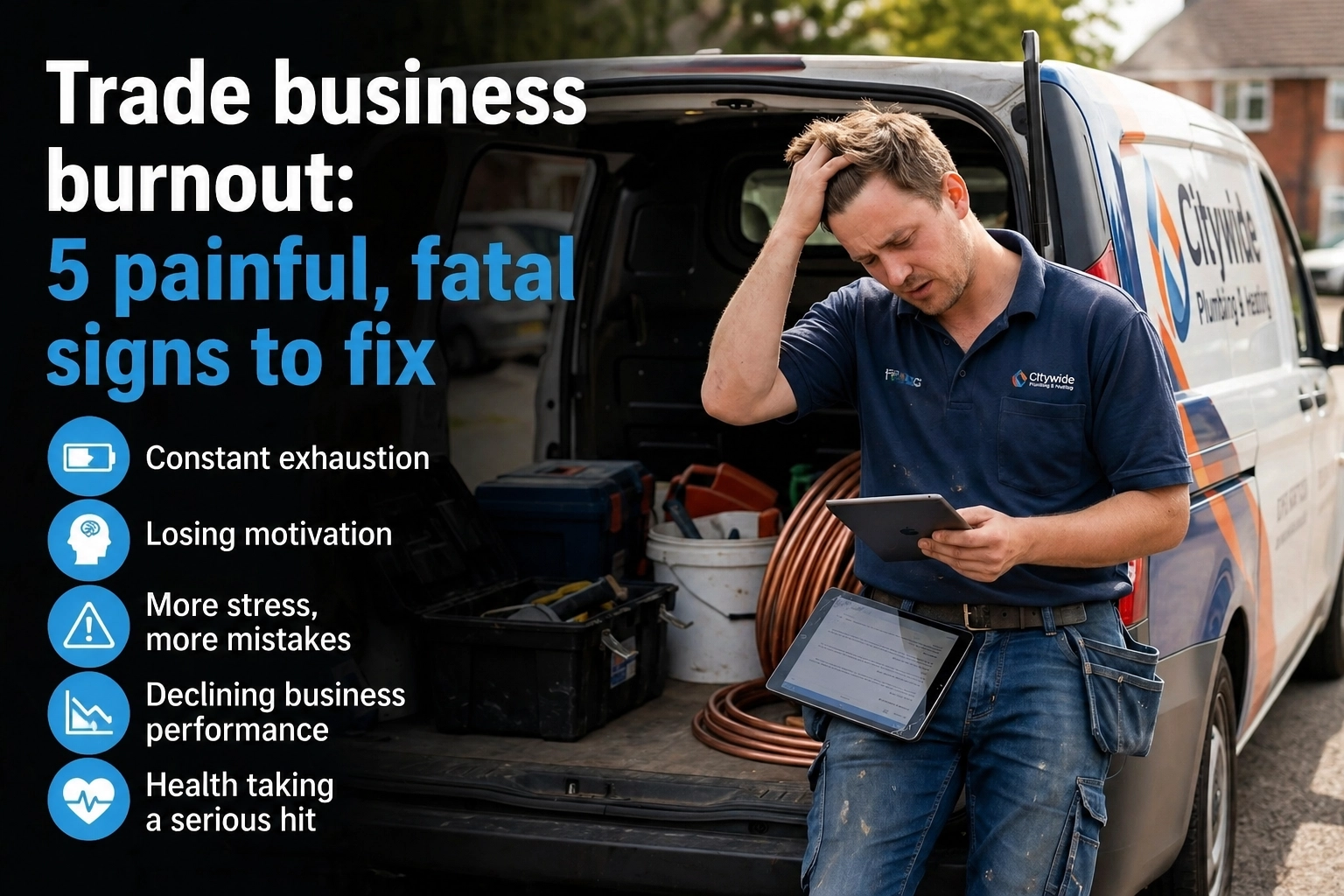
Trade business burnout: 5 painful, fatal signs to fix
You are killing your business because you are too proud to admit you are drowning. You think that working eighteen hour days is a badge of honor that proves you are a real entrepreneur. You believe that if you just push through one more week of midnight invoicing and three hours of sleep, things will miraculously stabilize. You are wrong. Trade business burnout is not a temporary hurdle. It is a terminal illness for your company if you do not stop the bleeding right now.
The truth is that your family barely remembers what you look like without a phone glued to your ear. Your crew is starting to look at you with a mix of pity and resentment because your temper is shorter than a blown fuse. You are missing out on high margin jobs because you are too exhausted to follow up on a simple lead. This is not the dream you bought into when you started your own shop. This is a prison of your own making. Stop doing this to yourself before there is nothing left to save.
Trade business burnout happens when the owner becomes the bottleneck for every single decision, every single phone call, and every single invoice. You are trying to be the technician, the salesperson, the accountant, and the receptionist all at once. It is physically impossible to sustain. There is a better way to run a small trade team that does not involve you ending up in the hospital or the divorce court.
The Myth of Work-Life Balance in the Trades
The biggest lie you have been told is that work-life balance is something you can achieve if you just manage your time better. In the world of HVAC, plumbing, and electrical work, work-life balance is a myth. When a pipe bursts at 2:00 AM, balance goes out the window. When a commercial freezer fails in a restaurant, you cannot just tell the client you are currently in your “life” portion of the day.
The problem with chasing balance is that it implies a fifty-fifty split that never actually exists for a small business owner. Instead of balance, you should be looking for harmony and scalability. You need systems that allow the business to breathe without you having to be the lungs. If your business requires your constant, conscious presence to survive, you do not own a business. You own a very stressful, very expensive job.
Trade business burnout thrives in the gap between your expectations and your reality. You expected freedom, but you got a leash. You expected profit, but you got overhead and headaches. When you realize that balance is a fairy tale, you can finally start building the structures that actually provide relief. You do not need balance. You need a team that handles the noise so you can focus on the signal.
Trade business burnout is the result of ignoring the warning signs for too long. You think you are being tough, but you are actually being reckless. A leader who is running on fumes is a liability to their crew and their customers. You make mistakes when you are burnt out. You miss details in ServiceTitan or Jobber that cost you thousands of dollars. You forget to order parts. You lose your cool with a loyal customer. These are not minor hiccups. These are the symptoms of a failing strategy.
Sign 1: Your Body is Physically Revolting Against Your Schedule
The first toxic sign of trade business burnout is physical collapse. You are not a machine, even though you try to act like one. When you start experiencing chronic sleep deprivation, it is not just about feeling tired. It is about your brain losing the ability to process information and regulate emotions. You are likely surviving on caffeine, gas station snacks, and pure adrenaline. This is a recipe for a heart attack or a total mental breakdown.
You might notice that your back hurts more than usual, or you have headaches that won’t go away. This is your body screaming at you to stop. In the trades, physical health is your primary asset. If an HVAC owner cannot get into a crawlspace because they are physically spent, the business suffers. If a plumber is too shaky from lack of sleep to sweat a joint properly, the job fails. Trade business burnout manifests in the physical world long before it shows up on your balance sheet.
Think about the last time you had a full eight hours of sleep without waking up to check your email or your dispatch software. If you cannot remember, you are in the danger zone. Trade business burnout turns you into a ghost in your own home. You might be physically present at the dinner table, but your mind is stuck on a job site or a late payment. This physical and mental exhaustion makes you ineffective at everything you do.
When you are physically depleted, your decision-making skills plummet. You start taking shortcuts that you would never allow your crew to take. You skip the safety checks. You ignore the rattling sound in your service van. You are essentially operating under the influence of exhaustion. This is how accidents happen. This is how trade business burnout transitions from a personal problem to a legal and financial nightmare for YROS clients who haven’t yet delegated their back office.
Sign 2: The Toxic “Always-On” Performance Trap
The second sign that you are failing is the belief that you must be available twenty-four hours a day. You have created an environment where your customers and your crew feel entitled to your time at any hour. This always-on culture is a primary driver of trade business burnout. You respond to texts at midnight. You take sales calls during your kid’s ball game. You have taught everyone around you that your boundaries do not exist.
This behavior is often disguised as “good customer service,” but it is actually a lack of professional systems. A professional business has set hours and an answering service or a remote team to handle inquiries. If you are the one answering the phone at 9:00 PM, you are telling the world that your time has zero value. Trade business burnout is the direct result of this devaluation of your own life.
In the trades, we often see owners who feel guilty for not being the “hardest worker” in the room. You think that if your crew is out in the heat, you should be suffering too. So, you stay up late doing the administrative work that you didn’t have time for during the day. This creates a cycle where you are never truly off the clock. Trade business burnout is inevitable when you refuse to separate your identity from the daily grind of the business.
Your crew notices this, too. They see you stressed, frantic, and perpetually distracted. It creates a culture of anxiety. If the boss is always panicking, the employees will follow suit. You are not leading; you are just reacting. Trade business burnout strips away your ability to look ahead and plan for the future. You are too busy putting out fires to notice that the whole building is made of dry tinder.
Sign 3: Rigidity and the “That Is Just How It Is” Mentality
When trade business burnout sets in, your creativity dies. You become rigid and resistant to change. You start saying things like, “That is just how the trades are,” or “You can’t find good help these days.” These are excuses. They are the defensive mechanisms of a mind that is too tired to innovate. You are failing because you have stopped looking for solutions and started accepting misery as a standard operating procedure.
A healthy business owner is always looking for ways to streamline. They look at their QuickBooks and realize they are spending ten hours a week on manual data entry and decide to change it. A burnt-out owner sees that same ten hours and just sighs, then stays up until 1:00 AM to get it done. Trade business burnout makes you a martyr for tasks that could easily be handled by someone else. You are holding onto the administrative weight because you are afraid to let go.
This rigidity extends to how you manage your team. You might be sticking to old, inefficient dispatching methods because learning a new system feels like too much effort. You are stuck in a loop of “doing” rather than “improving.” Trade business burnout keeps you small. It prevents you from scaling because you are already at your maximum capacity. If you cannot handle the administrative load of three trucks, how do you ever expect to run ten?
The moment you stop believing that things can be better is the moment your business starts to die. Complacency is a slow poison. You might still be making money, but you are losing ground to competitors who are using modern remote support to free up their time. Trade business burnout blinds you to the opportunities right in front of you. You are too busy staring at the mud to see the horizon.
Sign 4: The Erosion of Culture and Team Communication
One of the most painful signs of trade business burnout is the breakdown of your relationship with your team. When you are burnt out, your empathy disappears. You start viewing your employees as tools rather than people. You become the “jerk boss” that you swore you would never be. You snap at people for minor mistakes. You stop providing clear direction because you assume everyone should just know what to do.
Toxic communication is a hallmark of trade business burnout. You might start using fear as a management tool because you don’t have the energy for real leadership. You raise your voice. You use public shaming. You make your crew feel like their jobs are always on the line. This doesn’t make them work harder; it just makes them look for another job. In a competitive labor market, you cannot afford to lose good techs because of your own inability to manage your stress.
Your crew wants to be part of something successful and stable. They don’t want to work for a person who looks like they are about to have a stroke every Monday morning. Trade business burnout creates a “dog-eat-dog” environment where your team members start undermining each other to stay in your good graces. This internal friction eats up your profits and ruins your reputation in the local community.
If you find yourself dreading the morning meeting or avoiding your crew’s questions, you are experiencing trade business burnout. You are failing as a leader because you are no longer providing the vision. You are just a middleman for chaos. A business that lacks clear communication and a positive culture will eventually collapse from the inside out, no matter how good the technicians are at their craft.
Sign 5: Psychological Unsafety and the Fear of Failure
The final toxic sign is a pervasive sense of psychological unsafety. You are constantly waiting for the other shoe to drop. You are terrified of making a mistake, so you micromanage everything. You don’t trust anyone to do the job as well as you do. This lack of trust is a primary symptom of trade business burnout. It forces you to keep all the responsibility on your own shoulders, which only increases the weight that is crushing you.
When you operate from a place of fear, you cannot think strategically. You make desperate moves. You take on jobs that you know are losers just because you are afraid of a slow week. You ignore your profit margins because you are too focused on just keeping the lights on. Trade business burnout turns you into a reactive gambler rather than a proactive owner. You are failing because you have lost the ability to say “no.”
This fear also prevents you from asking for help. You think that if you hire a remote office team like YROS, it means you have failed to handle it yourself. The opposite is true. Hiring support is a sign of intelligence and strength. It means you recognize that your time is better spent on high-level strategy and technical excellence than on answering the phone and scheduling appointments. Trade business burnout is what happens when pride prevents progress.
Your fear is contagious. Your customers can sense when you are desperate or distracted. Your vendors can tell when you are disorganized. Trade business burnout radiates from you like heat from a broken furnace. Until you address the root cause of your stress, no amount of marketing or sales training will save your business. You have to fix the engine before you can win the race.
In the Wild: Mark’s Electrical Meltdown
Let us look at a real scenario. We will call him Mark. Mark owned a successful electrical company in a busy suburban area. He had four trucks on the road and a reputation for high-quality work. But Mark was suffering from severe trade business burnout. He was the one answering the phone at all hours. He was the one doing the invoicing on Sunday mornings. He was the one dealing with every single permit issue and customer complaint.
Mark thought he was being a “hands-on” owner. In reality, he was a bottleneck. Because he was so exhausted, he started making mistakes in his job costing. He underestimated a large commercial project by twenty percent because he was looking at the blueprints at 11:00 PM after a fourteen-hour day. This mistake put his cash flow in a stranglehold. Instead of stepping back to fix the problem, Mark worked harder. He got on the tools himself to try and make up the difference.
This move was the final straw for his trade business burnout. While he was out in the field trying to save a few bucks on labor, he missed three high-ticket leads that came in through his website. His existing customers started complaining because no one was answering the phone or returning emails. His best lead technician quit because Mark snapped at him in front of a client. Mark was failing, and he was doing it with a hammer in his hand and tears in his eyes.
The moment of total failure came when Mark’s van was involved in a minor accident because he fell asleep at the wheel for a split second. Thankfully, no one was hurt, but the van was totaled, and his insurance rates skyrocketed. This was the “punch in the gut” that Mark needed to realize that his current path was unsustainable. Trade business burnout had nearly cost him his life and his livelihood. He had to decide: change the way he worked, or close the doors for good.
The Escalation: From Stress to Total Collapse
Trade business burnout does not stay at the same level of intensity. It compounds. Like interest on a bad loan, the cost of your exhaustion grows every single day. First, it is just a missed phone call. Then, it is a late invoice. Next, it is a lost customer. Eventually, it is a legal dispute or a tax audit because your records are a mess. You cannot outrun the consequences of a broken system.
When you are in the middle of trade business burnout, you lose perspective on what is actually important. You start prioritizing the “urgent” over the “important.” Answering a trivial email feels more productive than training a new hire or reviewing your monthly financials. You are caught in the “Two-Role Trap,” where you are trying to be the worker and the manager at the exact same time. You are failing at both because no one can do two full-time jobs effectively.
This escalation often leads to a “hiring spree” that actually makes things worse. You hire more technicians to handle the workload, but because you don’t have an office system in place, you just have more people to manage, more payroll to run, and more phone calls to take. Without remote support to handle the administrative side, more technicians just means more trade business burnout for you. You are adding fuel to a fire that is already out of control.
The worst-case scenario is that you simply quit. You shut down a profitable business because you can’t stand the sight of your service van anymore. You walk away from years of hard work and hundreds of loyal customers because you are mentally and emotionally bankrupt. This is the ultimate failure of trade business burnout. It robs the community of a skilled tradesperson and robs you of the future you worked so hard to build.
The Fix: Admitting You Need a Human Solution
You do not need more software. You do not need another “automation” tool that requires ten hours of setup and a degree in computer science to operate. You do not need AI to write your emails. What you need is human support. You need people who understand the trades and can take the weight off your shoulders. The fix for trade business burnout is delegation to a professional team like YROS.
The Fix: You must remove yourself from the administrative cycle immediately.
Before you can fix your business, you have to fix your mindset. You have to accept that your time is the most valuable resource you have. If you are spending your time doing tasks that someone else could do for twenty or thirty dollars an hour, you are devaluing yourself. You are essentially paying yourself a pittance to be an office clerk. Stop it. Trade business burnout ends when you start acting like a CEO instead of a secretary.
The first step is to identify the tasks that are draining your battery. Is it the constant phone calls? Is it the scheduling? Is it the back-and-forth with customers about their invoices? These are all things that a remote team can handle. When you hand these off, you aren’t “giving up control.” You are gaining control. You are gaining the control to focus on growth, training, and your own physical well-being. This is how you cure trade business burnout.
You need a human touch. Your customers don’t want to talk to a robot or an automated menu. They want to hear a friendly, professional voice that can solve their problem. By bringing on a remote office partner, you provide that human connection while you are out in the field or, better yet, taking a well-deserved nap. Trade business burnout is solved through professional partnership, not through more “grinding.”
Rebuilding Your Trade Business for Sanity
Once you have the support of YROS, you can start rebuilding. You can re-establish the boundaries that you let crumble. You can set firm office hours and stick to them. You can trust that your leads are being captured and your customers are being cared for. This peace of mind is the antidote to trade business burnout. It allows your brain to shift from survival mode to growth mode.
Imagine waking up and knowing that your calendar is organized, your invoices are sent, and your phone is being handled by professionals. You can walk onto a job site with a clear head and a steady hand. You can lead your crew with patience and clarity. This is what a healthy trade business looks like. It is not a myth. It is a reality for owners who understand the power of delegation.
Trade business burnout often makes you feel isolated. You feel like no one else understands the unique pressure of the trades. But there are thousands of owners who have been exactly where you are and have found a way out. They didn’t do it by working harder. They did it by working smarter and surrounding themselves with the right people. You have the skills to do the work. Let us have the skills to run the office.
This is your opportunity to reclaim your life. Your business should serve you, not the other way around. If you continue on your current path, trade business burnout will take everything from you. But if you make the choice to change today, you can build a legacy that lasts. You can be the owner of a thriving company and still be home in time for dinner.
Why Remote Support is the Only Way Out
For a small trade team, hiring a full-time, in-house office manager is often too expensive. Between the salary, the benefits, the desk space, and the payroll taxes, it can eat up your entire profit margin. This is why many owners try to do it themselves, leading directly to trade business burnout. Remote support is the middle ground that provides professional-grade results without the overhead of a local employee.
A remote team like YROS doesn’t need an office. They don’t need you to buy them a computer or pay for their health insurance. They are a scalable solution that grows with you. If you have a busy season, they handle the extra volume. if things slow down, you aren’t stuck with a heavy payroll. This flexibility is key to preventing trade business burnout in an industry that is naturally cyclical.
Furthermore, a specialized remote office team understands the specific software you use. Whether it is ServiceTitan, Jobber, or QuickBooks, they can hit the ground running. You don’t have to spend weeks training them on the basics of the trade. They know what a “no-cool” call is. They understand the urgency of a leaking water heater. This industry knowledge is vital for maintaining your professional image while you recover from trade business burnout.
You are at a crossroads. One path leads to more of the same: more stress, more exhaustion, and the eventual collapse of your business. The other path leads to sanity, growth, and a renewed passion for your trade. Trade business burnout is a choice you are making every day that you refuse to delegate. It is time to make a different choice. It is time to choose your health, your family, and your future.
Stop the Bleeding and Get Your Life Back
You have heard the signs. You know which ones apply to you. You are likely feeling a mix of guilt and relief right now. Guilt for letting things get this far, and relief that someone finally called it what it is. Trade business burnout is a heavy burden, but you do not have to carry it alone. You have built something valuable, and it deserves to thrive. You deserve to thrive.
The trades are a noble profession. You build, you fix, and you maintain the world around us. But you cannot do that if you are a shell of a human being. Your expertise is needed on the job site and in the leadership chair, not in the weeds of office work. Let go of the “always-on” mentality. Embrace a new way of operating that prioritizes your sanity as much as your service.
Trade business burnout is the enemy of excellence. When you are exhausted, you settle for “good enough.” Your customers deserve excellence, and so do you. By bringing in a remote support team, you are raising the bar for your entire organization. you are signaling to your crew and your clients that you are a professional, sustainable business that is here for the long haul.
There is no prize for being the most stressed-out contractor in town. There is only the quiet satisfaction of a job well done and a life well lived. Do not let trade business burnout be the reason you fail. Recognize the signs, accept the reality, and take action to fix it. Your future self will thank you.
Related Blogs
- The Two-Role Trap: Why You Can’t Be the Tech and the Admin
- Growing a Small Team Without Losing Your Mind
- The Two-Role Trap: Why You Can’t Be the Tech and the Admin
- Growing a Small Team Without Losing Your Mind
- Work-Life Integration for Trade Business Owners
- Why Work-Life Balance Is the Wrong Goal for Contractors
- How to Take a Real Vacation When You’re Self-Employed
- After-Hours Call Coverage Without Hiring Full-Time Staff
- The Real Cost of Answering Your Own Phone
- Centralized Call Handling Systems for Contractors
- Missed Calls = Missed Revenue: Why Contractors Need Live Answering Support
- How to Stop Being the Bottleneck in Your Own Business
- The Hidden Cost of Context Switching in Your Trade Business
- Decision Fatigue and How to Reduce It in Your Business
- The Cost of Perfectionism in Small Business Operations
- Creating Your Stop Doing List
- How to Delegate When You’ve Always Done Everything Yourself
- The First 5 Things to Delegate When You Hire Your First VA
- Building a Business That Runs Without You (Even For a Week)
- Administrative Tasks Eating Your Profit Margin (And What to Do)
- The Real Cost of DIY Administration in Your Trade Business
- Email and Calendar Management: How Executives Win Back 15 Hours Per Week
- Inbox Management Systems for Busy Contractors
- Scheduling Systems That Protect Your Time
- From Chaos to Calendar: Scheduling Systems for Growing Contractors
- Dispatching Without Interruptions: Protecting Technician Focus
- Customer Communication Systems That Reduce Interruptions
- Human Support vs Technology: Where Each Actually Wins
- Virtual Assistants vs AI Tools: What Each Does Best
- US-Based Virtual Assistants vs Offshore: The Real Differences
- Industry-Specific Virtual Assistants: Generalist or Specialist?
- In-House Admin vs Virtual Support: 5-Year Cost Comparison
- When Your Business Is Too Small for an Employee But Too Big to DIY
- Scaling From One VA to a Team of Support
- Operations Management for Small Businesses: The COO-Level Support You Can Actually Afford
- What Is a Fractional COO and Do You Actually Need One? – Clarity Ops Engine
- Why Busy Contractors Still Feel Behind
- Mental Load Management for Small Business Owners
- How to Be Present at Home Without Ignoring Work
- Why Contractors Burn Out During Growth Phases
- Breaking the Always-On Culture in Trade Businesses
- How to Rebuild Team Culture After Burnout
- Leadership Systems That Reduce Owner Stress
- Weekly Planning Systems That Actually Stick
- Goal Setting That Actually Drives Daily Action
You are exhausted and your business is suffering because of it.
You do not need a sales pitch. You need to sleep through the night without worrying about your inbox or your schedule. You need to know that your phones are covered by humans who care as much about your reputation as you do. If you are ready to stop the trade business burnout and reclaim your sanity, let us talk about how we can help you breathe again.