Gap Analysis: Finding Operational Weaknesses
Your business is bleeding money and you don’t even know where the wound is.
You’re working 60-hour weeks. Your team is scrambling. Customers are waiting too long. Jobs are taking longer than they should. And your profit margin keeps shrinking even though you’re busier than ever.
Sound familiar?
Here’s the brutal truth: Most small business owners can tell you they have problems, but they can’t tell you exactly what those problems are. They know something is wrong. They feel the operational weaknesses dragging them down every single day. But they’re too busy putting out fires to actually identify where the smoke is coming from.
That’s where gap analysis comes in. And no, it’s not some fancy consulting buzzword. It’s a straightforward way to figure out where you are, where you need to be, and what operational weaknesses are stopping you from getting there.
Let’s break it down.
What Gap Analysis Actually Means (Without the Corporate Jargon)
Gap analysis sounds complicated. It’s not.
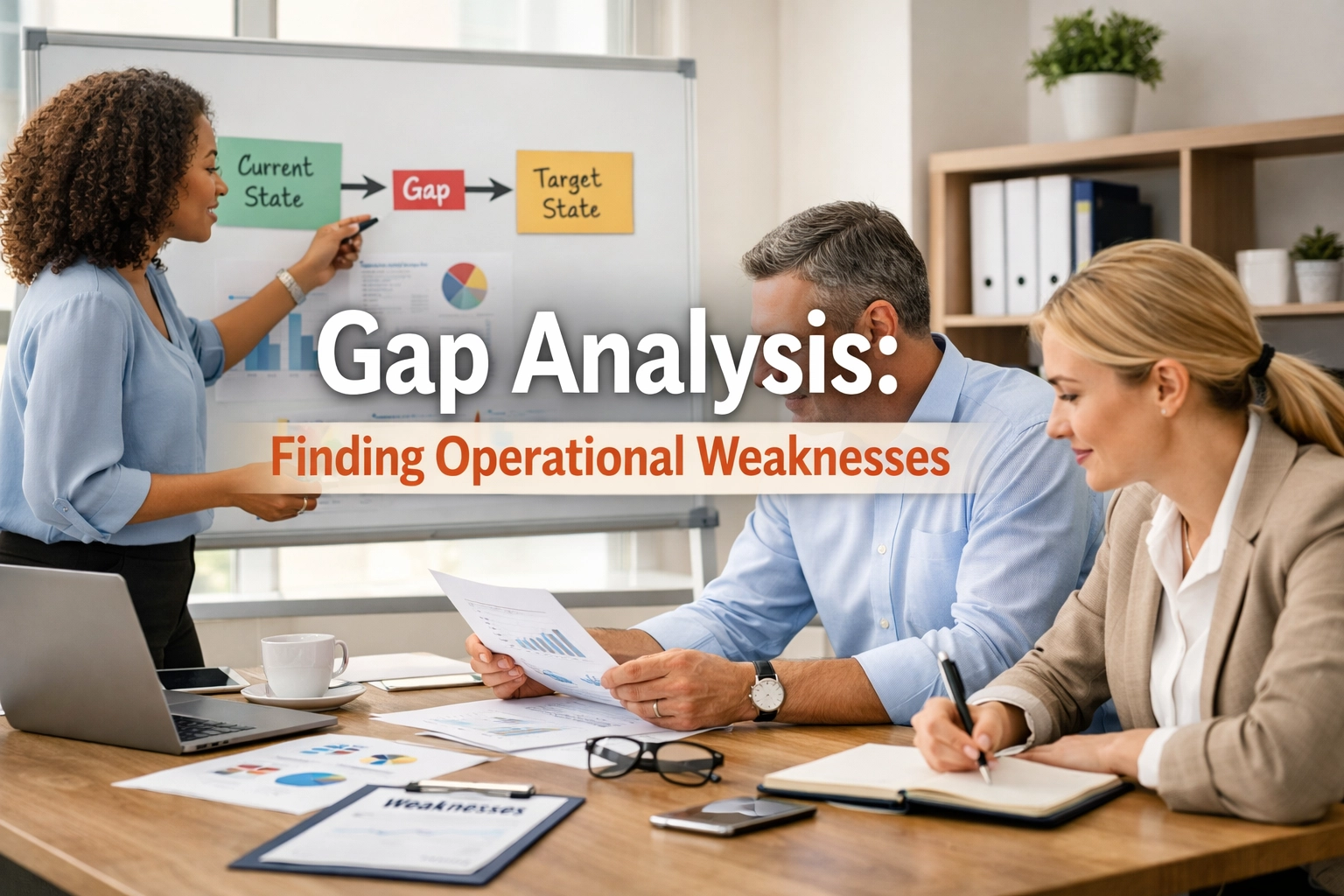
You’re comparing two things: where your business is right now versus where you want it to be. The space between those two points? That’s the gap. And inside that gap are all the operational weaknesses that are costing you time, money, and sanity.
Think of it like this. You want to complete 40 HVAC jobs per month. Right now, you’re only completing 28. That’s a gap of 12 jobs. But why? Is it scheduling problems? Are technicians sitting idle? Is your phone system missing calls? Are you buried in paperwork instead of running service calls?
Those are your operational weaknesses.
Most business owners skip the diagnosis and jump straight to symptoms. They hire another technician when the real problem is their dispatching system. They work longer hours when the real issue is their phone keeps going to voicemail. They blame the market when their invoicing process is losing 15% of billable time to errors.
You can’t fix what you can’t see. Gap analysis forces you to see it.

The Most Common Operational Weaknesses Hiding in Plain Sight
Let’s talk about the operational weaknesses that are probably killing your business right now. These aren’t theoretical. They’re the same patterns we see in HVAC companies, plumbing businesses, pest control services, construction firms, and SaaS startups every single week.
Missed Calls Equal Missed Revenue
Your phone rings. You’re on a ladder. You’re in a meeting. You’re elbow-deep in a job. The call goes to voicemail.
That customer calls your competitor. Job lost.
Here’s what most business owners don’t realize: if you’re missing 20% of your incoming calls, you’re not just losing 20% of potential revenue. You’re losing the easiest revenue to capture. Inbound calls are warm leads. They already want what you’re selling. And you’re sending them straight to voicemail.
This is one of the most damaging operational weaknesses in service businesses. And it’s completely invisible until you actually track it.
In the Wild: A plumbing company in Alton, Illinois was convinced they needed more marketing. They were spending $2,500 per month on Google Ads. When we ran a gap analysis, we found they were missing 34% of their incoming calls during business hours. That’s $4,200 in lost revenue every single month, just from calls they paid to generate but never answered.
The gap wasn’t marketing. The gap was operational. They didn’t need more leads. They needed someone to answer the phone.
The Scheduling Black Hole
You’re scheduling jobs on a whiteboard. Or in a notebook. Or in your head. Maybe you’ve got a digital calendar, but it’s a mess of overlapping appointments, unclear job details, and technicians who don’t know where they’re going until you text them that morning.
This creates operational weaknesses across your entire workflow. Jobs run late. Customers get annoyed. Your team wastes time driving back and forth. You can’t accurately estimate how long anything takes because you have no real data.
Result: You’re leaving 10-15 hours per week on the table. At $150 per billable hour, that’s $78,000 to $117,000 per year disappearing into bad scheduling.
Paperwork Paralysis
You finish a $3,200 HVAC install. Great job. Customer is happy. But the invoice doesn’t go out for five days because you’ve been too busy to sit down and do the paperwork. The customer forgets the details. They question a line item. Payment gets delayed another two weeks.
Meanwhile, you’ve got 14 other invoices in the same state. You’re constantly chasing money you’ve already earned. Your cash flow is a disaster. And you’re working evenings just to keep up with administrative tasks that should take 20 minutes but somehow consume three hours.
These operational weaknesses don’t feel urgent. No one is yelling at you. But they’re quietly strangling your business.
The Follow-Up Failure
A customer calls asking for a quote on a new furnace. You give them a price. They say they’ll think about it. You never follow up.
Two weeks later, they buy from someone else. Not because your price was too high. Not because they didn’t like you. Because the other company followed up and you didn’t.
This operational weakness is epidemic in trade businesses. You’re so focused on the jobs in front of you that you completely abandon the pipeline behind you. Estimates sit in limbo. Maintenance agreements don’t get renewed. Seasonal tune-up reminders never get sent.
You’re working harder to find new customers when you’re ignoring the ones who already said yes.

How to Actually Run a Gap Analysis (The Practical Version)
Forget the flowcharts and the consulting frameworks. Here’s how you identify operational weaknesses in your business without spending three months on a strategic planning retreat.
Step 1: Define Where You Want to Be
Get specific. Not “I want to grow.” That’s useless.
Try this instead:
- I want to complete 50 service calls per week.
- I want 90% of incoming calls answered within three rings.
- I want invoices sent within 24 hours of job completion.
- I want every estimate followed up within 48 hours.
- I want to work 45 hours per week, not 65.
Write down your targets. Make them measurable. If you can’t measure it, you can’t track the gap.
Step 2: Measure Where You Actually Are
This is the painful part. Most business owners avoid this step because they don’t want to know how bad it really is.
Track your reality for two weeks:
- How many calls are you actually answering?
- How many jobs are you completing?
- How long does it take to send an invoice?
- How many estimates are sitting in your inbox right now with no follow-up?
- How many hours are you actually working?
Don’t estimate. Don’t guess. Measure.
You’ll be shocked at how big the gap is. That shock is valuable. It’s what finally motivates you to fix the operational weaknesses you’ve been ignoring.
Step 3: Identify the Operational Weaknesses Creating the Gap
Now you’ve got two numbers for every metric. Your target and your reality. The gap between them is caused by operational weaknesses. Your job is to figure out which ones.
Ask yourself:
- Why aren’t we hitting the target?
- What’s preventing us from getting there?
- What tasks are eating up time without producing results?
- Where are we losing money we should be capturing?
- What would have to change for us to close this gap?
Be honest. The answer is usually uncomfortable. It’s often you. You’re the bottleneck. You’re the operational weakness. You’re answering the phone, doing the scheduling, handling the paperwork, and running service calls. You’re one person trying to do four jobs, and all four are suffering.

Real Gaps from Real Businesses
Let’s look at actual operational weaknesses we’ve identified in gap analyses for YROS clients.
HVAC Company, St. Louis Metro Area:
- Target: 45 service calls per week
- Reality: 31 service calls per week
- Gap: 14 calls per week (728 calls per year)
- Operational Weakness: Owner spending 18 hours per week on scheduling, invoicing, and customer follow-up instead of running calls or managing technicians
- Cost: $109,200 in lost revenue annually (14 calls × $150 average × 52 weeks)
Pest Control Service, Southern Illinois:
- Target: Follow up on 100% of estimates within 48 hours
- Reality: Following up on 23% of estimates, average delay of 11 days
- Gap: 77% of estimates receiving no timely follow-up
- Operational Weakness: No system for tracking estimates; owner relying on memory and sticky notes
- Cost: 41% lower close rate on estimates, approximately $87,000 in lost annual revenue
Construction Consultant, Remote:
- Target: Invoice clients within 24 hours of project milestone completion
- Reality: Average invoicing delay of 9 days
- Gap: 8-day delay per invoice
- Operational Weakness: Owner handling all administrative tasks between client meetings and site visits
- Cost: Cash flow problems, two missed growth opportunities due to lack of available capital
SaaS Startup, 4-Person Team:
- Target: Respond to customer support tickets within 2 hours during business hours
- Reality: Average response time of 6.5 hours
- Gap: 4.5-hour delay
- Operational Weakness: Developers handling support tickets alongside product work; no dedicated support person
- Cost: 18% monthly churn rate, significantly higher than industry average
See the pattern? The operational weaknesses aren’t mysterious. They’re obvious once you actually look. And they’re expensive.
How YROS Closes the Gaps You Can’t Close Alone
Here’s where we get practical. You’ve identified your operational weaknesses. You know where the gaps are. Now what?
You have three options:
- Ignore them and keep bleeding money
- Try to fix them yourself by working even more hours
- Get help from people who specialize in fixing these exact operational weaknesses
Guess which one actually works?
Your Remote Office Space exists specifically to close the operational gaps that are killing small businesses. We’re not a generic virtual assistant service. We’re a remote office team that handles the operational weaknesses you can’t afford to keep ignoring.
We Answer Your Phone (And Stop the Revenue Bleeding)
Remember that plumbing company missing 34% of their calls? We fixed that operational weakness in one week.
Every call gets answered. Every caller gets a professional, friendly voice. Every lead gets captured. You stop losing revenue to voicemail.
Our after-hours call answering service means you’re not missing opportunities when you’re off the clock either. Weekend emergency? We’ve got it. Evening service request? Captured and scheduled.
No more missed calls. No more lost revenue. That operational weakness? Gone.
We Handle Your Scheduling (And Fix the Black Hole)
You don’t need to be staring at a calendar for three hours a day. You need to be running your business.
YROS takes over scheduling. We coordinate with your team. We confirm appointments. We send reminders. We handle the reshuffling when jobs run long or emergencies pop up.
We work inside your existing systems. ServiceTitan, Jobber, Housecall Pro, whatever you’re using. We learn it. We run it. You stop being the bottleneck.
Our dispatching systems expertise means we’re not just moving names around on a calendar. We’re optimizing routes, maximizing billable hours, and making sure your team is productive instead of sitting in traffic.
That’s an operational weakness you can measure in real dollars. And we close it.
We Process Your Paperwork (And End the Paralysis)
Invoices go out same-day. Estimates get followed up within 24 hours. Customer records stay updated. Your books stay clean.
This isn’t about us being faster than you at QuickBooks. It’s about removing the operational weakness of having your highest-value person (you) doing the lowest-value work (data entry).
At $150 per billable hour, every hour you spend on paperwork is an hour you’re not billing. If we save you 10 hours per week, that’s $1,500 in recovered billable time. Per week. That’s $78,000 per year.
Our remote administrative support is built specifically for trades and service businesses. We know how to read a work order. We know what details matter on an invoice. We understand the seasonal patterns of HVAC, plumbing, pest control, and construction.
We’re not learning on your dime. We’re closing operational weaknesses from day one.

We Follow Up (So You Don’t Leave Money on the Table)
Every estimate gets tracked. Every quote gets followed up. Every seasonal customer gets a reminder when it’s time for their annual service.
This operational weakness is invisible until you fix it. Then you see the revenue you were leaving behind.
In the Wild: An electrical contractor started working with YROS in March. We implemented a simple follow-up system for estimates. Nothing fancy. Just a phone call 48 hours after the estimate, an email at one week, and a final check-in at two weeks.
Close rate went from 31% to 54% in 90 days. Same leads. Same pricing. Same quality of work. The only change was following up on the operational weakness they’d been ignoring.
That’s an extra $143,000 in annual revenue from work they were already quoting. They didn’t need more leads. They needed someone to follow up.
The Math on Fixing Operational Weaknesses
Let’s run the numbers on a typical small service business working with YROS.
Before (Living with Operational Weaknesses):
- Missing 25% of incoming calls: -$60,000/year in lost revenue
- Owner spending 15 hours/week on admin work instead of billable work: -$117,000/year in opportunity cost
- Following up on 20% of estimates instead of 100%: -$95,000/year in unclosed deals
- Invoicing delays causing cash flow problems: Unable to take two growth opportunities worth $45,000 in profit
Total annual cost of operational weaknesses: $317,000
After (Working with YROS):
- Calls answered: +$60,000/year in recovered revenue
- Owner billable time recovered: +$117,000/year
- Estimate follow-up system: +$95,000/year in closed deals
- Improved cash flow: +$45,000 in captured growth opportunities
Total annual value: $317,000
Cost of YROS services: $36,000/year
Net benefit: $281,000/year
That’s not a projection. That’s not a best-case scenario. That’s the actual math on operational weaknesses we close for service businesses every single month.
You can keep trying to do it all yourself. You can keep working 60-hour weeks. You can keep watching revenue slip through operational weaknesses you don’t have time to fix.
Or you can be pragmatic.
Stop Trying to Fix Operational Weaknesses with Willpower
Here’s what doesn’t work: deciding to “be better” at answering the phone. Promising yourself you’ll follow up on estimates this week. Setting a goal to invoice faster.
Operational weaknesses don’t get fixed by trying harder. They get fixed by changing systems.
You became a business owner because you’re good at something. You’re a skilled HVAC technician. You’re an excellent plumber. You’re a talented consultant. You know how to solve problems in your field.
But you’re not an expert at administrative systems. You don’t want to be. And you shouldn’t have to be.
That’s the gap analysis insight most business owners miss. Your operational weaknesses aren’t personal failures. They’re structural problems. And structural problems need structural solutions.
YROS is the structural solution.
We’re not telling you to work harder. We’re not selling you a productivity course. We’re not handing you a template and wishing you luck.
We’re taking the operational weaknesses off your plate entirely.
You focus on the work only you can do. We handle everything else. That’s how you close the gap.

What Fixing Operational Weaknesses Actually Looks Like
You wake up Monday morning. Your calendar is already organized. Your team knows where they’re going. Customer calls from over the weekend have been logged and prioritized.
You spend the morning running service calls. Not answering the phone between jobs. Not scrambling to figure out scheduling. Just working.
Midday, you get a text. Three new estimates have been sent. Two follow-up calls have been made. One customer scheduled for next week.
You didn’t do any of it. But it got done.
You finish your last call at 4 PM. You check your email. Invoices from today’s jobs are already sent. Tomorrow’s schedule is confirmed. A customer who requested a quote last week just responded to a follow-up and wants to book.
You close your laptop at 5:30 PM. Not because you’re forcing yourself to stop. But because the work is actually done.
That’s what happens when you fix operational weaknesses instead of just tolerating them.
The Decision You Actually Need to Make
You know you have operational weaknesses. You’ve known for months. Maybe years.
You know they’re costing you money. You know they’re stealing your time. You know they’re preventing you from growing.
The question isn’t whether you should fix them. The question is how long you’re going to wait.
Every week you delay is another week of missed calls, lost estimates, and delayed invoices. Another week of working 60 hours to accomplish what should take 40. Another week of watching competitors pull ahead while you’re buried in administrative work.
Your Remote Office Space specializes in identifying and eliminating operational weaknesses for small service businesses. We’ve done it for HVAC companies in Missouri. Plumbing services in Illinois. Pest control companies across the Midwest. Construction consultants. SaaS startups. Nonprofits.
We know the operational weaknesses because we’ve seen them a hundred times. We know how to fix them because we do it every day.
Here’s how it works:
You book a 30-minute gap analysis call. We talk about your business. Where you are. Where you want to be. What operational weaknesses are creating the gap.
We identify the specific tasks and systems that are bleeding your time and money. We show you exactly what it would look like to hand those operational weaknesses to our team.
You decide if it makes sense. If it does, we start immediately. No long onboarding. No complicated implementation. We jump in and start closing gaps.
Within two weeks, you’ll see the difference. Calls answered. Estimates followed up. Invoices sent. Schedule managed. Operational weaknesses eliminated.
Schedule your gap analysis call here.
The Cost of Not Fixing Operational Weaknesses
Let’s be clear about what happens if you don’t fix this.
The operational weaknesses don’t go away. They get worse. The missed calls compound. The delayed invoices pile up. The lost estimates accumulate. The gap between where you are and where you want to be gets wider.
You keep working longer hours for the same revenue. Your team gets frustrated with the chaos. Your customers notice the delays. Your competitors keep taking the jobs you should be winning.
Eventually, something breaks. You burn out. You lose a major account. A key employee quits. You miss payroll because your cash flow is a disaster.
Or you just keep grinding. Year after year. Never quite hitting your goals. Never quite getting ahead. Always feeling like you’re one crisis away from disaster.
That’s the real cost of operational weaknesses. Not just the money you’re losing today. The future you’re sacrificing.
Your Operational Weaknesses Are Fixable
Most business problems are complicated. Operational weaknesses aren’t.
You identify them. You systematize them. You delegate them to people who specialize in handling them. Problem solved.
The reason most business owners don’t fix operational weaknesses isn’t because they don’t know how. It’s because they can’t let go. They think they have to do everything themselves. They convince themselves that no one else can handle it as well as they can.
That might be true for the skilled work. The HVAC repairs. The plumbing installations. The client consultations.
But answering phones? Sending invoices? Following up on estimates? You’re not special at those tasks. You’re just available. And that availability is costing you six figures a year.
YROS exists because operational weaknesses are predictable, fixable, and profitable to eliminate. We’ve built systems specifically for the industries we serve. We know what works for HVAC companies because we support HVAC companies. We know what plumbing businesses need because we run administrative operations for plumbing businesses.
We’re not figuring it out as we go. We’re applying proven solutions to operational weaknesses we’ve already solved a hundred times before.
Stop treating operational weaknesses like personality flaws you need to overcome through sheer determination. Start treating them like structural problems that need structural solutions.
Book your call. Identify your gaps. Fix your operational weaknesses.
Your business doesn’t need you to work harder. It needs you to work on the right things. Let us handle the rest.