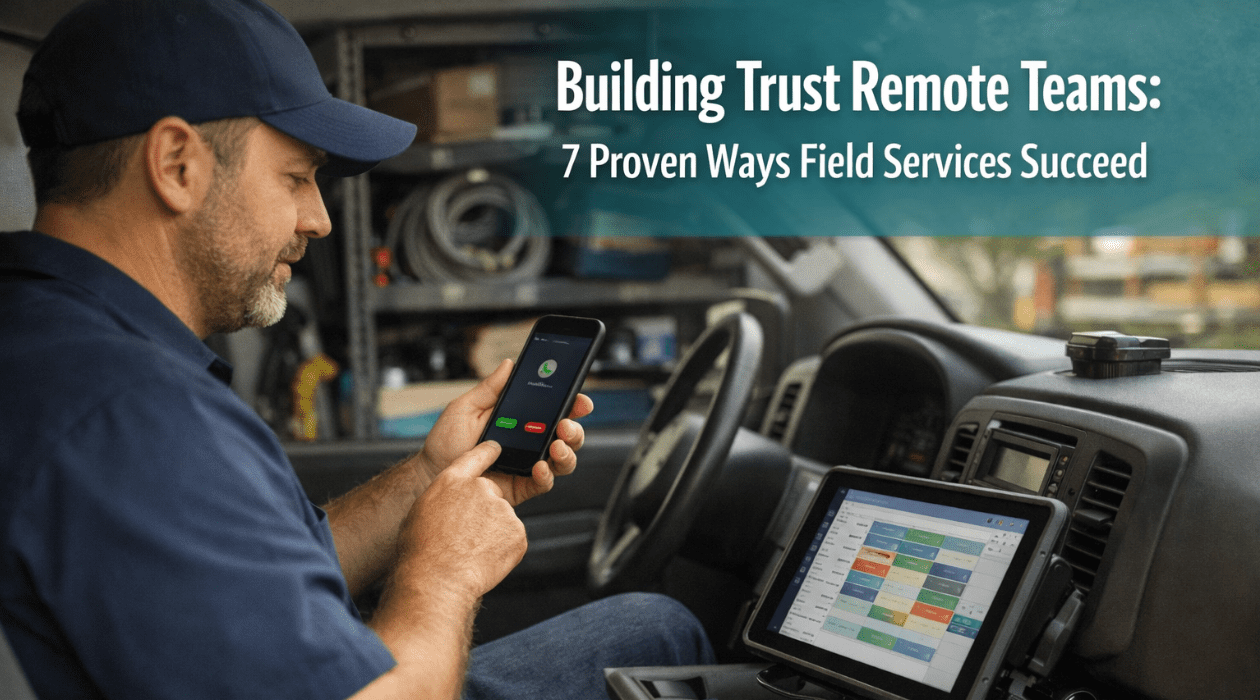
Building Trust Remote Teams: 7 Proven Ways Field Services Succeed
Running a field service business means you’re constantly in the field, on job sites, or managing crews. When you hire remote support to handle your administrative work, you face a unique challenge: building trust remote teams when you’ve never actually met face-to-face. For HVAC technicians, electricians, plumbers, and contractors across the St. Louis metro area, this challenge is real and pressing.
Building trust remote teams isn’t just a nice-to-have skill for modern field service companies. It’s absolutely essential. Your remote team members handle critical tasks like customer communications, scheduling, invoicing, and QuickBooks management. Without trust, your entire operation can suffer from miscommunication, delays, and costly mistakes.
The good news? Building trust remote teams is entirely possible, even when your admin support is working from Alton, Illinois while you’re installing HVAC systems in Chesterfield or troubleshooting electrical issues in Collinsville. This comprehensive guide reveals exactly how successful field service businesses create rock-solid trust with remote team members they’ve never met in person.
Why Building Trust Remote Teams Matters for Field Service Companies
Before diving into specific strategies, let’s understand why building trust remote teams is particularly crucial for trade businesses. Unlike corporate environments where remote work has been normalized for years, field service industries are just beginning to leverage virtual administrative support.
When you’re a solo electrician or running a small plumbing company, every phone call matters. Missing just one customer inquiry can mean losing hundreds or thousands of dollars in revenue. Research shows that field service businesses miss 30-40% of incoming calls when they’re on job sites. That’s where remote team trust becomes mission-critical.
Your remote virtual assistant isn’t just answering phones. They’re representing your brand, managing customer relationships, handling sensitive financial information, and making decisions that directly impact your bottom line. Without trust, you’ll constantly second-guess their work, micromanage every task, and ultimately waste more time than you save.
Building trust remote teams transforms this relationship from a source of anxiety into a genuine business partnership. When you trust your remote support, you can focus entirely on billable work while confident that administrative tasks are handled professionally. This isn’t just about delegation; it’s about building a sustainable business model that doesn’t require you to do everything yourself.
1. Start With Crystal-Clear Communication Protocols
The foundation of building trust remote teams starts with communication. Unlike in-person teams where you can walk over to someone’s desk for quick clarification, remote teams need structured communication systems from day one.
Establish specific communication channels for different purposes. Use text messaging for urgent, time-sensitive issues like emergency service calls. Leverage email for detailed instructions, project briefings, and documentation. Consider project management tools like Jobber or ServiceTitan’s messaging features for task-specific communication.
Building trust remote teams requires defining response time expectations. Your remote virtual assistant should know that emergency dispatch issues need immediate responses, while routine invoicing questions can wait until the next business day. When both parties understand these expectations, trust builds naturally through consistent, reliable communication.
Set up regular check-in schedules. Many successful field service companies hold brief 15-minute video calls every Monday morning to review the week ahead. This ritual creates accountability and ensures everyone starts the week aligned. Building trust remote teams becomes easier when communication happens predictably rather than sporadically.
2. Use Technology to Bridge the Distance Gap
Technology plays a massive role in building trust remote teams. The right tools make distance irrelevant and create transparency that builds confidence on both sides.
Screen recording tools like Loom are game-changers for field service businesses. Instead of writing long, complicated emails explaining how to process a change order in QuickBooks, record a five-minute video walking through the process. Your remote team member can watch it multiple times, pause when needed, and fully understand your expectations. This visual communication is essential for building trust remote teams.
Shared access to your field service management software creates real-time visibility. When your remote assistant can see your schedule in ServiceTitan or Housecall Pro, they can proactively manage customer communications without constantly asking for updates. This independence builds trust faster than any other single factor.
Time tracking software adds another layer of transparency essential for building trust remote teams. Platforms that show exactly when your remote team is working and on which tasks eliminate concerns about productivity. You’re not paying for someone scrolling Facebook; you’re investing in focused work that moves your business forward.
Video conferencing normalizes face-to-face interaction. While you may never meet in person, regular Zoom calls create personal connection. Building trust remote teams becomes significantly easier when you can see facial expressions, read body language, and share screens to solve problems together.
3. Define Roles and Responsibilities With Precision
Ambiguity destroys trust. Building trust remote teams requires absolute clarity about who does what, when, and how.
Create a detailed task list that outlines every responsibility your remote team member handles. For a field service business, this might include answering phones during business hours, scheduling service appointments, sending estimate follow-ups, processing invoices in QuickBooks, ordering supplies, and managing customer review requests.
Document your standard operating procedures. Building trust remote teams requires written processes for common tasks. How should your assistant handle an angry customer call? What’s the protocol for emergency service requests outside normal hours? When should they escalate issues to you versus handling them independently?
Many contractors worry that documenting everything takes too much time. The reality is that building trust remote teams through clear documentation saves massive amounts of time in the long run. Instead of answering the same questions repeatedly, you point to your documented process once and move on.
Establish decision-making authority boundaries. Your remote assistant should know exactly which decisions they can make independently (like rescheduling non-emergency appointments) versus which require your approval (like offering discounts to upset customers). This clarity is fundamental for building trust remote teams that function smoothly.
4. Prioritize Consistent, Predictable Behavior
Trust grows through consistency. Building trust remote teams means both parties need to demonstrate reliable, predictable behavior over time.
As the business owner, you set the tone. If you promise to review invoices every Thursday morning, do it every Thursday morning. If you commit to responding to non-urgent messages within 24 hours, honor that commitment. Your remote team member will mirror your consistency. Building trust remote teams is a two-way street where both parties must demonstrate reliability.
Establish and maintain work schedules. If your remote virtual assistant works Monday through Friday from 8 AM to 4 PM Central Time, they should be consistently available during those hours. This predictability matters tremendously for field service businesses where customer calls come in throughout the day. Building trust remote teams requires knowing you can count on someone being there when needed.
Create consistent feedback loops. Instead of only addressing issues when something goes wrong, schedule regular feedback sessions. A simple monthly 30-minute call to discuss what’s working well and what needs adjustment prevents small issues from becoming trust-breaking problems. This proactive approach is essential for building trust remote teams.
Consistency also means following through on commitments. If you tell your remote team you’ll provide access to a new software tool by next week, deliver on that promise. If they commit to having all estimates sent by end of day, they need to meet that deadline. Building trust remote teams happens through thousands of small promises kept, not grand gestures.
5. Invest in Trade-Specific Training and Context
Generic virtual assistants often struggle with field service businesses because they don’t understand trade-specific terminology, customer expectations, or operational urgency. Building trust remote teams in the trades requires proper training and context.
Take time to explain your industry’s unique characteristics. Teach your remote assistant the difference between a routine maintenance call and a genuine emergency. Help them understand why a burst pipe requires immediate response while a maintenance tune-up can be scheduled for next week. This contextual knowledge is crucial for building trust remote teams that can represent your business professionally.
Share industry terminology. Your remote team member should understand terms like service calls, estimates, change orders, job costing, warranty work, and seasonal maintenance. When they speak your language, customer interactions feel more professional and you’ll feel more confident in their ability to represent your company. Building trust remote teams becomes natural when everyone speaks the same language.
Many successful field service companies find that working with US-based remote teams who already have trade industry experience makes building trust remote teams significantly easier. A virtual assistant who previously worked for an HVAC company or plumbing contractor brings immediately applicable knowledge that offshore generalists simply can’t match.
Provide ongoing training as your business evolves. When you add a new service line, implement new software, or change your pricing structure, brief your remote team immediately. Building trust remote teams requires keeping everyone informed and equipped to do their jobs effectively.
6. Establish Accountability Without Micromanagement
One of the biggest challenges in building trust remote teams is finding the balance between accountability and micromanagement. Too little oversight creates anxiety about whether work is actually getting done. Too much oversight suffocates independence and signals you don’t trust your team.
Create outcome-based accountability measures. Instead of tracking every minute of activity, focus on results. Did all estimate follow-ups get sent? Are invoices processed within 24 hours of job completion? Is the phone answered within three rings during business hours? These objective measures make building trust remote teams straightforward because success is clearly defined.
Implement weekly reporting that takes minimal time but provides maximum visibility. A simple end-of-week summary showing calls handled, appointments scheduled, invoices processed, and any issues encountered gives you confidence while respecting your remote team’s independence. This structured accountability is essential for building trust remote teams.
Trust but verify through random spot checks. Occasionally listen to recorded customer calls, review sent emails, or audit QuickBooks entries. This isn’t about catching mistakes; it’s about quality assurance. When your remote team knows random checks happen, they stay sharp. When you consistently find quality work, your trust deepens. This verification process supports building trust remote teams by confirming reliability.
Address issues directly and immediately. If something concerns you, discuss it right away rather than letting resentment build. Building trust remote teams requires honest, respectful communication about problems. Most issues stem from miscommunication rather than incompetence or malice, and quick conversations can resolve misunderstandings before they damage the relationship.
7. Recognize Cultural and Regional Advantages
For field service businesses serving the St. Louis metro area, working with US-based remote teams from the Midwest offers specific advantages for building trust remote teams.
Shared time zones eliminate scheduling headaches. When your remote assistant in Alton, Illinois works Central Time alongside your customers in Missouri and Illinois, communication flows naturally. No one is starting their day when you’re ending yours. This alignment is surprisingly important for building trust remote teams because it creates natural opportunities for real-time collaboration.
Cultural familiarity matters more than people realize. A virtual assistant who understands Midwest work ethic, communication styles, and customer service expectations will naturally align with how your field service business operates. They’ll intuitively understand why a customer in O’Fallon might prefer a Friday appointment over Monday, or why weather impacts your schedule. This cultural alignment accelerates building trust remote teams.
Clear communication without language barriers protects your business reputation. When your remote team speaks with neutral American English, customers perceive professionalism and competence. This isn’t about prejudice; it’s about practical reality. Field service customers often prefer speaking with someone who sounds local. Building trust remote teams becomes easier when customer interactions go smoothly.
Supporting the local economy creates additional goodwill. When you hire US-based remote support, you’re keeping jobs in America and supporting families in communities like yours. This values alignment contributes to building trust remote teams because you share similar economic realities and work philosophies.
Real-World Example: Building Trust Remote Teams in Action
Consider Mike, an electrical contractor in St. Charles who was skeptical about building trust remote teams. He’d always done his own administrative work, staying up until 9 or 10 PM to handle invoicing and follow-ups after long days in the field.
When Mike hired a US-based virtual assistant through YROS, he started with just phone answering and appointment scheduling. The first week felt uncomfortable. He constantly checked his voicemail and second-guessed scheduling decisions. Building trust remote teams felt impossible when he’d never even met his new assistant.
Then Mike implemented the strategies outlined above. He recorded screen videos showing exactly how he wanted estimates processed. He established clear communication protocols: text for emergencies, email for everything else, video call every Monday morning. He defined precisely which decisions his assistant could make independently.
Within six weeks, Mike stopped checking voicemail entirely. His assistant sent weekly summaries showing calls handled, appointments scheduled, and follow-ups completed. Random spot checks consistently showed quality work. Building trust remote teams transformed from an abstract goal into daily reality.
Three months in, Mike expanded his assistant’s responsibilities to include QuickBooks management, supply ordering, and customer review requests. The trust he’d built allowed him to delegate increasingly important tasks. He estimated saving 15-20 hours weekly, which he reinvested into actual electrical work that paid his bills.
The turning point came when Mike took his first real vacation in seven years. His business ran smoothly without him for an entire week because building trust remote teams had created operational independence. His assistant handled everything from emergency calls to routine invoicing, and Mike returned to find his business in better shape than when he left.
Common Mistakes That Undermine Building Trust Remote Teams
Understanding what not to do is just as important as knowing the right strategies for building trust remote teams.
Don’t withhold information. Some business owners fear giving remote teams full access to systems or customer information. This suspicion becomes a self-fulfilling prophecy. Building trust remote teams requires trusting first, then verifying. If you can’t trust someone with necessary information, you hired the wrong person.
Avoid inconsistent communication. Nothing destroys building trust remote teams faster than the business owner who disappears for three days, then suddenly demands immediate responses to fifteen questions. Your communication patterns train your team’s expectations. Erratic behavior creates anxiety and resentment.
Don’t skip the training phase. Expecting your remote team to intuitively understand your business, customers, and processes is unrealistic. Investing proper time in training is essential for building trust remote teams. Yes, it feels like you’re working harder initially, but this investment pays dividends for years.
Resist the urge to micromanage. If you’re constantly looking over your remote team’s shoulder, questioning every decision, and demanding justification for minor choices, you’ll never succeed in building trust remote teams. Either trust your team to handle delegated tasks or bring the work back in-house.
Don’t ignore red flags. Building trust remote teams doesn’t mean blind faith. If your assistant consistently misses deadlines, makes repeated errors, or shows poor judgment, address these issues directly. Trust should be earned through demonstrated competence, not given unconditionally regardless of performance.
Measuring Success in Building Trust Remote Teams
How do you know if you’re successfully building trust remote teams? Look for these indicators:
You stop constantly checking on task completion. When you delegate something, you trust it will get done without follow-up. This mental freedom is perhaps the clearest sign of successfully building trust remote teams.
Customer feedback remains consistently positive. Your customers don’t distinguish between you and your remote team; they just experience professional, responsive service. When building trust remote teams succeeds, customers never know the difference.
You can take time off without anxiety. Whether it’s a family vacation, medical appointment, or just a mental health day, you trust your business continues functioning. This operational independence proves you’ve succeeded in building trust remote teams.
Your remote team proactively solves problems. Instead of escalating every minor issue, they handle situations independently and only bring you truly important decisions. This initiative demonstrates the confidence that comes from building trust remote teams.
Financial metrics improve. Faster invoicing means better cash flow. More completed estimates mean more closed jobs. Better customer communication means higher retention. The business benefits of building trust remote teams show up directly in your bottom line.
FAQs About Building Trust Remote Teams
How long does building trust remote teams typically take?
Most field service businesses report feeling comfortable with their remote teams within 4-8 weeks. The first two weeks feel awkward as both parties learn communication styles and work processes. Weeks 3-6 involve building confidence through successful task completion. By week 8, building trust remote teams becomes natural as patterns establish and reliability proves consistent.
Can you build trust with remote teams you’ve never met in person?
Absolutely. While in-person meetings can accelerate relationship building, they’re not necessary for building trust remote teams. Modern communication technology, clear expectations, consistent behavior, and demonstrated competence create strong working relationships regardless of physical distance. Many highly successful business partnerships exist entirely virtually.
What if my remote team member makes mistakes?
Mistakes are inevitable, even with in-house staff. The key to building trust remote teams is how you handle errors. Address issues directly and constructively. Focus on preventing future mistakes through better training, clearer processes, or improved communication rather than assigning blame. Most errors stem from misunderstanding rather than incompetence.
Should I use offshore or US-based remote teams for my field service business?
For field service businesses serving US customers, US-based remote teams offer significant advantages for building trust remote teams. Shared time zones, cultural familiarity, clear communication, and understanding of local business practices all contribute to smoother operations and faster trust development. While offshore options may seem cheaper initially, hidden costs in training time, communication challenges, and customer experience issues often make them more expensive long-term.
How much should I delegate when first building trust remote teams?
Start with clearly defined, low-risk tasks like phone answering, appointment scheduling, or email management. As confidence grows, gradually expand responsibilities to include invoicing, customer follow-up, supply ordering, and eventually more complex tasks. Building trust remote teams works best through progressive delegation rather than immediately handing over mission-critical responsibilities.
What technology is essential for building trust remote teams?
At minimum, you need reliable communication tools (email, text, video conferencing), shared access to your field service management software, time tracking capabilities, and screen recording tools for training. Most field service businesses find that ServiceTitan, Jobber, or Housecall Pro combined with Zoom, Loom, and basic time tracking software provides everything necessary for building trust remote teams.
How do I know if building trust remote teams is working?
Key indicators include reduced time spent on administrative tasks, consistent completion of delegated work, positive customer feedback, improved financial metrics, and your personal comfort level with delegation. If you find yourself naturally trusting your remote team without constant verification, building trust remote teams has succeeded.
What if I’m naturally skeptical about remote work?
Skepticism is healthy and common, especially for hands-on field service professionals used to doing everything themselves. The key is giving building trust remote teams a fair trial. Start small, implement the strategies outlined in this guide, and evaluate results objectively. Most skeptical business owners become remote work advocates once they experience the time savings and operational benefits.
The Bottom Line on Building Trust Remote Teams
Building trust remote teams isn’t mysterious or complicated. It requires clear communication, appropriate technology, defined roles, consistent behavior, proper training, balanced accountability, and cultural alignment. For field service businesses in the St. Louis metro area, these strategies transform skeptical contractors into confident business owners who leverage remote support to scale operations without sacrificing quality.
The reality is that building trust remote teams takes intentional effort. You can’t just hire a virtual assistant and hope everything works out. Success requires implementing systems, maintaining communication, providing training, and demonstrating your own trustworthiness through consistent leadership.
However, the payoff makes this effort worthwhile. Successful building trust remote teams means reclaiming 15-20 hours weekly, improving customer response times, accelerating cash flow through faster invoicing, and finally having the freedom to take time off without your business collapsing.
For HVAC technicians tired of doing paperwork until 10 PM, electricians missing calls while pulling wire, and plumbers drowning in administrative work, building trust remote teams offers a viable path forward. It allows you to focus on what you do best while competent professionals handle the office work you’ve been neglecting.
Ready to Experience the Benefits of Building Trust Remote Teams?
Your Remote Office Space (YROS) specializes in helping field service businesses across the St. Louis metro area succeed with virtual administrative support. Our US-based team understands trade industry terminology, customer expectations, and operational urgency because we’ve been working with contractors, HVAC companies, plumbers, and electricians since 2022.
We don’t just provide virtual assistants; we provide partners who understand your business. Our team knows the difference between a routine maintenance call and a genuine emergency. We’re familiar with ServiceTitan, Jobber, Housecall Pro, and QuickBooks. We speak your language and understand Midwest work ethic.
Most importantly, we’ve helped dozens of field service businesses successfully implement the building trust remote teams strategies outlined in this guide. We know what works, what doesn’t, and how to create working relationships that transform your business operations.
Contact YROS today for a free consultation about building trust remote teams for your field service business. Let’s discuss how US-based virtual support can help you reclaim your evenings, improve customer service, and scale your operations without the overhead of traditional employees.
Related Blog Posts
- Contracting Virtual Assistant: 5 Vital Epic Wins
- St. Louis VAs: Number 1 Trade Guide for Growth
- Office Support Expectations: 3 Clear Essential Rules
- Remote Communication Tools: 6 Masterful Great Joys
- Business Owner Delegating: 5 Essential Proven Success Steps
- VA Training: 5 Proven Success Tips for Trade Terminology
- VA Boundaries: 4 Steps to Better Support