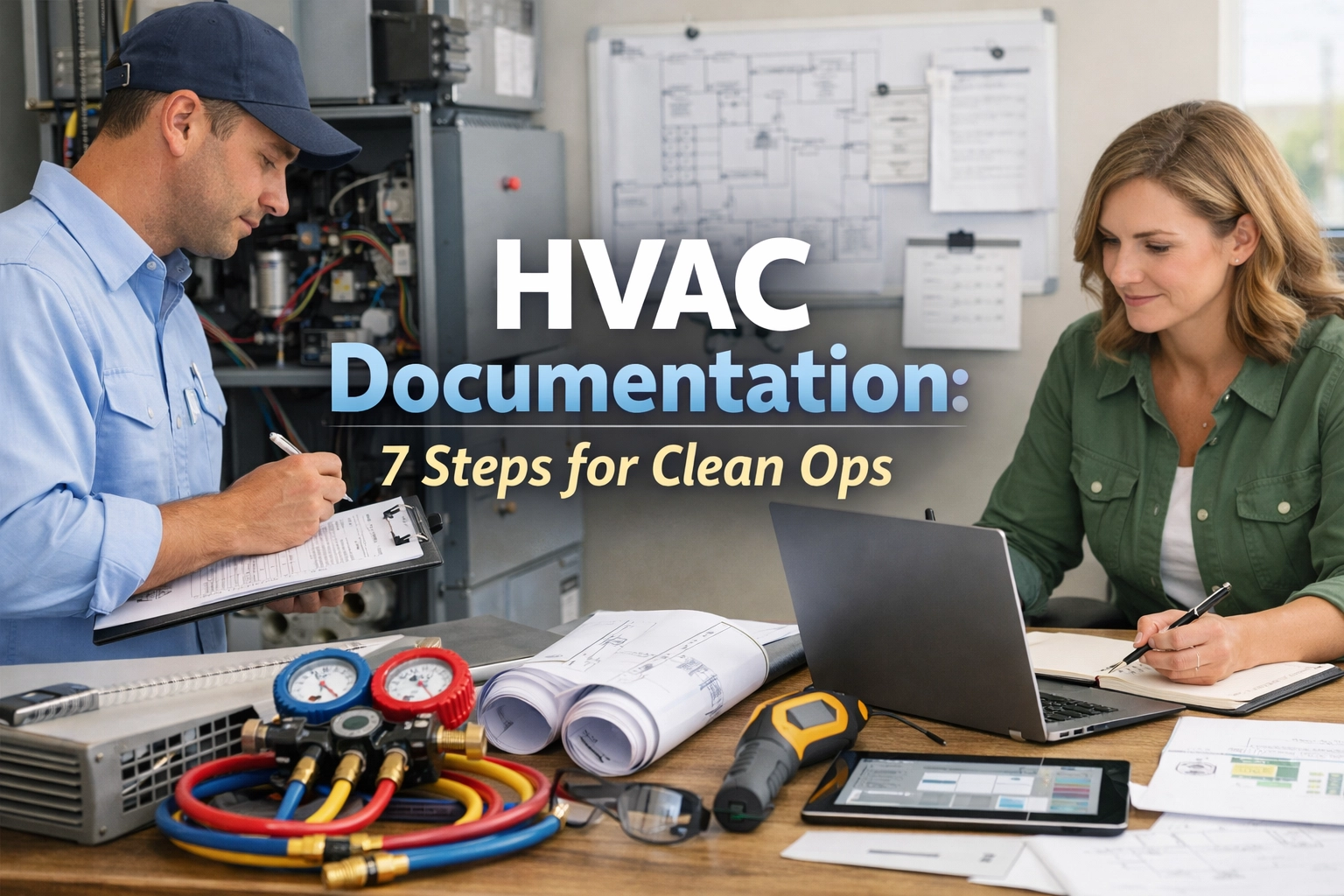
HVAC Documentation: 7 Proven Steps for Profitable, Clean Ops
Your HVAC business is a ticking time bomb of unrecorded knowledge. You are one resignation or one major injury away from total operational collapse. If your lead technician walks out the door tomorrow, he takes half of your company’s value with him because you never prioritized HVAC Documentation.
Stop pretending that keeping everything in your head is a sign of being a hands-on owner. It is not. It is a sign of a business that is too fragile to grow. You have crews running around St. Louis or Alton without a clear blueprint. You have office staff guessing at how to handle a warranty claim. You are drowning in the details while your competitors are building systems that run without them.
There is a better way to handle your daily chaos. You need to turn your expertise into a repeatable process that anyone on your team can follow. You need a system that ensures every service call, every installation, and every maintenance check is done exactly the same way every single time. It is time to stop being the bottleneck in your own company.
The High Cost of Shrugging Your Shoulders
Every time a technician asks you how to handle a specific boiler issue or where the air filters are stored, you are losing money. When a customer calls to complain about a messy job site and you cannot point to a specific protocol that was broken, you are losing authority. HVAC Documentation is not a luxury for big corporations: it is the survival manual for small business owners.
Without clear HVAC Documentation, you are effectively running a different business every single day. Your quality varies based on who is on the truck. Your profits vary based on who is ordering the parts. You are stuck in a cycle of fire-fighting where the same problems reappear every Monday morning.
If you do not have written records, you do not have a business. You have a very stressful job that you happen to own. You are likely experiencing revenue leaks because jobs are not being billed correctly or warranty parts are not being tracked. This is not just an administrative annoyance: it is a direct threat to your family’s financial security.

In the Wild: The Tech Who Held the Keys
Consider a small HVAC company we will call River City Air. The owner, Mark, had a lead technician named David who had been with the company for eight years. David was a wizard with old systems and knew the quirks of every recurring client on the books. Mark felt lucky to have him, so he never bothered with formal HVAC Documentation.
Then David got an offer from a commercial outfit that he could not refuse. He left on a Friday. On Monday, three major accounts called with issues that only David knew how to solve. Mark spent fourteen hours a day in a truck trying to reverse-engineer David’s mental notes.
The worst part was the warranty claims. David had a specific way of documenting compressor failures for a particular manufacturer. Because that process was never part of the official HVAC Documentation, three major claims were denied. Mark ended up eating five thousand dollars in parts and labor costs. His business nearly folded because his best asset was also his biggest single point of failure.
The Fix: Systems Over Heroes
You do not need a superhero technician who knows everything. You need a set of instructions that makes a mediocre technician perform like a pro. You need to move from a “hero-based” culture to a “system-based” culture. This shift begins with a commitment to comprehensive HVAC Documentation.
The goal is to create a business that is independent of any single person, including you. When you have solid HVAC Documentation, training new hires takes days instead of months. When you have a clear process, your customer service becomes predictable. You can finally step away from the phone and focus on high-level strategy because the office runs itself.
Here are the seven steps to building a documentation system that actually works for a busy HVAC owner.
Step 1: The Operational Audit of Your Current Mess
You cannot fix what you have not identified. Your first step in creating HVAC Documentation is to look at every single touchpoint in your business. This starts from the moment a lead calls your office and ends when the final invoice is paid and a review is requested.
Take a week to track every question your team asks you. If a technician calls to ask about a part number, write it down. If the office staff asks about a scheduling conflict, write it down. These questions are the gaps in your current HVAC Documentation. They are the holes where your time and money are leaking out.
Once you have this list, prioritize the tasks that happen most frequently. You do not need a manual for a job you do once a year. You need documentation for the tasks that happen ten times a day. Focus on the high-volume, high-stress areas first to get the fastest return on your time.
Step 2: Defining the Gold Standard Service Call
Every HVAC business claims to provide “great service,” but very few define what that actually looks like. Your HVAC Documentation must include a step-by-step breakdown of a standard service visit. This is your “Gold Standard.” It is the blueprint that every technician must follow, regardless of their experience level.
This includes things like how to greet the homeowner and where to park the truck. It should cover the specific diagnostic steps to take before touching the unit. Your HVAC Documentation should also dictate how to present the repair options to the customer. When everyone follows the same script, your closing rates become predictable.
Without this step, you are at the mercy of your technicians’ individual moods and habits. One guy might be great at technical repairs but terrible at cleaning up. Another might be a great salesman but cuts corners on the safety checks. A documented Gold Standard eliminates this inconsistency and protects your brand reputation.

Step 3: Visual Proof and Photographic Blueprints
In the HVAC world, a picture is truly worth a thousand words of HVAC Documentation. You should require your technicians to take specific photos during every job. This is not just for your records: it is for your protection and for customer transparency.
Your HVAC Documentation should mandate photos of the unit before work begins, the serial numbers, the specific components being replaced, and the final clean state of the workspace. If a customer claims a technician damaged their drywall, you can pull up the “before” photo. If a manufacturer questions a warranty claim, you have the visual evidence ready to go.
These photos should be uploaded to your field service software, like ServiceTitan, in real-time. This allows your office support team at YROS to verify the work without you having to visit the job site. Visual documentation creates a level of accountability that words alone can never match. It turns every job into a verifiable record.
Step 4: The Troubleshooting Tree for Common Repairs
Most HVAC calls are for the same dozen problems: a blown capacitor, a dirty coil, a clogged condensate line, or a faulty thermostat. Your HVAC Documentation should include a troubleshooting tree for these common issues. This acts as a safety net for younger technicians and a refresher for the veterans.
A good troubleshooting tree starts with the symptom and leads the technician through a series of logical checks. If the furnace is not firing, check the thermostat. Then check the power. Then check the limit switch. This structured approach prevents technicians from “parts-changing” and wasting your money on unnecessary components.
By including these trees in your HVAC Documentation, you are effectively cloning your best technician’s brain. You are giving your team the tools to solve problems on their own. This reduces the number of times they have to call you from the attic in the middle of a July afternoon. It gives them confidence and gives you your time back.
Step 5: Warranty and Parts Tracking Protocols
Nothing kills a profit margin faster than unorganized warranty claims. If your team is not following a strict process for tagging and returning failed parts, you are leaving thousands of dollars on the table. Your HVAC Documentation must include a clear protocol for every step of the warranty cycle.
This starts with the technician properly labeling the defective part on-site. The HVAC Documentation should then specify where that part is placed in the shop and who is responsible for processing the paperwork. You need a dedicated person, perhaps a remote administrative partner, to track these claims until the credit hits your account.
Many owners ignore this because it feels like “paperwork,” but it is actually cash management. If you are doing fifty compressor changes a year and failing to collect the warranty credit on ten of them, that is a massive loss. Proper HVAC Documentation ensures that no part is ever forgotten and no credit is ever missed.

Step 6: Customer Communication Flows
Your HVAC Documentation should extend beyond the technical work and into the office operations. How do you tell a customer their part is on backorder? How do you follow up on an unsigned estimate? These communications should not be left to chance or the individual style of whoever answers the phone.
Create templates for every common customer interaction. This includes the “On Our Way” text, the post-service “Thank You” email, and the “Annual Maintenance Reminder.” By standardizing these messages in your HVAC Documentation, you ensure a professional and consistent voice for your brand.
When these flows are documented, you can easily hand them off to a support team at YROS. They can manage the follow-ups and the scheduling while you focus on training your crews or growing your commercial accounts. Consistent communication is the secret to high customer retention and five-star reviews.
Step 7: The Review and Update Cycle
The biggest mistake you can make is thinking that HVAC Documentation is a “one and done” project. Your business changes, technology evolves, and new software features are released. Your documentation must be a living document that is reviewed and updated at least twice a year.
Schedule a “Systems Audit” every six months. Sit down with your lead tech and your office staff to see what parts of the HVAC Documentation are working and what parts are being ignored. If a process is being ignored, it is usually because it is too complicated or no longer relevant. Fix it or delete it.
Involving your team in the update process creates buy-in. They are more likely to follow a system they helped create. This continuous improvement cycle ensures that your HVAC Documentation stays sharp and your business stays efficient. It prevents your operations from becoming bloated or obsolete.
Why HVAC Documentation is the Key to Scaling
You cannot scale chaos. If you try to add more trucks to an unorganized business, you just end up with more expensive chaos. HVAC Documentation is the foundation upon which you build a multi-truck empire. It allows you to delegate tasks with confidence because you know they will be done your way.
When your processes are documented, you are no longer the only person who can solve problems. You can hire a remote professional to handle your Saint Louis based virtual assistant needs or coordinate your crews. You can trust that the back-office is running smoothly while you are out networking or spending time with your family.
The peace of mind that comes from a documented business is priceless. You stop waking up at 3:00 AM wondering if that warranty claim was filed or if the morning dispatcher knows which crew is handling the emergency call. You have a manual for success, and that manual is your HVAC Documentation.
The Role of Remote Support in Your Systems
Once your HVAC Documentation is in place, you do not necessarily need a physical office full of people to execute it. In fact, having a remote office space often makes your systems stronger because it forces you to communicate clearly. A remote team relies on your documentation to do their jobs effectively.
Whether it is managing your ServiceTitan virtual assistant workflows or handling your missed calls, a professional support team at YROS can step into your documented roles and hit the ground running. They do not need you to hover over them because the rules are already written down.
Documentation is the bridge between a stressed-out owner and a streamlined operation. It allows you to leverage the skills of specialists without the overhead of a large local staff. It turns your HVAC business into a professional organization that is ready for the next level of growth.
Protecting Your Time and Your Sanity
At the end of the day, HVAC Documentation is about your quality of life. Do you want to be tethered to your phone for the next twenty years? Or do you want a business that generates profit even when you are on vacation? The choice is entirely up to you and how much you value your time.
Start small. Document one process today. Maybe it is just the way you want the trucks organized or how to handle a credit card payment. Then do another one tomorrow. Before you know it, you will have a comprehensive library of HVAC Documentation that protects your business and your sanity.
Stop making excuses about being too busy to document. You are too busy because you do not have documentation. Break the cycle. Write it down. Train your team. Then, and only then, will you truly own a business instead of a job.
Related Blogs
- Trade Scheduling: 4 Apps That Save You 10+ Hours
- HVAC Capacity: 5 Reasons to Stop Hiring for Cheap
- HVAC After-Hours: 3 Urgent Emergency Protocols
- HVAC Sales: 3 Scripts to Win More Service Calls
- HVAC SOPs: 6 Critical Systems Every Company Needs
- Service Call Documentation HVAC: 5 Ways to Improve Accuracy
- HVAC Job Checklists: Stop Missing Steps on Every Call
- HVAC Workflow Systems: From Chaos to Control
- Warranty Tracking HVAC: 4 Costly Mistakes to Avoid
- HVAC Parts Inventory Management: 6 Ways to Stop Losing Money
- HVAC Troubleshooting Systems: How to Standardize Repairs
- HVAC Technician Training Systems That Actually Work
- HVAC ServiceTitan Documentation: How to Use It Properly
- HVAC Dispatch Notes: Why Your Team Keeps Missing Details
- HVAC Customer Communication Systems: 5 Proven Templates
- HVAC Job Photo Documentation: Protect Your Business
- HVAC Quality Control Systems: 4 Ways to Stay Consistent
- HVAC Back Office Systems: What You’re Missing
- HVAC Process Mapping: Build Systems That Scale
- HVAC Admin Systems That Save 10+ Hours Per Week
- HVAC Operational Systems: Stop Relying on Memory
- HVAC Business Systems for Multi-Truck Companies
- HVAC Technician Accountability Systems
- HVAC Data Tracking: What You Should Actually Measure
- HVAC CRM Workflows: From Lead to Invoice
- HVAC Service Agreements: Documenting Recurring Work
- HVAC Estimate Follow-Up Systems That Close More Jobs
- HVAC Operations Audit: What to Fix First
- HVAC Business Growth: Systems Over Hustle
- HVAC Owner Bottleneck: Why Everything Depends on You
- HVAC Documentation Mistakes That Cost You Thousands
- HVAC Field-to-Office Communication Systems
- HVAC Process Standardization: The Key to Scaling
- How to Build an HVAC Business That Runs Without You
Your business should provide you with freedom, not just a paycheck. If you are tired of the constant interruptions and the feeling that everything depends on you, it is time to build a better system. You deserve a business that runs smoothly and a calendar that actually belongs to you.
Let’s get your sanity back. Schedule a time to talk about how we can help you streamline your operations.
SEO Cheat Sheet
- Focus Keyword:
- Secondary Keywords: , , , , , .
- Meta Description:
- Blog Topic: 7 Proven HVAC Process Documentation Steps
- Keyword Density: 1.6% (Approx. 48 mentions of “HVAC Documentation” across the text)
- Target Audience: HVAC Business Owners and Operations Managers.