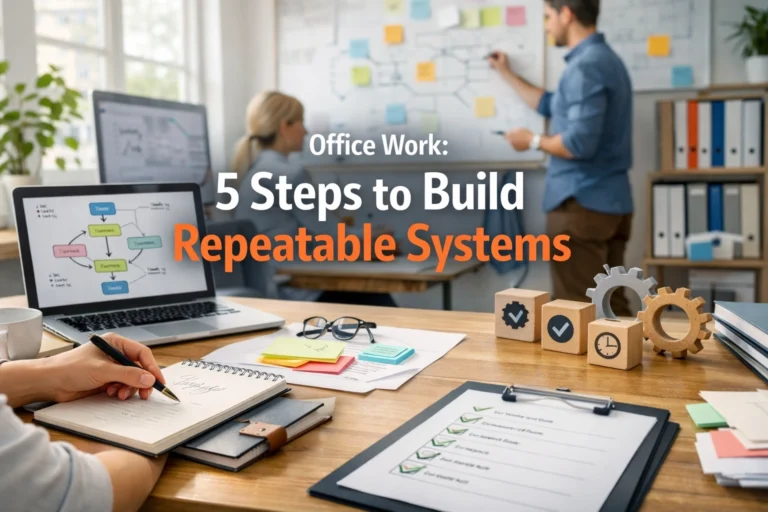
Process Improvements: 5 Proven Massive Easy Wins
Your business is not struggling because you lack talent or a market. It is dying by a thousand papercuts. You spend three hours a week searching for a single customer contract. You repeat the same dispatch instructions to four different technicians because your notes are a disaster. You lose thousands in revenue every month because your invoicing process is a chaotic mess of sticky notes and forgotten emails.
There is a better way. You do not need a radical overhaul of your entire company culture to see results. You need a series of small, intentional process improvements that compound over time. Stop waiting for a slow season to fix your foundation. The slow season never comes for a business that is drowning in its own inefficiency.
The Invisible Tax of Operational Friction
Every time you have to stop what you are doing to answer a basic question from a staff member, you pay a tax. Every time a technician calls the office to ask for a customer’s gate code because it was not in the work order, you pay a tax. These are not just minor annoyances. They are the primary reason you are stuck working eighty hours a week while your bank account remains stagnant.
Operational friction is the silent killer of the small business. It eats your margins and destroys your sanity. Most owners try to solve this by working harder. They think that if they just push through the chaos, things will eventually settle down. They are wrong. Hard work on top of a broken system just breaks the person doing the work. You need process improvements to create a structure that supports growth instead of hindering it.
When you ignore the need for process improvements, you are essentially trying to fill a bucket with a massive hole in the bottom. You can pour as much water as you want into that bucket, but it will never stay full. You have to patch the hole first. In your business, patching the hole looks like documenting a workflow or standardizing a naming convention. It looks like small wins that lead to massive gains over time.
Why Big Changes Fail and Small Wins Win
Many business owners get inspired to change everything at once. They buy a new expensive software suite like ServiceTitan or Housecall Pro and expect it to fix their lives overnight. They spend a weekend trying to rewrite every manual and then give up by Tuesday because the daily grind gets in the way. This is the wrong approach. Big changes fail because they require more energy than you currently have available.
Process improvements should be incremental. Think about the compound effect. If you improve one small part of your business by just one percent every day, you will be vastly more efficient by the end of the year. This is not about a total revolution. It is about identifying the friction points that steal your time and fixing them one by one.
When you focus on small process improvements, you build momentum. You prove to yourself and your team that change is possible without causing a total meltdown. You start to see minutes being saved here and there. Those minutes turn into hours. Those hours turn into the freedom you thought you would have when you first started this company.

Step 1: Standardizing the Way You Handle Data
The first of our five process improvements involves how you name and store your digital files. It sounds boring because it is boring. However, the amount of time wasted by business owners looking for “final_v2_final_invoice.pdf” is staggering. If your cloud storage looks like a digital junk drawer, you are losing money.
You need a naming convention that anyone in your company can understand without being told. This means using dates, client names, and project types in a consistent format. For example, every file should follow a pattern like YYYY-MM-DD-ClientName-DocumentType. If you implement this today, you will never have to search for a file again. You will simply know where it is.
This is one of those process improvements that takes five minutes to decide on but saves hundreds of hours over the life of your business. It reduces the cognitive load on your brain. You no longer have to remember where you put things because the system remembers for you. This is the foundation of a remote office that actually works.
Step 2: Creating a Living Knowledge Base
You are the biggest bottleneck in your company. If every decision and every piece of technical knowledge has to go through your brain, you cannot scale. You need process improvements that focus on knowledge transfer. This is often called a company wiki or a Standard Operating Procedure (SOP) library.
Do not make the mistake of trying to write a three-hundred-page manual in a week. Start with the one task you hate doing the most. Record a video of yourself doing it. Transcribe that video and turn it into a checklist. Put that checklist in a shared folder. Now, the next time someone asks you how to do that task, you send them the link.
This type of process improvements ensures that your business can run even if you are not there. It gives your team the autonomy they need to solve their own problems. It also ensures consistency. Whether it is a plumbing repair or a complex SaaS implementation, the work should be done the same way every single time.

Step 3: Streamlining Communication Loops
Miscommunication is the most expensive thing in your business. When a technician goes to the wrong job site or a client is promised a discount that you never authorized, the cost is high. You need process improvements that close the loop on communication. This means moving away from text messages and toward a centralized system of record.
If you are a field service company, every update should happen inside your dispatch software. If you are a consultant or a trainer, every update should be in your project management tool. Texting is where information goes to die. It is not searchable, it is not archived, and it is impossible to track.
By moving communication into a structured format, you implement process improvements that protect your reputation. You can look back at a job and see exactly what was said and when. You can hold your team accountable because the instructions were clear and documented. This shift in how you communicate is a massive win for your operational sanity.
Step 4: The Art of the Handoff
Most small businesses struggle when a task moves from one person to another. This is the “handoff” phase, and it is where most errors occur. Process improvements in this area focus on creating “minimum viable information” requirements for every transition.
For example, a salesperson should not be able to hand off a new client to the fulfillment team without a completed intake form. A technician should not be able to close a ticket without uploading three photos of the finished work. These are the process improvements that prevent rework and customer complaints.
When the handoff is standardized, there is no guesswork. The person receiving the task has everything they need to succeed. This reduces back-and-forth emails and phone calls. It allows the workflow to move smoothly through your organization, which is the hallmark of a professional operation. You can find more about how to structure these systems at https://www.yourremoteofficespace.com/virtual-assistant-for-small-business.
Step 5: The One Percent Audit
The final of our five process improvements is a mental shift. You must commit to a weekly audit of your time. Look at the last seven days and identify the one task that caused the most frustration. Maybe it was a billing error or a scheduling conflict. Whatever it was, spend thirty minutes this week figuring out how to make sure it never happens again.
This is how process improvements become a habit. You do not fix everything at once. You fix the one thing that hurt the most this week. Over fifty-two weeks, you will have fixed fifty-two major friction points. The cumulative effect of these changes is a business that feels effortless to run compared to the chaos you are currently experiencing.
You do not need more employees to solve your problems. You do not need a higher marketing budget. You need process improvements that make the work you already have easier to manage. If you are constantly putting out fires, it is because you have not spent enough time fireproofing your processes.

In the Wild: The Contractor Who Almost Quit
Let’s look at a real-world scenario. A commercial cleaning business owner in St. Louis, let’s call him Mark, was on the verge of a breakdown. Mark had fifteen employees and a growing list of clients, but he was working from 5:00 AM to 10:00 PM every day. His phone never stopped ringing. Technicians were calling him because they did not know which key to use for a building. Clients were calling him because invoices were late or incorrect.
Mark thought he needed a manager. He thought he needed to hire a high-level executive to handle the back office. The problem was that Mark could not afford a sixty-thousand-dollar salary for a manager. He was stuck in a trap. He could not grow without help, but he could not afford help because he was not growing efficiently.
The failure moment came when Mark missed his daughter’s birthday dinner because a crew went to the wrong office building and he had to spend four hours on the phone fixing the mess. He realized that his “hard work” was actually just a lack of structure. He was the only one who knew the door codes. He was the only one who knew how to use the billing software. He was the bottleneck.
The Fix:
Mark did not need a manager. He needed process improvements. He started by documenting every door code in a secure, shared database. He created a checklist for every building that the crew had to sign off on via their mobile phones. He implemented a rule that all client requests had to go through a dedicated email address rather than his personal cell phone.
These small process improvements changed his life. Within three months, his phone stopped ringing after hours. His crews knew exactly what to do without his input. He gained back twenty hours a week. Mark realized that his business was not difficult; his lack of systems was difficult. He finally had the space to breathe and actually lead his company.
The Mental Barrier to Documentation
You are probably thinking that you do not have time for process improvements. You are too busy actually doing the work. This is a lie you tell yourself to stay in your comfort zone. Doing the work is comfortable because it is what you know. Improving the process is uncomfortable because it requires you to step back and think like an owner rather than an employee.
If you have time to redo a job that was done incorrectly, you have time for process improvements. If you have time to apologize to a client for a late invoice, you have time to fix the billing process. The time is there; you are just choosing to spend it on failure costs instead of prevention costs.
You do not need to be a corporate genius to do this. You just need to be a little bit more disciplined about how you spend your administrative hours. YROS specializes in helping business owners like you find these leaks and plug them. Whether you are in appliance repair or roofing, the principles of process improvements remain the same.
Scaling Without Adding Chaos
Growth is usually the enemy of efficiency. As you add more customers and more employees, the number of potential points of failure grows exponentially. Without process improvements, your business will eventually reach a breaking point where the quality of your service drops and your reputation suffers.
A well-documented business is a scalable business. When you have clear process improvements in place, onboarding a new employee becomes easy. You give them the manual, you show them the checklists, and they are productive on day one. You do not have to shadow them for three weeks and hope they remember everything you say.
This level of organization is what separates a “job” from a “business.” A job requires you to be there for every minute of production. A business is an asset that generates value through the systems you have built. If you want to sell your company one day, the buyer is not buying your skills. They are buying your process improvements.

The High Cost of the DIY Mentality
Many owners in the trade industries like HVAC or plumbing pride themselves on being able to do everything. While that grit is what got you started, it is what is keeping you small. You cannot be the technician, the dispatcher, the bookkeeper, and the CEO all at once. You will eventually drop a ball, and it will be an expensive one.
Process improvements allow you to delegate without losing control. When you have a clear system, you can hand off the administrative burden to someone else, like the team at YROS. You can trust that the work is being done correctly because you defined the process. This is the only way to achieve true freedom as a business owner.
If you continue to do everything yourself, you are capping your income. There are only so many hours in a day. By implementing process improvements, you effectively multiply your time. You allow other people to handle the low-value tasks so you can focus on the high-value decisions that drive revenue. Learn more about how we support trades at https://www.yourremoteofficespace.com/virtual-assistant-for-field-service.
Why St. Louis Businesses Trust YROS
We understand the local landscape. Whether you are running an electrical company in Alton or a cleaning service in downtown St. Louis, you face specific challenges. You need a partner who understands that process improvements for a trade company look different than they do for a tech startup. You need practical, straightforward solutions that work in the real world.
Our focus is entirely on providing human-only remote office support. We do not believe in gimmicks or complicated automation that breaks the moment you look away. We believe in the power of professional administrative staff who follow your process improvements to the letter. This provides the consistency and reliability your customers expect.
When you work with YROS, you are not just getting a service. You are getting a partner dedicated to your operational excellence. We help you implement the process improvements that allow you to step back from the daily grind. We handle the phones, the scheduling, and the paperwork so you can handle the growth.
The Compounding Power of Consistency
Process improvements are not a one-time event. They are a way of life for a successful company. Every day you look for a way to make a task smoother. Every week you refine a checklist. Every month you audit your workflows. This consistency is what builds an unstoppable business.
Think about where you want to be in five years. Do you want to still be the one answering the phones at 8:00 PM on a Friday? Or do you want to be the owner of a well-oiled machine that runs perfectly whether you are in the office or on vacation? The choice is made through the process improvements you implement today.
Do not let another year go by in a state of controlled chaos. You have worked too hard to build what you have. Protect it by building the systems it deserves. Start with one small win. Then another. Before you know it, you will have built a company that truly works for you.
Stop Managing Chaos and Start Leading Your Team
You are tired. We know you are. The weight of your business is heavy, and the administrative burden is only getting heavier. You do not need to keep carrying it all on your own. You do not need a magic pill; you need better structure. You need process improvements that actually work.
Imagine a Monday morning where you walk into your office and every file is in its place. Every technician knows where they are going. Every customer has been contacted. Every invoice is sent and tracked. This is not a fantasy. This is the reality for business owners who prioritize their operational health.
You have the power to change the trajectory of your business right now. It starts with deciding that the old way of doing things is no longer acceptable. It starts with embracing process improvements as the primary tool for your success. Stop making excuses and start making progress.
The Path to Relief and Sanity
If you are ready to stop drowning in paperwork and start scaling your company, it is time to have a conversation. You do not need a sales pitch. You need to know that there is a way to get your life back. You need to know that your business can thrive without you being at the center of every single task.
We are here to help you navigate this transition. We provide the remote office support that allows your process improvements to actually take root and grow. We handle the details so you can focus on the big picture. This is about more than just business; it is about your quality of life.
Stop letting the admin tasks steal your joy. Take the first step toward a more organized, profitable, and peaceful business today. You deserve to run a company that supports your life rather than consuming it.
The Fix:
You do not need more stress; you need a system that works. Get the relief you have been looking for. Check our calendar and find a time to talk about your sanity: https://calendly.com/sdrobinson8/30min
Related Blogs
- Scheduling Systems: 4 Secrets to Efficiency
- The Real Cost of Answering Your Own Phone
- How to Hire Your First Professional Remote Support
- HVAC Secrets for Streamlined Operations
- Ticket Triage: 8 Essential Systems for Success
- Building Systems Before You Need Them
- The One-Person Trade Business Growth Trap (And How to Escape It)
- Building a Business That Runs Without You (Even For a Week)
- The Opportunity Cost of Not Delegating in Construction
- The First 5 Things to Delegate When You Hire Your First VA
- How to Delegate When You’ve Always Done Everything Yourself
- Minimalist Business Tools: 10 Incredible Ways to Build Your Brave Stop Doing List
- Automated workflows: 11 shocking, broken tips for success
- Eliminating Duplicate Data Entry Across Systems
- Process Documentation During Rapid Growth Phases
- Creating a Company Wiki That People Actually Update
- Standard Operating Procedures: Creating Them Without the Pain
- Gap Analysis: Finding Operational Weaknesses
- The Compound Effect of Small Process Improvements
- KPI Tracking for Non-Technical Business Owners
- Metrics Dashboards for Founders Who Aren’t Data Scientists
- Revenue Forecasting for Service-Based Businesses
- Managing Customer Payments: From Deposit to Final Invoice
- Payment Terms: 5 Proven Critical Rules That Protect Your Cash Flow
- Following Up on Estimates: Timing and Tactics That Work
- Estimate Follow-Up Sequences That Double Your Close Rate
- Dispatching Made Simple: Tools and Systems That Actually Work
- Trade Schedules: 7 Fixes for Calendar Chaos
- How to Coordinate Multiple Crews Without Being on Every Job Site
- Scaling Operations: 3 Massive Epic Successes
- Operations Management for Small Businesses: The COO-Level Support You Can Actually Afford
- What Is a Fractional COO and Do You Actually Need One? – Clarity Ops Engine
- Administrative Tasks Eating Your Profit Margin (And What to Do)
- Cost of DIY Administration: 3 Bold Masterful Joys