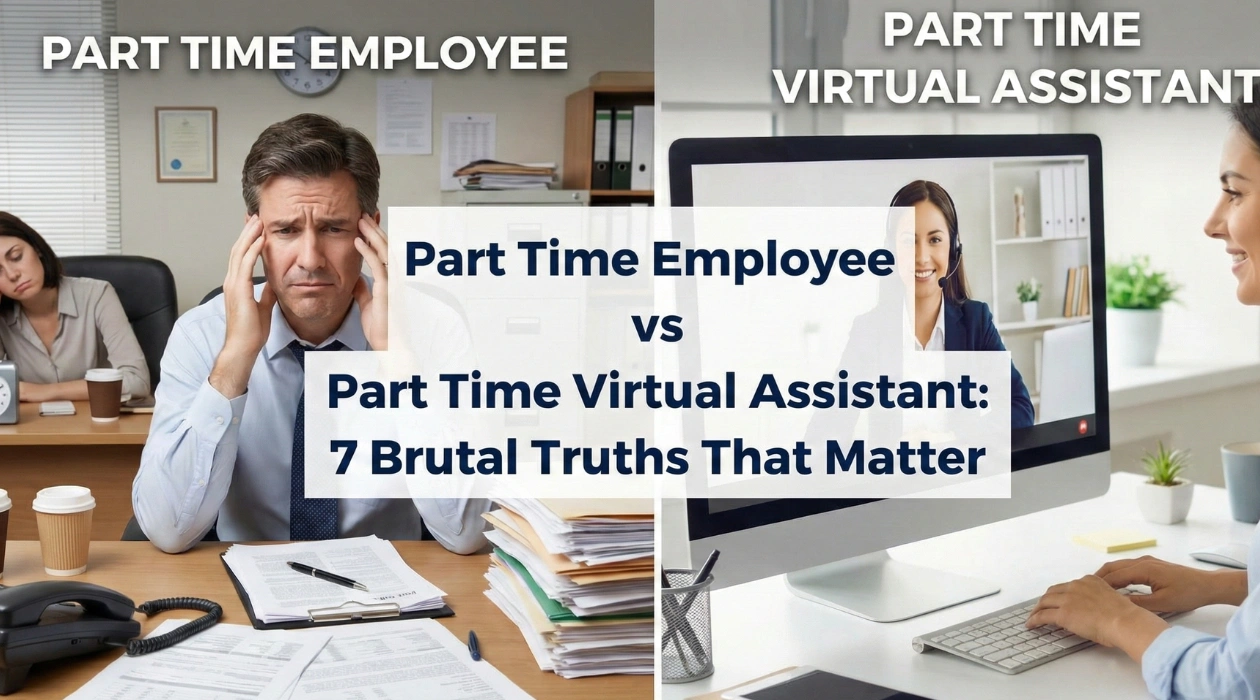
Part Time Employee vs Part Time Virtual Assistant: 7 Brutal Truths That Matter
When business owners begin the search for help, they often start with a sense of desperation mixed with hesitation. You are drowning in administrative tasks, missing calls, and working late into the evening, but the idea of bringing someone else into your business feels daunting. Most owners eventually find themselves staring at two distinct paths, trying to weigh the pros and cons of a part time employee vs part time virtual assistant. While the comparison often starts with financial calculations, most owners are actually asking a much deeper, more emotional question: What solution will give me immediate relief without creating a brand new set of problems to manage?
For the vast majority of small and service-based businesses, the traditional route of hiring staff is fraught with hidden complexities. This is where the modern solution shines. In the battle of the part time employee vs part time virtual assistant, the virtual assistant frequently wins because it delivers immediate support, predictable costs, and significantly less risk than hiring a W2 employee. This reality is exactly why forward-thinking companies turn to Your Remote Office Space, or YROS, to secure reliable, U.S.-based help without adding the heavy burden of payroll complexity.
What This Decision Is Actually About
The internal monologue regarding the choice of a part time employee vs part time virtual assistant often sounds highly emotional to the business owner. You might find yourself saying things like, “I want someone who feels invested in my vision,” or “I am terrified of losing control over my quality,” or perhaps simply, “Hiring feels like such a massive step that I am not ready to take.” These are valid feelings, but they can cloud the operational reality.
Operationally, the decision does not have to be emotional. It comes down to three cold, hard metrics. First, you must determine how fast you need help. Second, you must calculate how much financial and legal risk you can afford to take on. Third, you must honestly assess how much time you have available to spend managing another human being. YROS was built specifically for owners who have realized they do not actually need another employee to manage; they simply need their business to run smoother right now.
1. The Financial Breakdown: The Cost Is Not Just the Hourly Rate
When you sit down with your calculator to look at the numbers, it is easy to make a mistake. You might look at an hourly wage for a local worker and compare it to a service rate, thinking they are apples-to-apples comparisons. However, in the analysis of a part time employee vs part time virtual assistant, the hourly rate is only the tip of the iceberg.
A part-time employee brings a host of hidden costs that do not appear on the initial job offer but definitely appear on your profit and loss statement. You must account for payroll taxes, which instantly add a percentage on top of every dollar paid. You must carry workers’ compensation insurance to protect yourself against accidents, even for desk workers. You have to consider the cost of paid downtime.
When an employee is at the water cooler, in the bathroom, or simply transitioning between tasks, you are paying for that time. Furthermore, there is the immense cost of training and supervision. Your time has a dollar value, and every hour you spend teaching a new hire is an hour you are not billing clients or growing the business.
With YROS, the financial model is entirely different. You pay for productive work only. There is no payroll tax, no insurance premium, and no paying for lunch breaks. When comparing part time employee vs part time virtual assistant, most owners are shocked to discover how much more predictable and efficient virtual support really is. You receive a single invoice for services rendered, allowing you to forecast your expenses with 100% accuracy.
2. Speed to Support: Why Urgency Changes the Equation
Time is often a more scarce resource than money for a growing business. If you are drowning in work today, you cannot afford a solution that starts six weeks from now. Hiring a part-time employee is a slow, methodical process. It can take weeks or even months to write a job description, post it, sift through resumes, conduct interviews, negotiate an offer, and wait for a two-week notice period to end at the candidate’s current job.
In the debate of a part time employee vs part time virtual assistant, speed is a massive differentiator. YROS clients typically onboard in days, not months. We have a roster of vetted, professional U.S.-based assistants ready to step in. If your phone is ringing off the hook, calls are being missed, and administrative work is bleeding into your nights and weekends, you do not have the luxury of a long recruitment drive. In these scenarios, the choice between a part time employee vs part time virtual assistant becomes a question of urgency, not theory. You need the leak plugged now, and a virtual assistant system is designed for rapid deployment.
3. The Management Burden: A Real Cost You Cannot Ignore
One of the most overlooked aspects of the part time employee vs part time virtual assistant conversation is the energy required to manage people. Employees require daily oversight. They need you to coordinate their schedules. They require ongoing coaching, career development discussions, and performance reviews. They bring human complexity into your office, including sick days, car troubles, and interpersonal dynamics.
If you are already overwhelmed, adding a management layer to your day is counterproductive. YROS virtual assistants work from documented processes with clear expectations. Because they are professionals who operate remotely, they are disciplined and self-sufficient. This means fewer interruptions for you and significantly less explaining. For overwhelmed owners, the decision of part time employee vs part time virtual assistant often hinges on how much management energy is left in the tank. If your tank is empty, you need a service that manages itself, not a person you have to manage.
4. Flexibility Without Human Resources Stress
Business is rarely a flat line. You have busy seasons and slow seasons. You have projects that ramp up and projects that wind down. A traditional employee structure is rigid. If you hire someone for twenty hours a week, they expect twenty hours a week, regardless of your current workload. Cutting their hours can lead to resentment or them quitting, while trying to add hours might conflict with their other commitments.
This rigidity is why the flexibility factor in the part time employee vs part time virtual assistant debate is so critical. With YROS, you can increase or decrease hours based on your actual business needs. You can shift responsibilities as your focus changes. You can adapt to the market without worrying about compliance concerns, unemployment claims, or changing employment contracts. Employees simply do not offer that same level of elasticity. This agility is a primary reason why the comparison of part time employee vs part time virtual assistant so often favors the virtual support model for small businesses.
5. Lower Risk and Fewer Regrets regarding Hiring
Hiring a human being carries inherent risk. There is the risk of a “wrong fit,” where the person looks great on paper but disrupts your culture or fails to perform. There are compliance mistakes that can lead to fines. There are the uncomfortable, sometimes litigious, difficulties of firing someone.
YROS significantly reduces this risk profile. When you engage with us, you are engaging in a B2B relationship, not an employer-employee relationship. We offer month-to-month support, proven onboarding processes, and clear scopes of work. If a specific virtual assistant isn’t the perfect match, we can swap them out without you needing to fire anyone or handle unemployment paperwork. Risk reduction is a major, but often overlooked, factor in the part time employee vs part time virtual assistant decisions owners must make. Why bet your peace of mind on a single hire when you can lean on a professional system?
6. One Person vs a Support System
When you hire a single part-time employee, you are limited by that one person’s skills, availability, and health. If they get sick, your support stops. If they don’t know how to use a specific piece of software, you have to train them or pay for a course.
In the comparison of part time employee vs part time virtual assistant through YROS, you are often tapping into a broader support system. YROS assistants commonly handle a diverse range of tasks including phone answering, complex scheduling, inbox management, CRM updates, invoicing, and follow-ups. Because we are a company, not just a freelancer, we have systems in place to ensure continuity. From a coverage standpoint, the analysis of part time employee vs part time virtual assistant almost always favors a virtual model because it offers redundancy and a wider breadth of knowledge.
7. Results Over Presence: The Shift in Mindset
There is an old-school mentality that says if you can see someone sitting at a desk, they are working. This is the “presence” bias. Employees are often measured by the hours they physically occupy a chair. However, presence does not equal productivity.
YROS virtual assistants are measured by outcomes delivered. Did the inbox get to zero? Were the calls answered professionally? Was the invoice sent? If your goal is fewer dropped balls and more consistency, the choice between a part time employee vs part time virtual assistant becomes an easy call. You stop paying for “attendance” and start paying for “achievement.” This shift in mindset is crucial for modern business efficiency.
How to Determine What You Actually Need
To make the right choice in the part time employee vs part time virtual assistant dilemma, you must audit your own bottlenecks. Take a piece of paper and write down everything you did today that you did not want to do. Did you spend an hour scheduling appointments? Did you spend two hours answering basic email inquiries? Did you spend thirty minutes trying to format a document?
These are the tasks that kill your growth. A part-time employee can do these things, but they require a physical desk, a computer, software licenses, and your constant physical supervision. A virtual assistant can simply take the login credentials and get the work done while you are out meeting clients. When you view the workflow through this lens, the part time employee vs part time virtual assistant debate clarifies instantly.
The Hidden Logistics of Physical Employees
Let us look deeper into the logistics of the part time employee vs part time virtual assistant conversation. If you hire an employee, where will they sit? Do you have office space? If you work from home, are you comfortable having a stranger in your house every day? Do you need to buy a second desk? A second computer? An ergonomic chair?
These are not trivial questions. They are capital expenses. With a virtual assistant, the infrastructure is already there. They have their own office, their own computer, and their own internet connection. You are renting their efficiency, not buying their furniture. This logistical freedom is a massive point in favor of the VA in the part time employee vs part time virtual assistant matchup.
The Quality of Talent: A Geographic Advantage
When you look for a local part-time employee, you are limited to the talent pool within a twenty-mile radius of your office. In many markets, finding high-quality administrative help who only wants part-time hours is incredibly difficult. You are competing with every other local business for a very small group of people.
In the part time employee vs part time virtual assistant comparison, the VA route blows the geographical constraints wide open. YROS provides U.S.-based support, but we recruit from a national pool of talent. We find the best professionals regardless of where they live, meaning you get higher quality support than you could likely find down the street. We handle the vetting, the background checks, and the skill testing. You just get the talent. This access to superior talent is a defining victory for the virtual side of the part time employee vs part time virtual assistant debate.
When a Part-Time Employee Makes Sense
To be intellectually honest, we must acknowledge that the part time employee vs part time virtual assistant choice is not always 100% in favor of virtual. A part-time employee may still be the right fit when the work must be done onsite. If you run a retail store and need someone to stock shelves, you need an employee. If you run a manufacturing plant and need someone to move boxes, you need an employee. If physical equipment that cannot be accessed remotely is involved, or if in-person customer service is a requirement of the role, then hiring is necessary.
However, even in these businesses, there is usually a split in duties. The person stocking the shelves does not need to be the person answering the phone or managing the email. Many businesses use YROS alongside their physical employees to eliminate admin overload for everyone. So, even when an employee is necessary, the part time employee vs part time virtual assistant question might actually result in a hybrid answer: You need both, but for very different roles.
Why YROS Is the Better Choice for Admin and Operations
YROS is ideal if you are buried in administrative work. If calls go unanswered while you are working on a job site or in a meeting, you are losing money. If you need help quickly and cannot wait for a six-week hiring cycle, you need YROS. If you want U.S.-based support without the hiring risk, we are the solution.
For most service businesses, the comparison of part time employee vs part time virtual assistant ends with virtual support winning on efficiency and peace of mind. We are designed to integrate into your business seamlessly. We become part of your team, appearing to your customers as if we are sitting right in your office, even though we are remote. This gives you the professional image of a larger company without the overhead of a larger staff.
Real-World Outcome: What Owners Experience
Owners who switch from the mindset of hiring a part-time employee to utilizing YROS often report a dramatic shift in their quality of life. They report fewer interruptions during their “deep work” time. They see better customer response times, which leads to higher customer satisfaction and retention. Perhaps most importantly, they get more evenings and weekends back to spend with their families.
That is the part time employee vs part time virtual assistant scenario playing out in real life. It is not just about a spreadsheet; it is about reclaiming your life from the jaws of your business. It is about waking up and knowing that the inbox is being handled, the phones are being answered, and you are free to do the high-value work that only you can do.
The Training Gap
Consider the training gap in the part time employee vs part time virtual assistant discussion. When you hire an employee, they often come to you with general skills but no specific process knowledge. You have to build the training materials. You have to sit next to them and show them how to do things.
At YROS, we specialize in rapid assimilation. We know how to document processes. We know how to pick up the ball and run with it. Because our VAs are experienced professionals, they often bring best practices to the table that you might not have thought of. They can suggest better ways to organize your files or better ways to handle scheduling. In the part time employee vs part time virtual assistant dynamic, the VA often acts as a consultant and a doer, adding value that a junior employee simply cannot providing.
The Scalability Factor
Growth is the goal, but growth breaks systems. If you rely on a single part-time employee, what happens when you double your revenue? That employee burns out, or you have to go through the painful hiring process all over again.
In the context of part time employee vs part time virtual assistant, the virtual model is infinitely more scalable. If your volume doubles, YROS can adjust. We can allocate more hours or more resources to handle the load. You do not have to scramble to put another desk in the office. You just let us know, and we handle the capacity planning. This scalability is essential for businesses that have aggressive growth goals. It ensures that your back office never becomes the bottleneck that slows down your front line.
Protecting Your Intellectual Property and Data
Security is a valid concern. When considering a part time employee vs part time virtual assistant, owners worry about data privacy. With a physical employee, you feel a sense of security because they are in the room. However, data theft can happen anywhere.
YROS operates with high standards of professionalism and confidentiality. We are a U.S.-based entity subject to U.S. laws. This offers a layer of protection and recourse that you might not get with offshore VAs, and it offers a level of professional separation that can sometimes be blurrier with casual part-time hires. When weighing part time employee vs part time virtual assistant, knowing that you are contracting with a reputable American company provides a safety net for your sensitive business information.
The Emotional Toll of Turnover
Turnover is a business killer. The average tenure of a part-time employee is often short. They might be students, or people looking for a stop-gap until they find a full-time role. Every time they leave, you are back to square one. You have to recruit, hire, and train all over again.
The part time employee vs part time virtual assistant comparison must account for this emotional toll. YROS provides stability. Even if life changes for a specific VA, the YROS system ensures that your business does not suffer. We handle the transitions. We ensure the knowledge is transferred. You step off the hamster wheel of constant hiring and firing. For a tired business owner, this stability is the ultimate tie-breaker in the part time employee vs part time virtual assistant debate.
Understanding the “U.S.-Based” Advantage
Throughout this discussion of part time employee vs part time virtual assistant, we have emphasized that YROS is U.S.-based. Why does this matter? It matters for communication nuances. It matters for cultural understanding. When your customers call, they want to speak to someone who understands the local context, the slang, and the geography.
While offshore VAs are cheaper, they often come with communication friction that can frustrate your high-value clients. A local part-time employee has the cultural fit but comes with the high cost. YROS bridges this gap in the part time employee vs part time virtual assistant market. We offer the cultural fluency and communication skills of a local hire with the flexibility and efficiency of a virtual contractor. It is the best of both worlds.
Focus on Your Core Competency
Why did you start your business? You started it because you are great at providing a specific service or building a specific product. You did not start it to become a professional HR manager. Yet, the path of hiring employees forces you to become a manager.
The part time employee vs part time virtual assistant decision is really a decision about your own role. Do you want to manage people, or do you want to grow your business? By choosing the virtual assistant route, you outsource the HR function. You outsource the management overhead. You free yourself to focus entirely on your core competency. This alignment of focus is perhaps the most strategic argument in the part time employee vs part time virtual assistant discussion.
Summary of the Part Time Employee vs Part Time Virtual Assistant Comparison
To recap, let’s look at the scoreboard in the part time employee vs part time virtual assistant match-up.
Cost: VA wins on predictability and lack of overhead. Speed: VA wins on immediate deployment. Risk: VA wins on low-liability B2B contracts. Flexibility: VA wins on the ability to scale up and down. Management: VA wins on self-sufficiency. Availability: Employee wins only if physical presence is required.
For the vast majority of administrative, operational, and customer service tasks, the logic is undeniable. The part time employee vs part time virtual assistant analysis points clearly toward the modern, remote solution.
Final Verdict
The answer to the question of part time employee vs part time virtual assistant is not about replacing people. It is about protecting your time, your energy, and your business. It is about recognizing that the old way of doing things, hiring a body to fill a seat, is no longer the most efficient way to solve a problem.
YROS exists to be your remote office. We handle the admin so you can focus on the work you actually love. We take the friction out of the part time employee vs part time virtual assistant decision by making the virtual option seamless, professional, and reliable. You do not need the headache of payroll. You do not need the stress of interviews. You just need the work done.
Actionable Steps for the Business Owner
If you are currently sitting on the fence regarding the part time employee vs part time virtual assistant decision, take a small step. Do not commit to a hire. Do not sign a long-term lease. Test the waters with a model that is built for your success.
Look at your to-do list for next week. Highlight every item that does not require your specific expertise. Highlight every item that can be done from a computer or a phone. These are the items that YROS can take off your plate immediately. Once you see that list, the part time employee vs part time virtual assistant choice becomes much clearer. You will see exactly how much of your week can be reclaimed.
The business landscape has changed. The tools available to you have changed. You no longer have to bear the burden of employment just to get some help answering the phone. The debate of part time employee vs part time virtual assistant is settled for modern, agile businesses. The virtual assistant model offers the relief you are seeking without the problems you are dreading.
Ready to stop guessing and start getting relief? If you are stuck deciding between a hire and getting help now, Your Remote Office Space can step in immediately with U.S.-based, professional virtual assistants who understand small business realities. We have helped countless owners navigate the part time employee vs part time virtual assistant confusion and come out the other side with more time and more money.
We will look at your workload, identify what can be offloaded right away, and help you decide, without pressure, if virtual support is the right move for your business. We will honestly help you evaluate the part time employee vs part time virtual assistant options for your specific situation.
You do not need another employee to feel supported. You need the right support system.
Related Blogs
- The First 5 Things to Delegate When You Hire Your First VA
- New Hire Expenses: 9 Shocking Traps for Small Business
- Virtual Assistant vs Employee: 5 Vital Bold Wins
- When Your Business Is Too Small for an Employee But Too Big to DIY
- Starting With a VA and Transitioning to an Employee: A Roadmap
- Managed Office Help: 5 Powerful, Proven, Bad Mistakes to Avoid
- Why Cheap Offshore VAs Cost More in the Long Run
- Time Audits: Where Your Day Really Goes
- Building a Business That Runs Without You (Even for a Week)
- Administrative Tasks Eating Your Profit Margin (And What to Do)