7 Proven Pest Control Process Documentation Steps
Your pest control business is growing fast. Service calls are up 40%, you just hired your third technician, and customers keep calling. But here is the problem: everything that made your business successful is trapped in your head. When you are not there, jobs get missed, callbacks increase, and new technicians struggle to match your quality standards.
This is where pest control process documentation becomes your competitive advantage. Instead of being the bottleneck, you become the architect of systems that scale. In this guide, you will discover exactly how to document your pest control processes so your business grows without depending on you being present for every decision.
Effective pest control process documentation does not mean writing a 200-page manual nobody reads. It means creating living, practical systems that your team actually uses. When done right, pest control process documentation transforms chaos into clarity and turns growth from overwhelming to manageable.
Why Pest Control Process Documentation Matters During Growth
Most pest control companies hit a growth ceiling around 3-5 trucks. The owner becomes the dispatcher, quality control manager, training director, and emergency backup technician all at once. Growth stalls not because of lack of customers, but because of lack of systems.
Pest control process documentation solves this by capturing the operational knowledge that makes your business work. Every time you say “Let me show you how we handle that,” you are identifying something that needs documentation. Every customer complaint about inconsistent service points to a process that exists only in someone’s memory.
The numbers tell the story. Pest control businesses with solid pest control process documentation report 30-40% faster technician training times, 25% fewer customer callbacks, and 50% less owner involvement in daily operations. These are not minor improvements. These are the differences between staying stuck at $500K revenue and scaling to $2M.
Consider what happens without pest control process documentation. Your best technician quits and takes years of learned shortcuts with him. Your new dispatcher creates her own system that conflicts with how you trained technicians. Seasonal workers show up and nobody knows who trains them or how. Every day without documentation is a day your business runs on luck instead of systems.
Step 1: Identify Your Core Pest Control Processes
Before you document anything, identify what actually matters. Not everything needs documentation. Start with the processes that directly impact revenue, customer satisfaction, or safety. These are your core pest control processes.
For most pest control companies, core processes include initial service calls, recurring treatment protocols, emergency response procedures, customer communication workflows, and billing and collections systems. These processes touch every customer and every team member. When these fail, your business suffers immediately.
Your pest control process documentation should start with the customer journey. Map every touchpoint from the first phone call to the final invoice. Where do calls come in? Who answers them? What information gets collected? How do estimates get scheduled? When do treatments happen? Who follows up? Each question reveals a process needing documentation.
Do not try to document everything at once. Pick one critical process and nail it. Most pest control businesses start with their initial service call workflow because it impacts every new customer. Once that is documented and working, move to the next process. Building pest control process documentation is a marathon, not a sprint.
Step 2: Choose the Right Documentation Format
The best pest control process documentation is the documentation your team actually uses. Fancy systems fail when they are too complex. Simple systems win when they match how your team works.
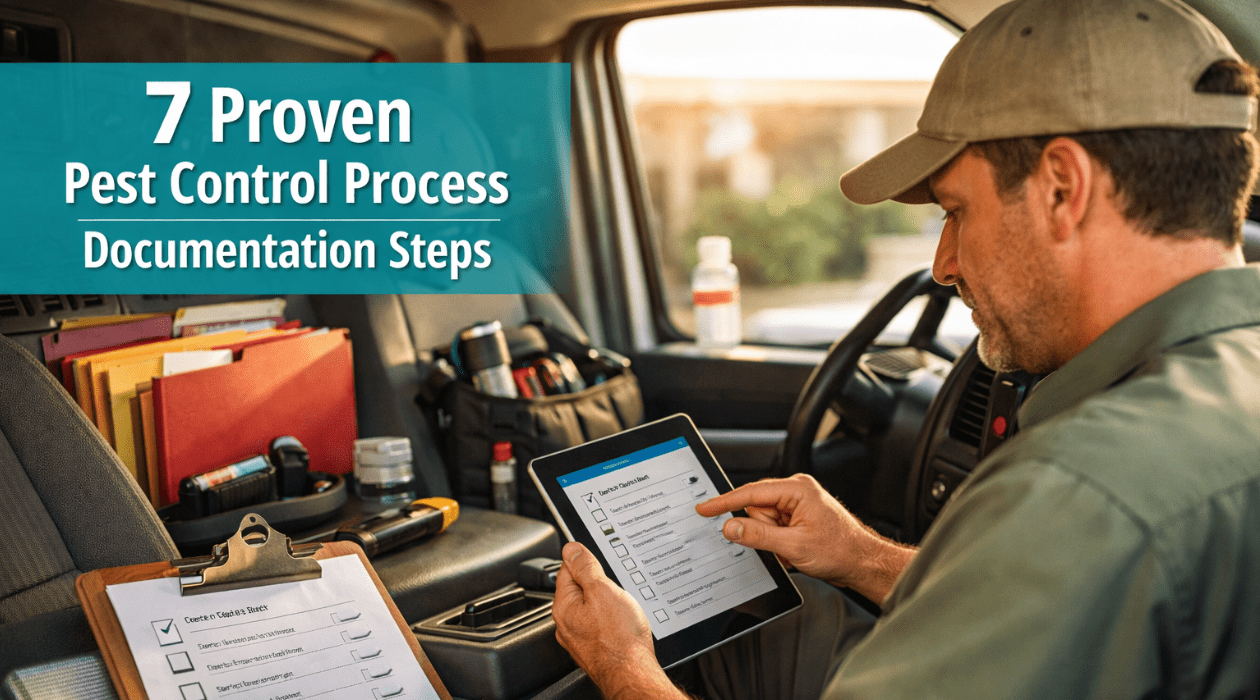
For field technicians, checklists work better than paragraphs. A laminated card in their truck beats a 10-page manual every time. For office staff handling complex workflows, step-by-step guides with screenshots prove most effective. For managers, decision trees help navigate situations with multiple possible outcomes.
Video documentation works exceptionally well for pest control process documentation. A 3-minute video showing exactly how to inspect a crawlspace beats a written description every time. New technicians learn faster. Experienced technicians can refresh their memory without reading. Videos also capture nuance that text misses.
Store your pest control process documentation where people need it. Field technicians need mobile access. Office staff need desktop access. Everyone needs search functionality. Cloud-based tools like Google Drive or Notion work well because they sync across devices and allow collaborative editing. Whatever system you choose, make sure it is accessible in under 10 seconds.
Step 3: Document Your Workflows Step-by-Step
Effective pest control process documentation breaks complex work into simple steps. Each step should be clear enough that someone with basic pest control knowledge could follow it successfully. This is harder than it sounds because experts forget what beginners do not know.
Start by doing the task yourself while recording every action. Not what you think you do, but what you actually do. Most business owners discover their real process differs significantly from what they thought it was. This recorded walkthrough becomes the foundation of your pest control process documentation.
Use action verbs and specific details. “Check for rodent activity” is vague. “Look for droppings in corners, gnaw marks on baseboards, and grease trails along walls” is specific. Good pest control process documentation eliminates ambiguity. Your technician should never have to guess what you meant.
Include decision points in your pest control process documentation. What happens if the customer is not home? What if you find damage beyond the original scope? What if payment gets declined? Document the if-then scenarios that happen regularly. This prevents technicians from calling you for guidance on situations you have handled a hundred times before.
Step 4: Create Standard Operating Procedures for Critical Tasks
Standard operating procedures (SOPs) are the backbone of scalable pest control process documentation. An SOP turns tribal knowledge into transferable knowledge. It ensures that every technician handles situations the same way, maintaining quality as you grow.
Your pest control process documentation should include SOPs for every safety-critical task. Chemical application procedures, ladder safety protocols, confined space entry guidelines, and emergency response procedures cannot vary by technician. These need precise, detailed documentation that gets reviewed regularly.
Customer-facing SOPs matter just as much. How do technicians introduce themselves? What do they say when customers ask about pricing? How do they handle complaints? Consistent communication builds trust. Your pest control process documentation should script the key moments that shape customer perception.
Each SOP in your pest control process documentation needs an owner. Someone responsible for keeping it current, training team members on it, and updating it when processes change. Without ownership, SOPs become outdated quickly and teams lose trust in the documentation.
Step 5: Build Your Pest Control Training System
Pest control process documentation and training are inseparable. Documentation without training is wasted effort. Training without documentation is unsustainable. Your goal is to create a training system where new hires can learn your processes without consuming all your time.
Structure your training to match your pest control process documentation. Week one covers basic safety and customer interaction. Week two focuses on common pest treatments. Week three introduces more complex scenarios. Each training session connects directly to documented procedures, so trainees know where to find answers later.
Create a certification system tied to your pest control process documentation. Technicians cannot work independently until they demonstrate competency in key processes. This protects quality and ensures your documentation actually transfers knowledge. A simple skills checklist works better than complicated tests.
Your experienced technicians should teach using the pest control process documentation, not despite it. When they show new hires the ropes, they should reference the documented procedures. This reinforces that documentation is not just paperwork, but the actual way work gets done. It also helps identify where documentation needs improvement.
Step 6: Implement Version Control and Updates
Pest control process documentation must evolve as your business evolves. New regulations change procedures. Better methods get discovered. Customer expectations shift. Static documentation becomes obsolete documentation.
Establish a regular review schedule for your pest control process documentation. Quarterly reviews work well for most pest control businesses. During reviews, solicit feedback from the people actually using the documentation. They spot problems you miss. They suggest improvements you would not think of.
Track changes to your pest control process documentation so everyone knows what is current. Date stamps and version numbers help. Change logs explain what updated and why. When technicians find outdated information, they lose trust in all documentation. Version control maintains credibility.
Communicate updates clearly. When pest control process documentation changes, do not just upload a new file. Send a quick message explaining what changed and why it matters. Better yet, hold a brief training session on significant updates. Documentation only works when people know it exists and trust it is current.
Step 7: Measure Documentation Effectiveness
How do you know if your pest control process documentation actually works? You measure it. Track metrics that reveal whether documentation improves performance.
Time-to-productivity for new technicians is a key indicator. Before pest control process documentation, how long did it take new hires to work independently? After implementation, has that time decreased? A 30-50% reduction in training time indicates effective documentation.
Customer callback rates reveal quality consistency. When pest control process documentation standardizes procedures, callback rates typically drop. If callbacks remain high or increase, your documentation might be missing critical steps or technicians are not following it.
Owner involvement in daily operations should decrease as pest control process documentation improves. Track how many times per day team members ask you questions. If your documentation is working, those interruptions should decline significantly. You move from doing the work to building the systems.
Common Pest Control Process Documentation Mistakes
The biggest mistake in pest control process documentation is making it too complicated. Business owners think comprehensive means better. Actually, comprehensive often means unused. Start simple. A one-page checklist used daily beats a 50-page manual gathering dust.
Another common mistake is documenting ideal processes instead of actual processes. You write how things should work in a perfect world. Your team lives in reality where customers change appointments, supplies run out, and equipment breaks. Effective pest control process documentation accounts for the messy reality of field service work.
Many pest control businesses create documentation and never update it. Processes change but documentation stays frozen. Within months, reality and documentation diverge. Teams stop referencing it because they know it is outdated. Your pest control process documentation needs ongoing maintenance or it becomes worthless.
Failing to involve your team in creating pest control process documentation is another mistake. The owner writes everything alone, then wonders why nobody follows it. Your technicians and office staff know details you miss. They understand obstacles you do not see. Collaborative documentation gets better adoption.
Tools for Pest Control Process Documentation
You do not need expensive software for effective pest control process documentation. Most successful pest control businesses start with simple, accessible tools.
Google Docs or Microsoft Word work fine for text-based pest control process documentation. They are familiar, easy to edit, and everyone knows how to use them. Add a simple folder structure in Google Drive or Dropbox for organization.
For visual pest control process documentation, Loom or similar screen recording tools create training videos quickly. Your smartphone camera works great for recording field procedures. The technology matters less than the consistency of creating and updating content.
Project management tools like Asana or Monday help track pest control process documentation tasks. Who is responsible for documenting what? What is the deadline? What is the status? These tools prevent documentation projects from stalling halfway through.
Getting Started with Pest Control Process Documentation
Start your pest control process documentation journey today, not next week. Pick one critical process, the one causing the most problems or taking the most time. Document it this week.
Block 2 hours on your calendar specifically for pest control process documentation. Not available time, but dedicated time. Treat it like a customer appointment because investing in systems is just as important as serving customers.
Do not aim for perfection. Your first pest control process documentation will be imperfect. That is fine. Version 1.0 beats version perfect that never ships. Put something in writing, test it with your team, get feedback, and improve it. Progress over perfection.
Consider involving a virtual assistant who understands pest control operations. Someone who can interview your technicians, observe your processes, and draft documentation while you focus on running the business. The investment pays back quickly through time savings.
Frequently Asked Questions About Pest Control Process Documentation
How long does pest control process documentation take to create?
For a typical pest control business, creating core pest control process documentation takes 20-40 hours spread over 2-3 months. You do not need to document everything at once. Start with your most critical processes and expand from there. Most businesses see benefits within the first month even with incomplete documentation.
What if my team resists using pest control process documentation?
Resistance usually signals documentation that is too complex or disconnected from reality. Involve resistant team members in creating pest control process documentation. When they have ownership, they become advocates. Also ensure documentation makes their jobs easier, not harder. If it adds work without clear benefit, resistance is justified.
How often should pest control process documentation be updated?
Review your pest control process documentation quarterly. Some processes stay stable for years. Others change monthly. The quarterly review lets you identify what needs updating while preventing documentation from becoming stale. Between reviews, update immediately when regulations change or safety issues emerge.
Can small pest control companies benefit from process documentation?
Absolutely. Small companies benefit most from pest control process documentation because every person matters more. When your only technician is sick or on vacation, documented processes let temporary help maintain operations. Documentation also makes selling your business easier since value is not locked in your head.
What is the ROI of pest control process documentation?
Most pest control businesses see positive ROI within 3-6 months. Time savings from reduced training, fewer owner interruptions, and decreased callbacks typically exceed documentation costs quickly. The real value appears long-term: the ability to scale revenue without proportionally scaling owner hours.
Real-World Pest Control Process Documentation Success
Consider a residential pest control company in St. Louis that implemented comprehensive pest control process documentation. Before documentation, the owner worked 60-70 hours weekly, fielding constant questions from technicians and office staff. Training new technicians took 8-12 weeks before they could work independently.
After six months of focused pest control process documentation work, the transformation was dramatic. New technician training time dropped to 4-6 weeks. Owner involvement in daily operations decreased by 60%. Customer callbacks fell by 35% due to consistent service delivery.
The owner now spends time on business development instead of firefighting. Revenue grew 40% year-over-year not because they worked harder, but because systems allowed scaling. Their pest control process documentation became their competitive advantage in a crowded market.
Take Action on Your Pest Control Process Documentation
Growing your pest control business without pest control process documentation is like building a house without blueprints. You might get something standing, but it will not be stable, efficient, or scalable. Documentation transforms your business from personality-driven to systems-driven.
The companies winning in pest control today are not necessarily those with the best technicians or lowest prices. They are the ones with the best systems. Systems that ensure quality without the owner being present. Systems that scale without breaking. Systems built on solid pest control process documentation.
Your next step is clear: choose one process to document this week. Not next month. This week. Start small, test it, refine it, then move to the next process. In six months, you will look back amazed at how much more efficiently your business operates.Struggling to find time for pest control process documentation while running your business? Your Remote Office Space (YROS) specializes in helping pest control companies build scalable systems. Our US-based team understands the trades and can document your processes while you focus on serving customers. Schedule a free consultation to discover how we can help transform your operational chaos into documented clarity.